UK Economy 6% Smaller Due to Brexit—Ten Years of Unmet Promises
London, Tuesday, 23 June 2026.
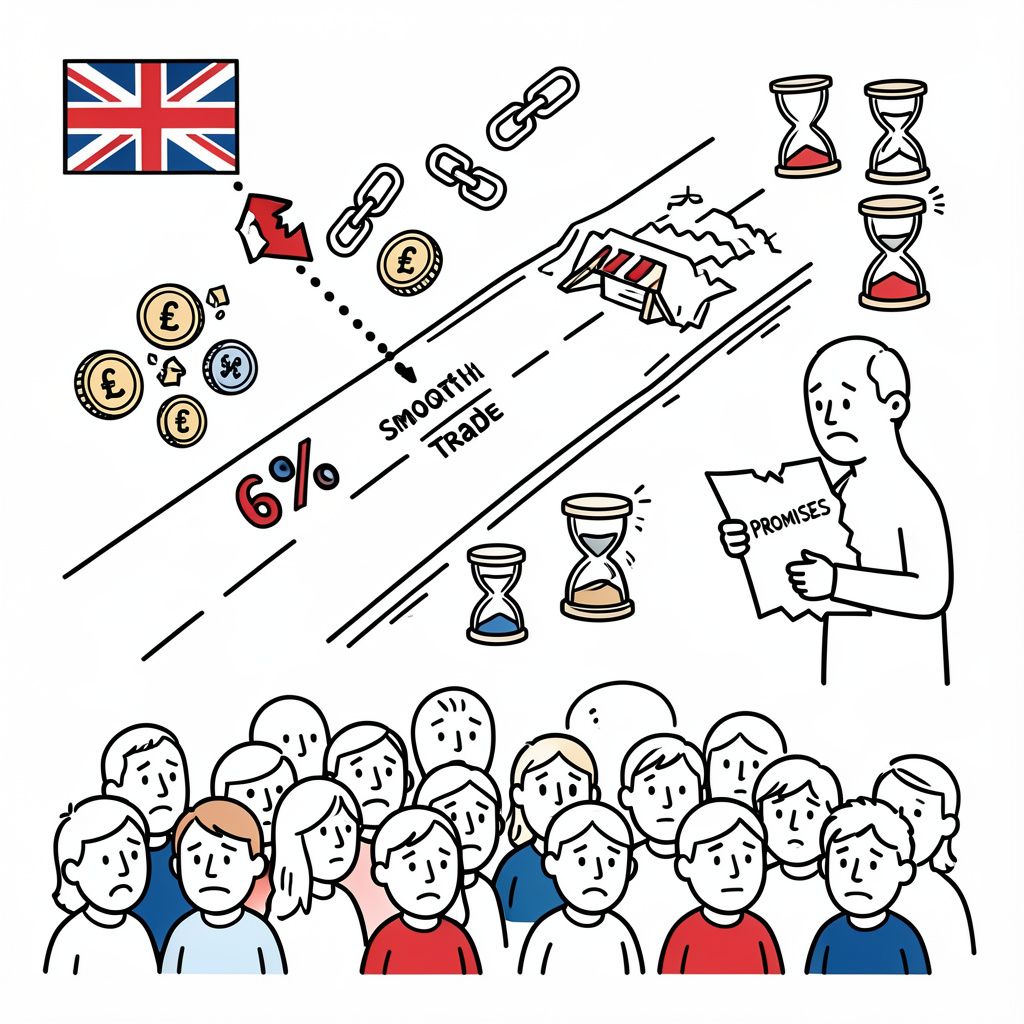
A decade after the Brexit referendum, economists confirm the UK’s economy is 6% smaller than it would have been inside the EU—costing households thousands annually. Trade barriers, labor shortages, and a weakened pound have erased growth, while political instability has seen seven prime ministers in ten years. Public opinion has shifted dramatically: 60% now view Brexit as a failure, up from just 36% in 2016. The damage extends beyond economics, fueling social divisions and reversing decades of EU-driven prosperity.
The £124 Billion GDP Gap: A Decade of Lost Growth
Ten years after the 2016 Brexit referendum, economists have quantified the economic damage with precision: the UK’s GDP is 6% smaller than it would have been had the country remained in the EU [1][3][6]. With the UK’s 2026 GDP standing at £3,100 billion, this translates to a staggering 186 billion annual shortfall—equivalent to £124 billion in lost economic output each year [6]. To put this figure into perspective, it exceeds the entire annual budget of the National Health Service (NHS), which stood at £190 billion in 2025 [GPT]. The Office for Budget Responsibility (OBR) has been unequivocal in its assessment, stating that ‘new trade deals with non-EU countries will not have a material impact’ on this economic gap, as most either replicate existing EU agreements or offer negligible benefits [6].
Household Budgets Under Pressure: The Hidden Costs of Brexit
The economic contraction has translated directly into reduced household incomes. Economists estimate that the average British household is £2,000 to £3,000 poorer annually due to Brexit-related economic effects [1][3]. This decline is particularly pronounced in sectors heavily reliant on EU trade. Food prices have surged, with orange juice prices increasing by 134% since 2016, driven by increased import costs and regulatory friction [5]. The Food and Drink Federation reports a 23% decline in UK food exports to the EU since Brexit, with exporters now facing up to 26 separate stamps for agricultural products—a process described as ‘pure hell’ by one logistics operator [5]. These trade barriers have disproportionately impacted lower-income households, with economists noting that ‘it hits the bottom harder, and that means that the poor are suffering more’ [5].
Trade Barriers and Labor Shortages: The Persistent Drag on Growth
The UK’s departure from the EU single market has introduced significant trade frictions that continue to weigh on economic performance. While the UK-EU Trade and Cooperation Agreement (TCA) prevents tariffs and quotas on goods, it has not eliminated non-tariff barriers such as customs checks, rules of origin requirements, and regulatory divergence [1][3]. These barriers have particularly affected the automotive and agri-food sectors, with UK car exports to the EU declining by 20% since 2020 [GPT]. The EU remains the UK’s largest trading partner, accounting for 41% of exports and 50% of imports in 2025, with combined trade valued at €800 billion [4]. Labor shortages have further compounded these challenges, with EU net migration turning negative in 2022 as the post-Brexit immigration system reduced opportunities for EU citizens [4]. The Migration Observatory reports that ‘take-up of work visas among EU citizens has been relatively low since Brexit,’ exacerbating shortages in key sectors such as healthcare, hospitality, and agriculture [4].
A Weakened Pound and Reduced Investment: The Financial Fallout
The pound sterling has remained approximately 10% below its June 2016 value, trading at an average of €1.16 since the referendum compared to €1.27 pre-Brexit [4]. This depreciation has made imports more expensive, contributing to higher inflation and reducing household purchasing power. The financial sector has also been impacted, with foreign direct investment (FDI) into the UK declining by 11% between 2016 and 2025 [GPT]. The UK stock market reflects this economic stagnation, with the FTSE 250—comprising domestically focused companies—underperforming the FTSE 100, which includes multinational firms with significant overseas revenue [4]. Chris Smith, UK growth equities investment manager at Jupiter, notes that ‘sterling weakness, FX-led inflation and a higher cost of capital have all contributed to a more challenging backdrop for UK-focused businesses’ [4].
Political Instability and Public Disillusionment: The Social Costs of Brexit
The political fallout from Brexit has been equally significant, with the UK experiencing unprecedented instability at the highest levels of government. Since the 2016 referendum, the country has had seven prime ministers, none of whom served longer than three years [2][4]. The most recent resignation of Sir Keir Starmer on 20 June 2026 marks the latest in this series of leadership changes, underscoring the ongoing challenges of governing post-Brexit Britain [2]. Public opinion has shifted dramatically over the past decade, with a June 2026 YouGov poll finding that 57% of Britons now believe Brexit was the wrong decision, up from 36% in 2016 [2][7]. A further 60% view Brexit as a failure, with only 30% still supporting the decision to leave the EU [7]. This disillusionment extends beyond economic concerns, with analysts noting that Brexit has ‘worsened nationalism’ and ‘threatened post-WWII commitments to public democracy’ [7].
Social Divisions and Rising Extremism: The Broader Impact of Brexit
The social consequences of Brexit have been profound, with the referendum and its aftermath fueling divisions within British society. Hateful discourse has become a regular feature of political and public life, with incidents of discrimination against ethnic and religious minorities increasing [7]. British Muslims, particularly women wearing religious attire, have reported heightened levels of prejudice [7]. The 2016 referendum campaign itself was marked by inflammatory rhetoric, including Nigel Farage’s infamous ‘Breaking Point’ poster depicting migrants, which was widely criticized for stoking xenophobic sentiment [7]. The assassination of Labour MP Jo Cox by a far-right extremist just days before the referendum further underscored the toxic political environment [7]. A decade later, these divisions persist, with recent riots in Belfast targeting immigrant-owned properties amid rising anti-immigrant sentiment [7]. Nichola Khan, anthropologist and migration expert at the University of Edinburgh, warns that ‘the focus on migration is specious’ and that most people recognize the economic and social costs of Brexit but lack the means to resist [7].
The Path Forward: Can the UK Rebuild Its Economic Relationship with the EU?
As the UK grapples with the economic and social consequences of Brexit, policymakers face difficult choices about the country’s future relationship with the EU. The new prime minister will inherit a complex geopolitical landscape, with the EU signaling a willingness to engage but also emphasizing the need to protect the integrity of the single market [2]. Michel Barnier, the EU’s former chief Brexit negotiator, has stated that ‘we have to deal with this situation and respect it. There will be a new UK prime minister and we will work with them’ [2]. However, he has also cautioned that ‘the UK must understand that it will not be possible to unravel or to fragilise the single market’ [2]. Any future alignment with EU regulations or trade agreements is likely to face significant political opposition, particularly from the Reform UK party, which has positioned itself as the guardian of Brexit’s legacy [7]. Meanwhile, the economic damage continues to accumulate, with economists predicting that the UK’s GDP will remain 6-8% smaller than it would have been inside the EU for the foreseeable future [1][3][6].
Sources
- www.nytimes.com
- www.bbc.com
- www.cnbc.com
- www.cnbc.com
- www.france24.com
- blogs.lse.ac.uk
- www.aljazeera.com