US Marines Execute Historic Overhead Live-Fire Drills to Bolster Indo-Pacific Readiness
Okinawa, Monday, 2 March 2026.
Marking a historic first at Camp Schwab, the 12th Marine Littoral Regiment executed high-risk overhead live-fire maneuvers, validating advanced combat tactics essential for securing the strategic First Island Chain.
A Benchmark in Tactical Evolution
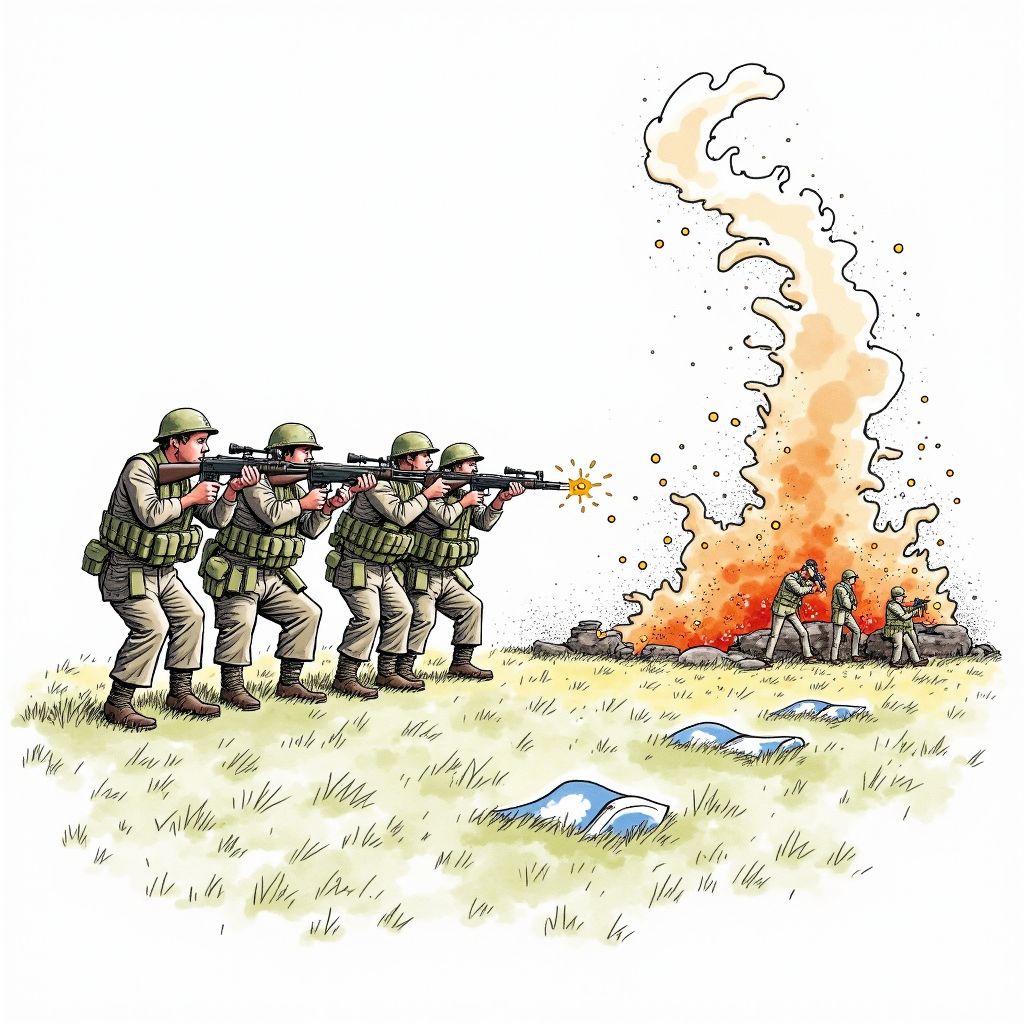
In a significant development for U.S. force posture in the Indo-Pacific, the 12th Marine Littoral Regiment (MLR) has successfully validated a new tier of combat capability through the execution of its first overhead live-fire range at Camp Schwab, Okinawa [2]. The exercises, which concluded in late January 2026, required Alpha Company Marines to maneuver forward of their own firing lines while machine gunners engaged targets over their heads [2]. This high-risk evolution tests the unit’s discipline and trust to a degree rarely seen in standard training environments, marking a pivotal step in modernizing infantry tactics for the contested geography of the First Island Chain [1][2].
Operational Precision and Risk Management
The complexity of overhead fire requires meticulous preparation to mitigate the inherent risks of friendly fire. According to Chief Warrant Officer 3 Joshua Larson, the regiment’s Gunner, the execution was the culmination of 120 days of deliberate planning and coordination [2]. Every tactical detail was briefed to the Marine Corps Installation Pacific commanding general, Maj. Gen. Brian Wolford, 30 days prior to execution to ensure strict safety standards were met [2]. Larson noted that the speed at which the machine gunners gained proficiency in this advanced employment technique was “impressive,” validating the unit’s ability to integrate fires and maneuver safely in complex environments [2].
Comprehensive Unit Mobilization
The overhead fire drills were part of a broader series of combat proficiency evaluations conducted throughout January 2026. On January 12 and 13, Bravo Company engaged in night live-fire platoon attacks, utilizing M240B machine guns and M4 carbines to enhance marksmanship and small-unit leadership under low-visibility conditions [4][5]. Following this, Akuma Company executed platoon-sized attacks on January 28, traversing jungle terrain to employ multiple weapons systems [1]. These maneuvers were designed to refine fire integration and increase lethality across different sized elements, ensuring that the regiment can operate effectively as a cohesive force [1][3].
Strategic Implications for the First Island Chain
The successful completion of these drills establishes a new overhead live-fire capability on Okinawa, expanding training opportunities for both forward-deployed and rotational forces [2]. By simulating realistic, high-threat scenarios, the 12th MLR aims to deter regional adversaries and secure key maritime terrain [1]. The exercises underscore the U.S. commitment to maintaining a “ready to fight” posture, with the capability to respond rapidly to crises and contingencies throughout the Indo-Pacific region [2].