Trump Backs House Proposal to Make Daylight Saving Time Permanent Nationwide
Washington, Wednesday, 5 August 2026.
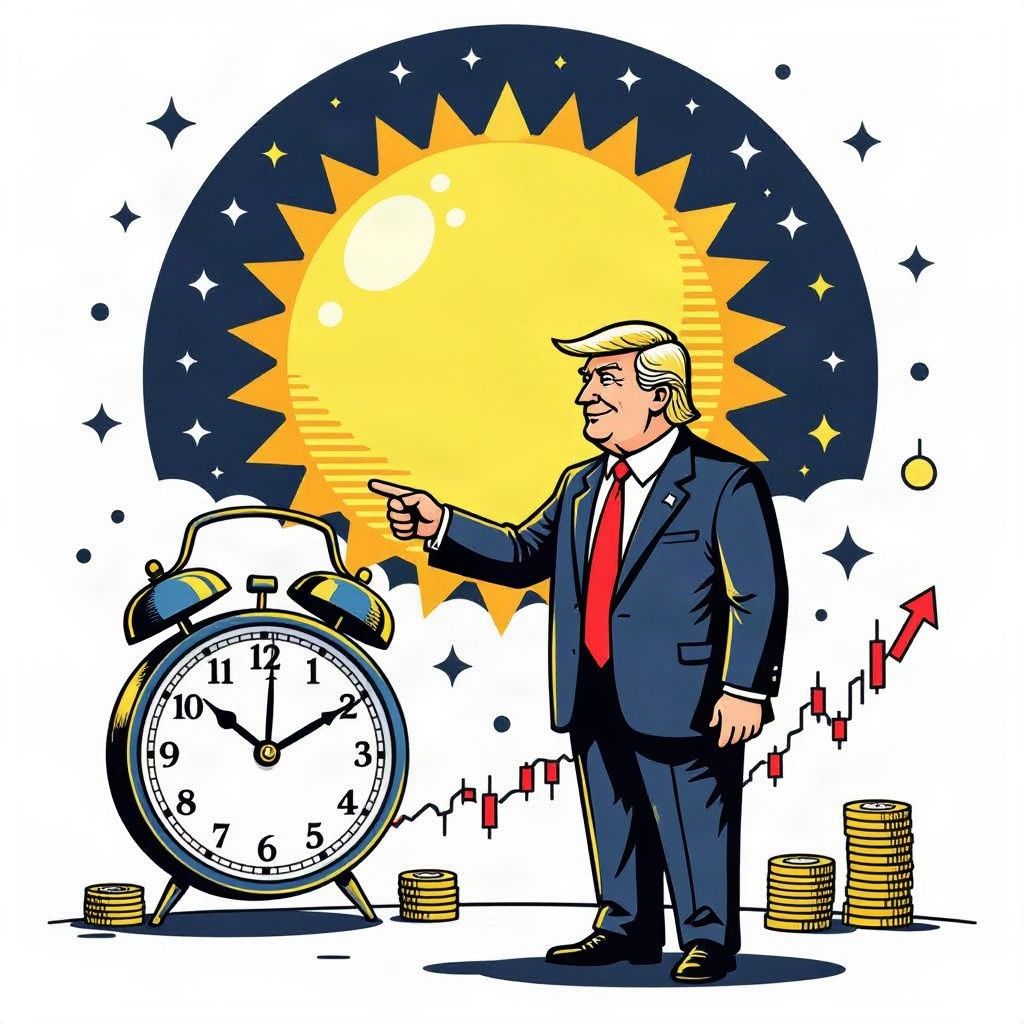
President Donald Trump endorsed the Sunshine Protection Act following a 308-117 House vote, urging the Senate to permanently eliminate biannual clock changes to benefit health, safety, and business.
Presidential Endorsement and Legislative Status
President Donald Trump publicly endorsed the Sunshine Protection Act on Tuesday, 4 August 2026, urging the Senate to finalize legislation that would make daylight saving time permanent nationwide [1][2]. This announcement follows a decisive vote in the U.S. House of Representatives, where the bill passed with a bipartisan margin of 308-117 roughly three weeks prior [1][2]. The proposed legislation aims to eliminate the biannual clock changes that occur in March and November, a move the administration argues will provide regulatory predictability for corporate scheduling and transport networks [1][4]. President Trump characterized the current system as “foolish, inconvenient and, in some cases, very costly,” citing potential benefits for public safety and the economy [2][4].
Legislative Momentum and Voting Dynamics
The House passage of the Sunshine Protection Act represents a significant legislative hurdle cleared, with 72.471 percent of voting members supporting the measure [1][2]. The bill was originally introduced by retiring Representative Vern Buchanan (R-Fla.) and has garnered support across party lines, though 22 Republicans and 95 Democrats voted against the measure in the lower chamber [1]. Social media coverage from various news outlets confirmed the House passed the act in July 2026, signaling momentum before the August recess [6][7]. Despite the House success, the legislation faces uncertain prospects in the Senate, where bipartisan skepticism remains regarding the impact on western states and agricultural sectors [2][3].
Economic and Public Health Implications
Proponents of the legislation argue that permanent daylight saving time will reduce crime rates, lower cardiac risks, and boost retail and tourism industries by extending evening daylight [2][4]. An AP-NORC survey released in December 2025 indicated that only 12% of Americans support the current biannual clock-change system, providing a statistical basis for the administration’s push [2]. However, experts warn that permanent daylight saving time could result in winter sunrises occurring after 8:00 a.m. in much of the U.S., a factor linked to the failure of similar legislation in the 1970s [3][5]. Historical precedent shows that a similar experiment under President Nixon in 1973 was repealed by Congress in 1974 following safety concerns regarding children traveling to school in the dark [1][3].
State-Level Preparations and Federal Hurdles
Nineteen states have enacted legislation to implement permanent daylight saving time contingent upon Congressional authorization, including Tennessee, which passed a trigger law in 2019 under Governor Bill Lee [4][5]. Federal law currently allows states to exempt themselves from daylight saving time to remain on standard time year-round, but does not permit states to adopt permanent daylight saving time without federal approval [4][7]. Senators from Western states, such as Steve Daines (R-Mont.), have voiced opposition, noting that late winter sunrises would not work for families in regions like Montana [1][3]. As of 5 August 2026, the bill remains pending in the Senate, requiring further negotiation to address regional concerns regarding morning sunlight exposure [3][4].
Sources
- thehill.com
- www.foxnews.com
- thehill.com
- www.al.com
- www.facebook.com
- www.facebook.com
- www.facebook.com