A Multi-Million Dollar Defense Plant Fails to Produce a Single Shell
Mesquite, Wednesday, 12 August 2026.
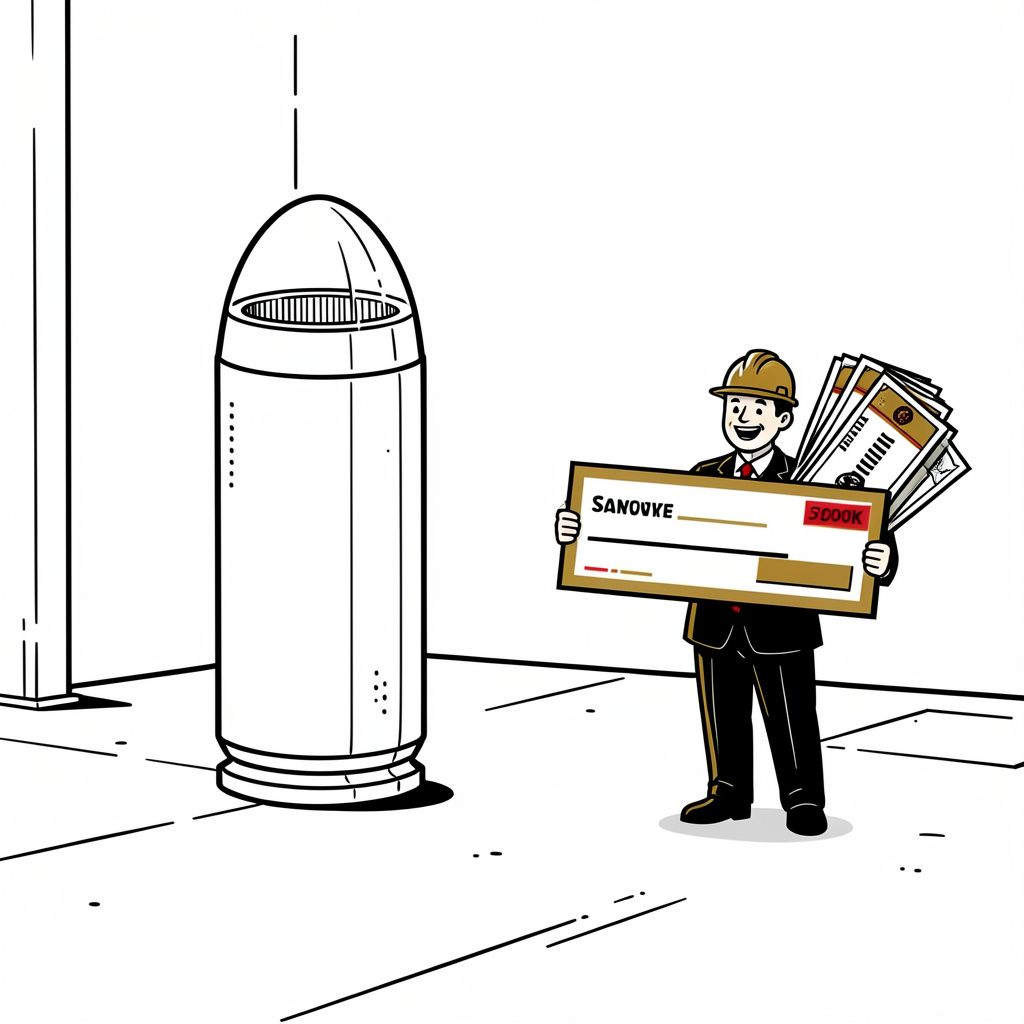
A $533 million taxpayer-funded Texas artillery factory created zero usable shells after severe machinery failures, yet the defense contractor later secured $2.5 billion in additional military contracts.
A Rush to Modernize and the Turkish Subcontractor
In November 2022, following Russia’s invasion of Ukraine, the U.S. Army awarded General Dynamics (NYSE: GD) [GPT] a contract eventually worth nearly $600 million to establish a new 155 mm artillery shell manufacturing line in Mesquite, Texas [1][2]. To expedite the process, Congress granted the Department of Defense extraordinary powers to bypass competitive bidding through “undefinitized contracting actions” (UCAs), which allowed production to begin before final contract terms were established [1][2]. Rather than relying on traditional forging methods used at its long-standing Scranton, Pennsylvania facility, General Dynamics opted for a modern “flow-forming” process utilizing machinery from the Turkish manufacturer Repkon [1][2]. This decision was made under immense pressure to quickly scale up ammunition production [1][2].
Unchecked Risks and a Hollow Grand Opening
Despite concerns that Repkon’s machinery had never been proven to manufacture the specific 155 mm artillery shells required by the U.S. military, standard due diligence was largely bypassed [1][2]. The Army committed to purchasing three production lines without inspecting active operations, as Repkon cited customer privacy concerns [1][2]. On May 29, 2024, General Dynamics celebrated the grand opening of the Mesquite facility, featuring then-Army Secretary Christine Wormuth, who emphasized the plant’s vital role in national defense [1][2]. However, former workers later revealed that the artillery shells displayed during the ceremony were actually fake, potentially plastic props, and the facility had already failed to perform its scheduled “first article test” to verify actual manufacturing capabilities [1][2].
Mechanical Chaos and Safety Hazards on the Factory Floor
Throughout the summer of 2024 and into 2025, the Mesquite facility descended into severe operational chaos [1][2]. The imported Turkish machinery, which processed steel heated to 982.22 °C (1,800 °F), suffered chronic malfunctions [1][2]. Robotic arms repeatedly swung out of control, caught fire, and smashed into equipment, while heavy steel components were dropped from heights of 1.5 meters [1][2]. Control cabinets regularly overheated to temperatures of 60 °C (140 °F), and workers resorted to using sledgehammers to keep the machines functioning [1][2][3]. The operational environment grew so hazardous that the Occupational Safety and Health Administration (OSHA) launched an investigation in October 2024 regarding “respirable hazards” from smoke, though no penalties were issued because the machinery was idle during the inspector’s visit [1][2].
Missed Deadlines and Financial Windfalls
The technical failures resulted in a series of missed milestones. General Dynamics repeatedly failed first article tests and missed eight consecutive contract deadlines between April 2024 and June 2025 [1][2][3]. Consequently, in August 2025, the U.S. Army ordered a halt to work on two of the facility’s three production lines [1][2][3]. A Department of Defense Inspector General report released in July 2026 confirmed that despite U.S. taxpayers funding $533 million for the project, the facility failed to produce a single usable artillery shell [2]. Remarkably, in December 2025—months after the partial shutdown—the government still issued $26.3 million in progress payments to General Dynamics for the non-functional production lines [1][2].
Subsequent Contracts and the Shift to Artificial Intelligence
Despite the complete lack of output in Mesquite, General Dynamics has faced minimal financial consequences. The company’s ordnance unit has been awarded an additional $2.5 billion in Army contracts since the August 2025 shutdown [1][2][3]. Combining the failed plant’s initial funding with these subsequent awards, the total defense capital allocated to General Dynamics reached 3.033 billion dollars. Meanwhile, Repkon USA rebranded as Paligen Technologies in March 2026 after receiving its own $435 million no-bid contract to build a TNT factory [1][2]. To address the ongoing mechanical issues, General Dynamics announced a partnership in June 2026 with an artificial intelligence startup named “Deterrence,” committing $200 million to integrate autonomous manufacturing systems into the plant [1][2].
Rigorous Oversight and Future Prospects
On August 7, 2026, the U.S. Army released a statement claiming it is exercising “rigorous oversight” and exploring options to recoup taxpayer funds, potentially through discounts on future orders [2]. General Dynamics, however, maintains that it has “met or exceeded requirements” [2]. While former employees express skepticism about utilizing unproven AI software to fix fundamentally broken physical machinery, General Dynamics has informed investors that it still plans to reach a production capacity of 20,000 shells per month by 2027 [1][2][3]. This comes at a time when defense priorities are shifting, with some former officials noting that conventional ammunition is taking a backseat to interceptors and missiles amid broader geopolitical conflicts [1][2].