Fiscal Analysis Projects $5.8 Trillion Debt Increase from Proposed Defense Expansion
Washington, Thursday, 8 January 2026.
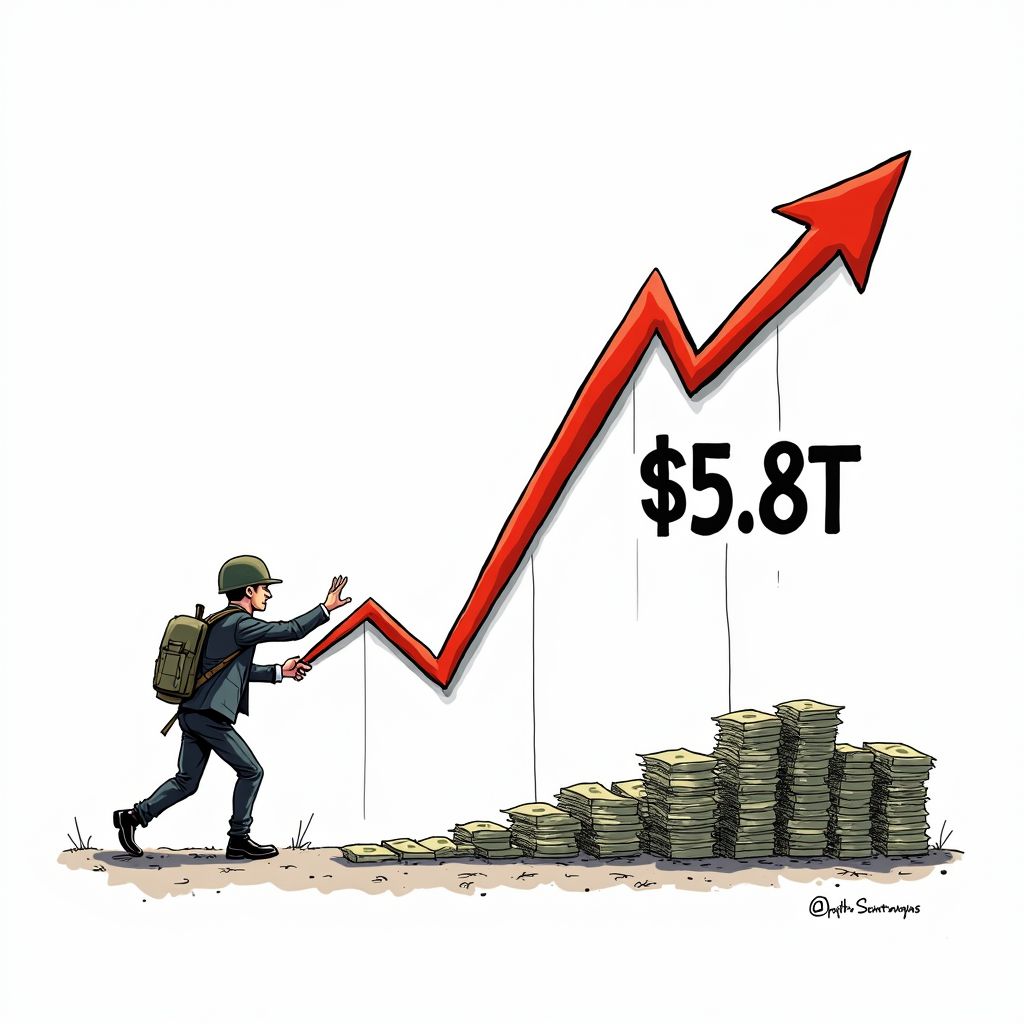
The Committee for a Responsible Federal Budget (CRFB) estimates that the proposed $1.5 trillion defense budget for Fiscal Year 2027 would add roughly $5.8 trillion to the national debt over the next decade. While the administration points to tariff revenues for funding, analysts warn of a substantial fiscal gap, noting that projected revenues cover only a fraction of the costs. Most intriguingly, data from the Peterson Foundation indicates this spending level would exceed the combined military budgets of the next 35 nations. As the Supreme Court weighs the legality of the funding source, these projections signal a critical turning point for U.S. borrowing and fiscal policy.
Breaking Down the $5.8 Trillion Projection
On January 6, 2026, President Trump utilized social media to formally propose increasing the Fiscal Year 2027 defense budget to $1.5 trillion, a distinct rise from his previous signal of a $1 trillion target [1][2]. The Committee for a Responsible Federal Budget (CRFB) released an analysis shortly thereafter, projecting that this plan would add $5.8 trillion to the national debt through 2035 when interest costs are included [2]. While the administration has argued that tariff revenues would cover military spending increases, rebate payments, and deficit reduction, the CRFB analysis suggests the military spending increase alone is roughly twice the size of expected tariff revenue [2]. This proposal follows the 2025 passage of the “One Big Beautiful Bill Act” (OBBBA), which had already appropriated $175 billion to the defense budget [1].
Global Context: The ‘Next 35’ Benchmark
The magnitude of this proposed expenditure is further illuminated by updated data from the Peter G. Peterson Foundation. Currently, the United States spends more on defense than the next nine countries combined [1]. However, under the proposed $1.5 trillion budget, U.S. expenditure would exceed the combined military budgets of the next 35 highest-spending countries [1]. This allocation would surpass the military expenditures of every other nation on the planet combined, with the sole exception of China [1]. These figures underscore a significant shift in fiscal prioritization, moving well beyond historical baselines for peacetime defense spending.
Revenue Reality and Legal Hurdles
The financial viability of this expansion relies heavily on tariff revenues, which the Congressional Budget Office (CBO) estimates will raise $2.5 trillion—or $3 trillion with interest savings—through 2035 [1]. However, this revenue stream faces significant legal jeopardy. The Supreme Court is expected to rule soon on the legality of tariffs implemented under the International Emergency Economic Powers Act (IEEPA) [1]. If the Court strikes these tariffs down, the CRFB estimates that deficit reduction from tariff revenue would drop to approximately $700 billion through 2035, covering only about 15% of the proposed defense hike [1].
Competing Promises: The Dividend Dilemma
This defense expansion also competes with other administration promises, specifically the “tariff dividend.” In November 2025, President Trump proposed $2,000 dividend checks for middle- and lower-income Americans, a plan reiterated as a goal for 2026 [3]. However, a single round of these checks would cost roughly $600 billion, while new tariffs are expected to generate only around $300 billion annually—a cost-to-revenue ratio of 2 to one [3]. If distributed annually, these dividends alone would increase deficits by $6 trillion over a decade [3]. Consequently, the simultaneous pursuit of a historic military buildup and a populist dividend program appears mathematically incompatible with current revenue projections.