Trump’s Midnight Move Shatters GOP Unity Ahead of Critical Spy Bill Vote
Washington D.C., Thursday, 18 June 2026.
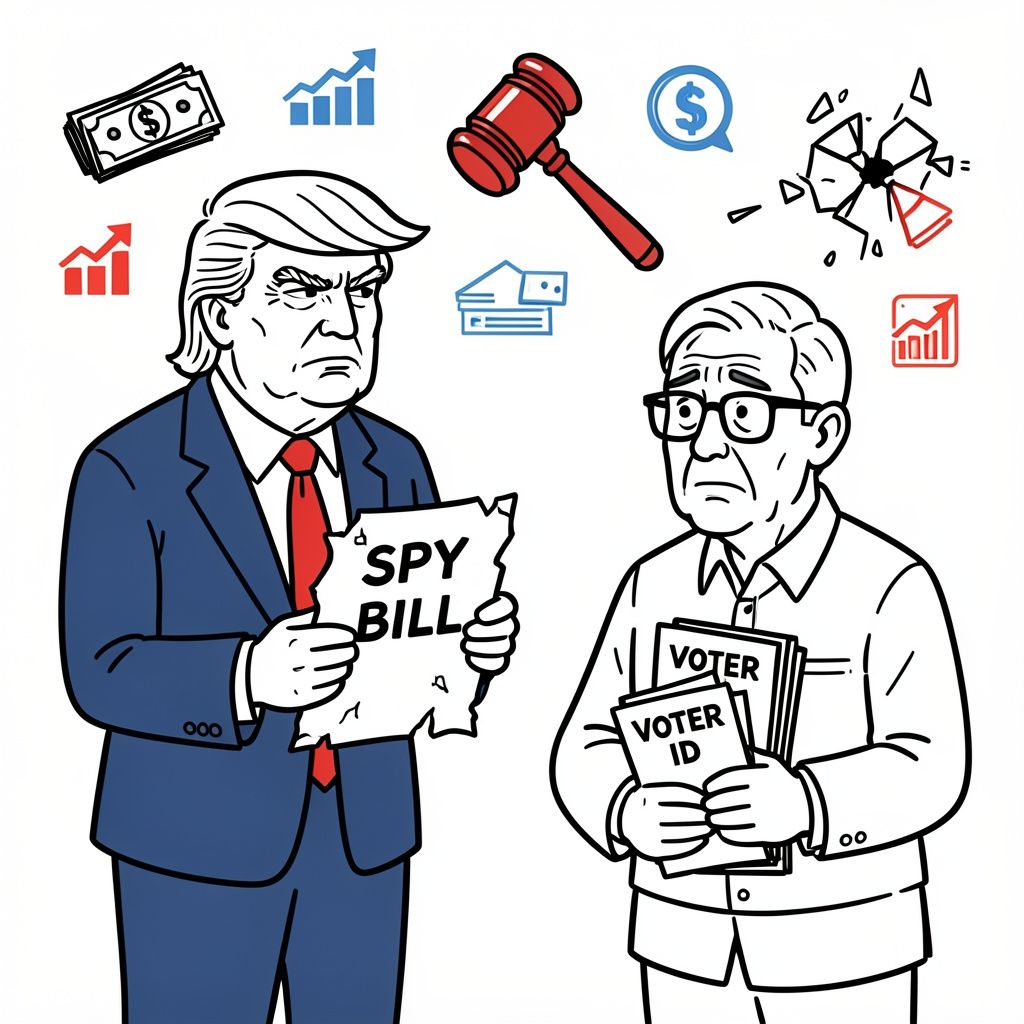
In a dramatic late-night reversal, President Trump withdrew support for a key surveillance bill after Senate Republicans refused to attach voter ID legislation, deepening a rift with Majority Leader John Thune. The standoff has paralyzed Congress, delaying national security measures and economic policies just months before midterms. Insiders call the chaos ‘unprecedented,’ with Trump’s demands—including blocking his own intelligence nominee—leaving allies stunned and investors wary of prolonged gridlock.
The Midnight Truth Social Post That Changed Everything
At 03:54 a.m. on 15 June 2026, President Donald Trump posted on Truth Social, effectively derailing Senate Majority Leader John Thune’s (R-S.D.) carefully crafted plan to revive the expired Foreign Intelligence Surveillance Act (FISA) Section 702. The post not only blocked the nomination of Bill Pulte as Director of National Intelligence (DNI) but also halted progress on a bipartisan housing bill, sending shockwaves through the Republican caucus [1]. The timing of the post—just hours before a critical vote—was seen as a deliberate attempt to force the Senate’s hand on voter ID legislation, a priority for Trump but a non-starter for many Republicans who feared it would alienate swing-state voters ahead of the 2026 midterms [1][2].
FISA Section 702: A National Security Tool in Limbo
FISA Section 702, which expired on 9 June 2026, is a cornerstone of U.S. intelligence operations, allowing the government to monitor the communications of foreigners outside the country without a warrant [3]. Its renewal has historically enjoyed bipartisan support, but Trump’s insistence on attaching the SAVE Act—a voter ID bill—to the FISA reauthorization has created an unprecedented standoff [1][3]. Senate Democrats, who hold 51 seats in the 100-member chamber, have signaled they will not support the FISA renewal if it includes voter ID provisions, leaving Thune and his allies scrambling for votes [1]. The delay has already raised alarms among national security officials, who warn that the lapse in surveillance authority could leave the U.S. vulnerable to foreign threats [3].
The Clayton Nomination: A Pawn in a Larger Game
Trump’s decision to delay the confirmation of Jay Clayton, his nominee for DNI, has further complicated the legislative landscape. Clayton, a federal prosecutor with bipartisan support, was scheduled to appear before the Senate Intelligence Committee on 16 June 2026, but Trump directed him to skip the hearing, citing unresolved issues with the FISA renewal and the confirmation of James McDonald as U.S. Attorney for the Southern District of New York [3]. Sen. Tom Cotton (R-Ark.), chairman of the Senate Intelligence Committee, called the move ‘regrettable’ and praised Clayton as a ‘patriot and highly qualified nominee’ [3]. However, Trump’s allies have framed the delay as a strategic play to pressure Democrats, with the president himself questioning why lawmakers are ‘afraid’ of Pulte, his interim DNI pick [3]. Critics, including Sen. Thom Tillis (R-N.C.), have dismissed Pulte as a ‘sycophant’ with no national security experience, arguing that his nomination undermines the credibility of the intelligence community [3].
The Broader Implications: Gridlock and Economic Uncertainty
The standoff over FISA and voter ID legislation is not occurring in a vacuum. Business leaders and investors are closely monitoring the situation, as prolonged intraparty conflict threatens to delay key economic legislation, including tax reforms and infrastructure spending [1][2]. The White House’s request for a $1 billion security upgrade for its ballroom and a $1.776 billion ‘anti-weaponization’ fund—both tied to an immigration funding bill—has further strained relations between Trump and Senate Republicans [1]. While the immigration bill ultimately passed after Republicans dropped the security funding, the episode underscored the deep divisions within the GOP [1]. Democrats have seized on the chaos, with Sen. Mark Warner (D-Va.) blaming the White House for the ‘confusion and chaos’ that has paralyzed Congress [3]. Meanwhile, Sen. Angus King (I-Maine) has suggested he might have supported Clayton’s nomination had the process not been politicized, highlighting the collateral damage of Trump’s strategy [3].
What’s Next: A Looming Deadline and a Party at War
With the 2026 midterms just months away, the stakes could not be higher. Tulsi Gabbard, the outgoing DNI, is set to leave office on 20 June 2026, creating a leadership vacuum at a critical time [3]. The Senate’s refusal to include voter ID legislation in the FISA renewal has left Trump with few options, and his allies are warning of a ‘constitutional crisis’ if the surveillance authority is not restored [1]. Thune, meanwhile, has refused to commit to Trump’s demands, stating that he is ‘waiting to see the specific details’ of the memorandum of understanding that the White House has yet to provide [4]. The impasse has left the GOP in uncharted territory, with some members questioning whether the party can function as a cohesive unit ahead of the elections. As Sen. John Cornyn (R-Texas) put it, there is ‘frustration in the GOP about the state of affairs,’ a sentiment that could have far-reaching consequences for the party’s ability to govern [2].