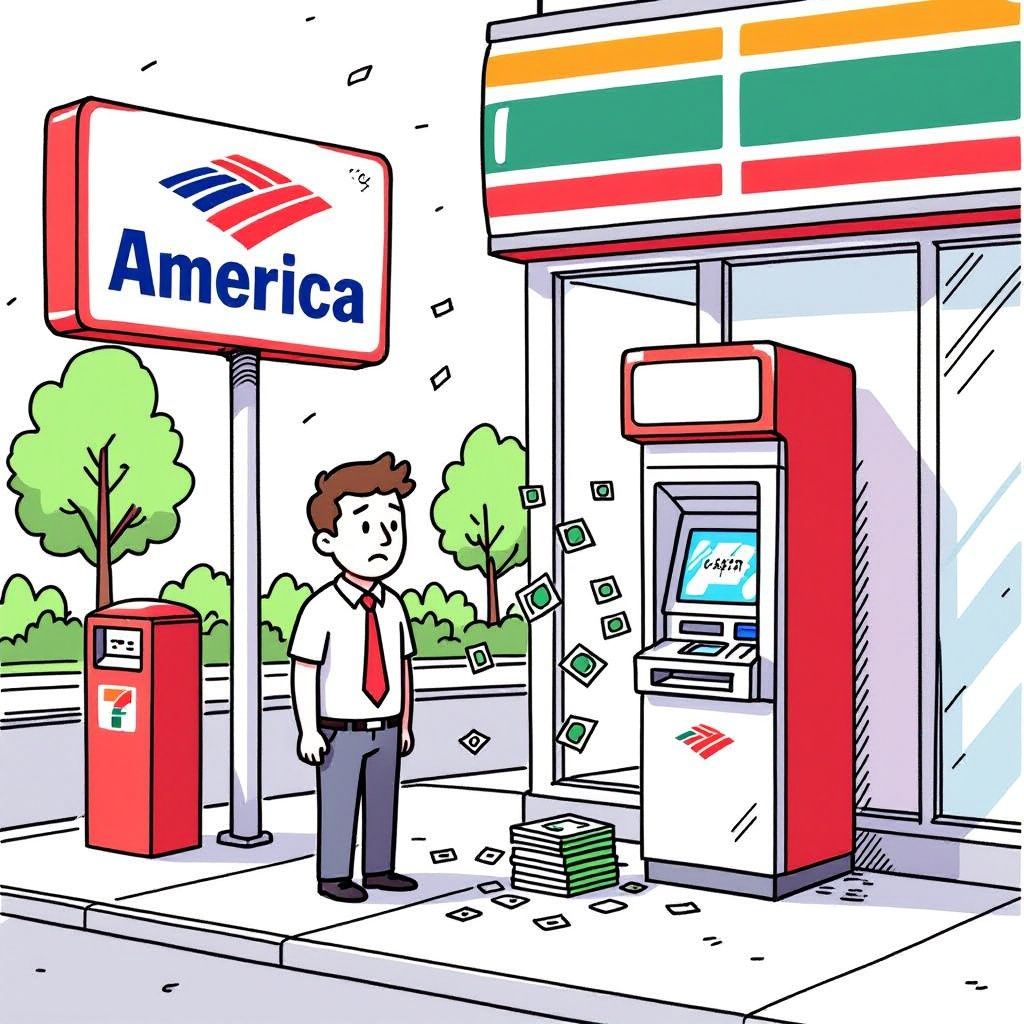
Bank of America Settles for $2.25 Million Over Hidden ATM Fees at 7-Eleven
Charlotte, Sunday, 17 May 2026.
A $2.25 million settlement resolves claims that Bank of America charged customers multiple fees for a single 7-Eleven ATM balance inquiry, exposing the costly reality of hidden banking charges.
The Anatomy of the Settlement
The class-action lawsuit, formally known as Schertzer, et al. v. Bank of America N.A., et al., was initially filed in a southern California district court in 2019 [1][2]. The core of the complaint alleged that Bank of America (NYSE: BAC) [GPT] levied multiple out-of-network fees against consumers for a single balance inquiry [2][4]. These transactions occurred specifically at ATMs owned by FCTI inside 7-Eleven convenience stores [1][2]. While Bank of America has agreed to the $2.25 million settlement fund, the financial institution has explicitly denied any wrongdoing, stating that the decision to settle was made primarily to avoid the compounding costs of ongoing litigation and a potential trial [1][2][3].
Eligibility and the Claims Process
The settlement outlines specific eligibility criteria for consumers seeking compensation. The payout class includes U.S. customers holding Bank of America checking accounts who were assessed more than one out-of-network balance inquiry fee during a single visit to a 7-Eleven FCTI ATM within the 2018 to 2021 timeframe [1][2]. Crucially, individuals who already received compensation from the prior Weiss v. FCTI Inc. settlement are excluded from this new distribution [1][2]. Current Bank of America account holders who meet the criteria and have received formal notice are not required to take any action; their accounts will be credited automatically if the court grants final approval [1][2][3][4].
Broader Implications for Retail Banking
While a $2.25 million payout represents a nominal fraction of revenue for a banking titan like Bank of America, the settlement underscores a growing intolerance for opaque fee structures [GPT]. Financial regulators and consumer advocacy groups have increasingly scrutinized hidden charges that disproportionately affect retail banking customers [GPT]. For financial executives, this case serves as a tangible reminder that inadequate fee disclosure—even at third-party, out-of-network kiosks—can result in years of costly litigation and reputational damage [1][3].