Spain Set as Only Major European Economy to Expand Population This Century Through Migration
Madrid, Wednesday, 2 September 2026.
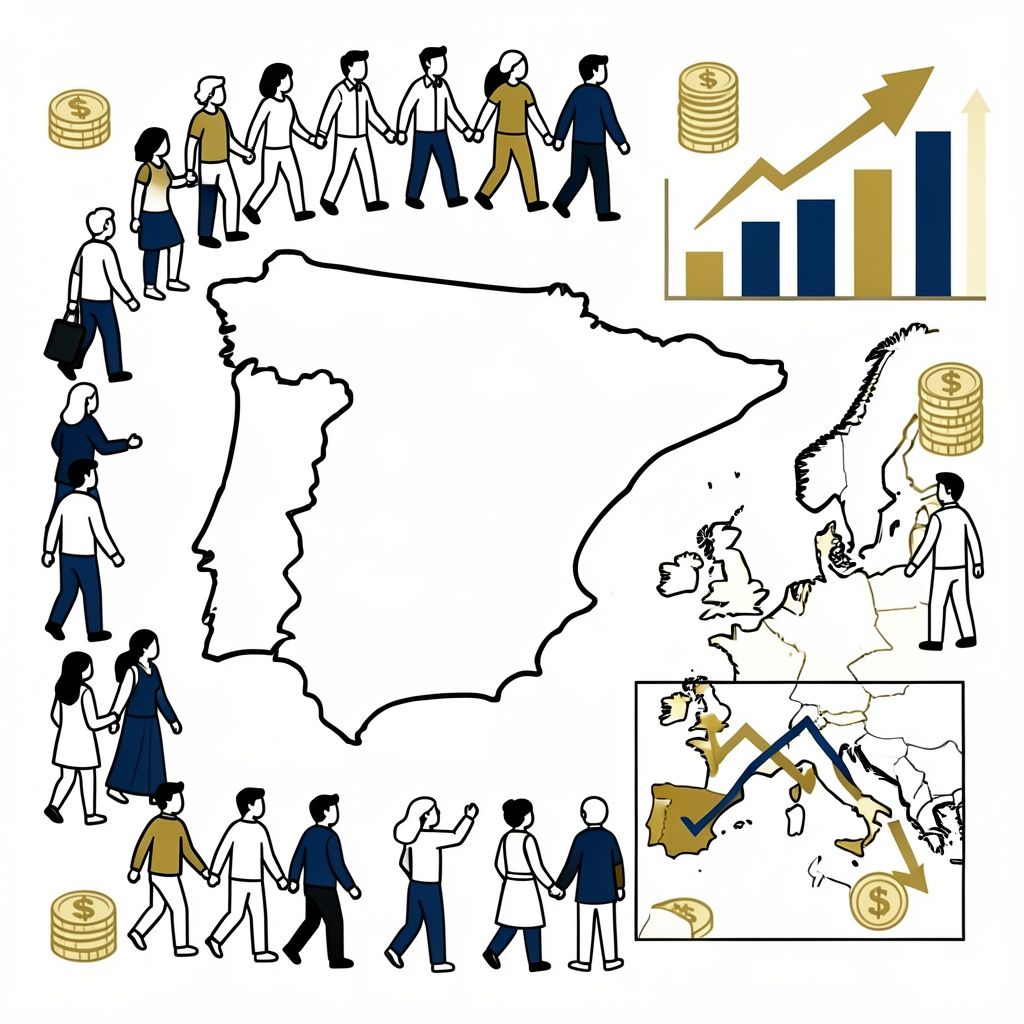
Driven by strategic immigration policies, Spain is projected to be the only major European economy to grow this century, offsetting a stark 37% domestic population plunge without foreign labor.
Demographic Projections and Economic Necessity
Spanish Prime Minister Pedro Sánchez declared on September 1, 2026, that Spain is positioned to be the only major European Union economy to avoid population contraction this century [1]. This projection relies heavily on strategic immigration policies designed to offset a domestic fertility rate of 1.29 children per woman, which remains significantly below the 2.1 replacement level [1]. Eurostat data indicates that without net migration, Spain’s population would plummet by 37%, falling from 53 million in 2026 to 31.7 million by 2076 [1]. The EU data office forecasts a modest population increase of 1.426 from 49.1 million in 2025 to 49.8 million in 2100 [1]. In contrast, other major EU economies face significant declines, with Italy projected to shrink by 24% and Germany by 11% over the same period [1].
Labor Market Dynamics and Fiscal Stability
The integration of foreign labor is described as vital to sustaining economic momentum and securing long-term public finances amidst aging demographics [1]. Currently, 22.5 million people contribute to the Social Security system, with immigrants filling 96% to 97% of the 600,000 new jobs created in Catalunya between 2017 and 2025 [1]. However, experts warn that ageing-related public spending is projected to rise from 20.3% of GDP in 2022 to 25.5% by 2050 [1]. Economist Joaquin Leguina noted that immigration can be a palliative but never a complete solution, as migrants also age over time [1]. Prime Minister Sánchez emphasized the immediate need, stating, “We need migrants – the labour force for an economy that is growing four times faster than the eurozone” [1].
Ceuta Migration Crisis and Discrepancies
These demographic discussions occur against the backdrop of a mass migration event in Ceuta between July 30 and July 31, 2026, where approximately 70,000 people crossed into the Spanish enclave [1]. While the government claims 5,000 illegal migrants remain in the city as of August 31, 2026, police sources estimate the figure at more than 15,000 [3]. Internal police reports suggest distribution across multiple zones, including 10,000 at Trampolín and Benítez beaches and 5,000 in the La Loma zone [3]. Between August 10 and August 31, 2026, 3,222 individuals returned voluntarily, representing a small fraction of the initial surge [3]. The government plans to establish 6,000 additional accommodation spots in the coming days relative to August 31, 2026 [3].
Diplomatic Pressures and Security Concerns
On September 1, 2026, reports emerged that a government source acknowledged the pressure exerted by Morocco on the Spanish border [4]. The source warned that maintaining fluid diplomatic relations with Rabat is essential, cautioning that breaking this dynamic could allow 70,000 migrants to enter Ceuta per week [4]. Security concerns have heightened following reports of sexual assaults during the weekend of August 29 to August 30, 2026 [3]. By August 31, 2026, the total number of reported aggressions rose to 34, including 12 classified as rapes [3]. Prime Minister Sánchez stated there is “no evidence” of Moroccan involvement in fueling the crisis, despite accusations from Israel and demands for proof from Russia [1].
Government Economic Response Package
In response to the crisis, the Council of Ministers approved a Royal Decree-law on September 1, 2026, mobilizing 309 million euros to support Ceuta’s economy and security [5]. This aid package represents 16% of the autonomous city’s GDP and is structured into four pillars, including 118 million for humanitarian aid and 90 million for security reinforcements [5]. Economic support measures include 36.6 million euros in direct aid for 2,500 self-employed workers and 1,500 companies, with applications opening on September 14, 2026 [5]. Additionally, the government has established over 3,400 additional reception places beyond the original capacity at the Ceuta Temporary Immigrant Stay Center [5]. Minister of Economy Carlos Cuerpo stated the goal is to “give confidence and tranquility to both companies and workers in the city of Ceuta” [5].