Europe Turns to Electronic Waste to Secure Critical Tech Materials
Brussels, Sunday, 20 September 2026.
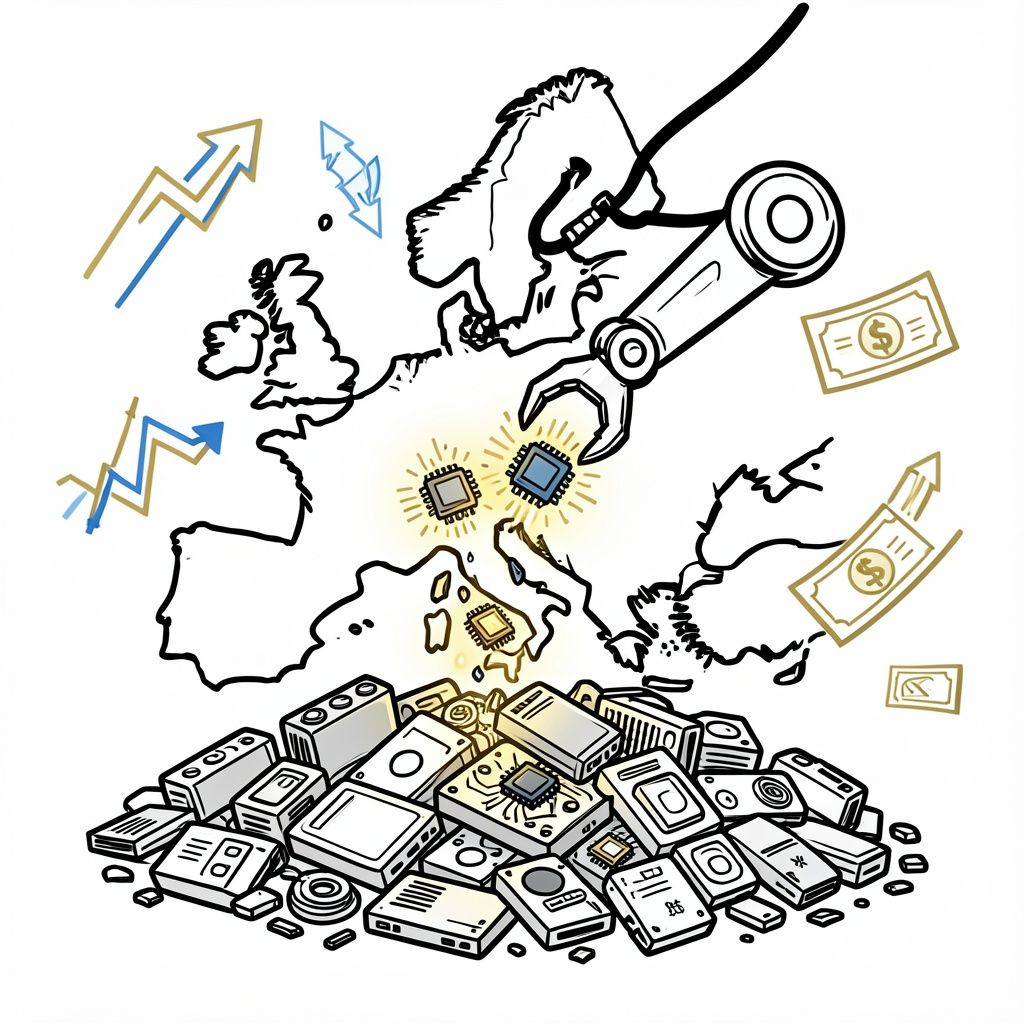
Electronic waste is becoming a national security priority as Europe taps discarded tech for critical metals, facing rising geopolitical competition and hidden surges in AI hardware disposal.
Strategic Shifts in Raw Material Recovery
The European Union is fundamentally altering its approach to supply chain security by prioritizing electronic waste recovery over new mining projects. Under the Critical Raw Materials Act, the EU has established a 2030 benchmark requiring recycling capacity to produce at least 25% of annual strategic raw material consumption to reduce dependence on concentrated supply chains [1]. This policy shift aims to mitigate geopolitical risks and supply bottlenecks for technology manufacturers, establishing a more localized secondary market for essential commodities [1]. Global electronic waste reached 62 million tonnes in 2022 and is projected to increase to 82 million tonnes by 2030, representing a significant potential resource pool [1]. The projected increase from 2022 levels indicates a growth rate of 32.258 percent over the eight-year period, highlighting the urgency of scalable recovery infrastructure [1].
Geopolitical Competition and Market Dynamics
Access to scrap and waste metals has become a national and economic security priority, driven by resource nationalism and export restrictions from major suppliers. On 30 July 2026, President Trump directed the Commerce Department to ban exports of tungsten, black mass, and permanent magnet scrap on defense grounds, signaling increased geopolitical interference in the flow of waste materials [5]. During the WEEE Forum Challenge to Change Conference on 16 September 2026, industry leaders emphasized that access to waste and scrap is now an issue of national security rather than just competitiveness [5]. Reflecting this strategic importance, the computer recycling market is forecast to grow at a compound annual growth rate of 9.2% from 2026 to 2033, driven by net-zero pledges and rising virgin metal costs [7].
The AI Waste Surge
A significant driver of future e-waste volumes is the rapid turnover of artificial intelligence infrastructure, which is often retired prematurely. A report by the Basel Action Network indicates that AI-driven electronic equipment retirement by 2030 will be approximately 40 to 60 times higher than previous academic projections due to the inclusion of previously uncounted infrastructure categories [6]. The report calculates that AI infrastructure generates approximately 70,000 metric tonnes of e-waste per GW of capacity, with data center operational doctrines compressing equipment lifespans to 2.5 to 5 years [6]. Total global e-waste production is projected to reach between 196 and 211 million metric tonnes annually by 2050, with AI-specific waste estimated to account for 31 to 46 million metric tonnes per year [6].
Technological and Chemical Enablers
Supporting the recovery of these materials requires specialized chemical processes and digital tracking systems. The global hydrochloric acid leaching market is projected to grow at a compound annual growth rate of 6.2% from 2026 to 2035, driven by rising rare earth recovery from electronics waste [8]. Digitalisation can go a long way to establishing a circular management of e-waste, with policy recommendations including the creation of a fully circular value chain for e-waste in the EU by 2030 [3]. Environmental scientist Nils Pauliks noted on 18 September 2026 that Europe is not facing a scarcity problem but a recovery challenge, emphasizing that better collection systems could transform electronic waste into a valuable domestic resource [2].
Policy and Security Implications
Regulatory frameworks are increasingly viewing producer responsibility as an industrial policy tool rather than solely an environmental one. The WEEE Forum proposes transforming the WEEE Directive into a Regulation and expanding end-of-life rules to include new categories like wind turbines and deep-sea cables [5]. Effective supply security for electronics depends on collection systems, sorting quality, component removal, material recovery technology, traceability, and the integration of recovered inputs back into qualified supply chains [1]. Manufacturers often lose value in their supply chains due to failures in tracking, storing, or evaluating inventory before it is designated as waste, underscoring the need for improved lifecycle visibility [1].
Conclusion and Future Outlook
The convergence of geopolitical tension, AI-driven hardware turnover, and regulatory pressure is reshaping the global materials landscape. While the headline numbers regarding AI waste volumes are assumption-sensitive, the strategic issue of materials lifecycle management is already present [6]. As the EU explores ways to promote the twin digital and green transition, improving e-waste management provides a timely and important case in practice [3]. Ultimately, the transition to a circular economy depends on converting the 60 metals contained in old electronic devices from waste streams into secure supply chains [4].
Sources
- blog.partstat.com
- www.universiteitleiden.nl
- www.epc.eu
- www.businessgreen.com
- www.linkedin.com
- www.cio.com
- www.linkedin.com
- www.indexbox.io