Supreme Court Weighs Bayer's Bid to Halt Thousands of Weedkiller Lawsuits
Washington, D.C., Monday, 27 April 2026.
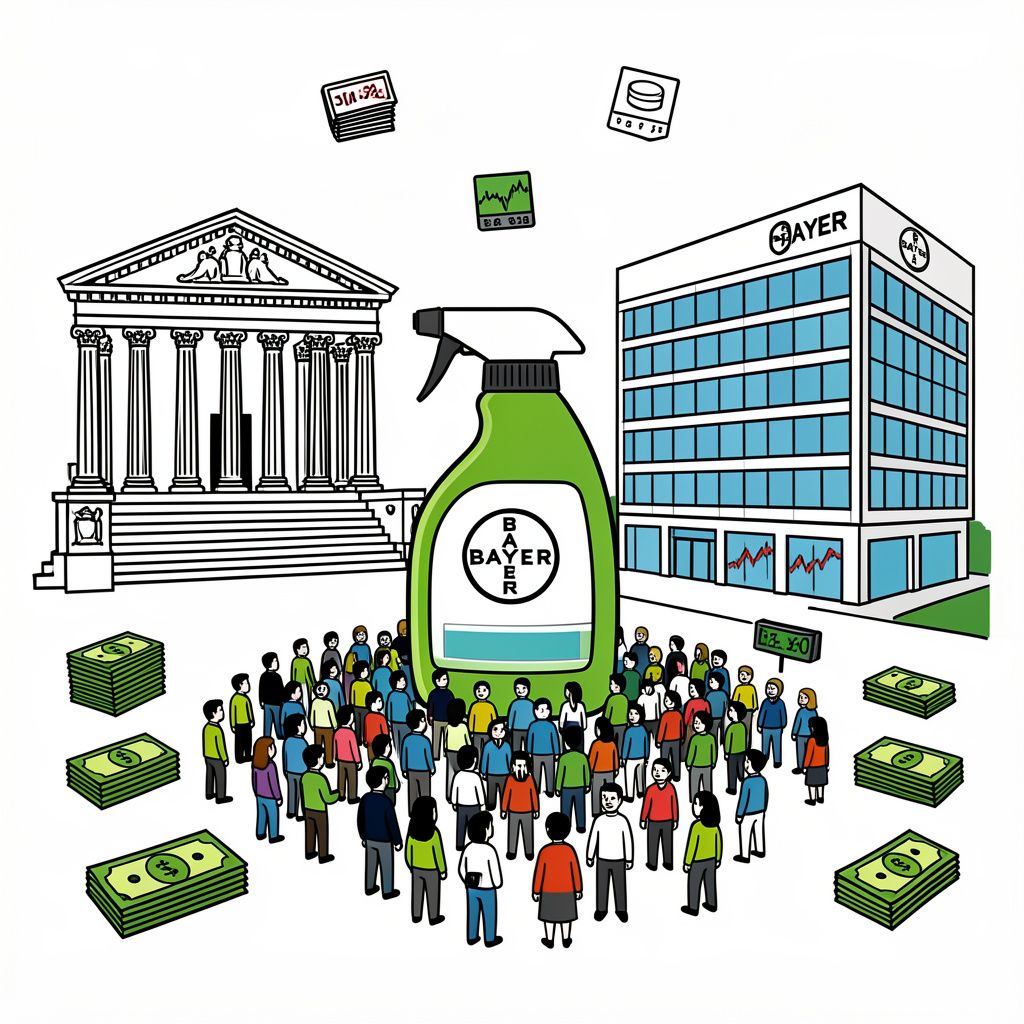
Today, the Supreme Court hears Bayer’s crucial appeal. A victory could shield the company from tens of thousands of weedkiller lawsuits that have already cost over $10 billion.
The Financial Toll of the Monsanto Acquisition
The financial ramifications of the Roundup litigation have been staggering for the German pharmaceutical and agricultural giant. Since acquiring Monsanto for $63 billion in 2018, Bayer has seen its market capitalization plummet, eroding to roughly $25.65 billion by May 2025—a devastating decline of approximately -59.286% [1][3][5]. To date, Bayer has resolved well over 100,000 claims, paying out more than $10 billion in settlements [3][5]. However, the company still faces between 61,000 and 65,000 active lawsuits, prompting it to reserve an additional $11.25 billion to handle outstanding claims [3][5].
Shifting Political Sands and Public Health Debates
The scientific consensus surrounding glyphosate remains fiercely contested, fueling a broader political divide. While the EPA maintains the chemical is safe, the World Health Organization’s International Agency for Research on Cancer classified glyphosate as a “probable human carcinogen” in 2015 [2][4]. This discrepancy has drawn intense political maneuvering. The Trump administration has formally backed Bayer in the current Supreme Court case, reversing the stance previously held by the Biden administration [4]. Furthermore, on February 19, 2026, President Trump issued an executive order invoking the Defense Production Act to protect and guarantee the domestic production of glyphosate-based herbicides [2][4].
A $7.25 Billion Settlement in the Balance
Anticipating the Supreme Court’s review, Bayer proposed a $7.25 billion global class-action settlement in February 2026, designed to resolve tens of thousands of current and future non-Hodgkin lymphoma claims [1][3][5]. The proposed fund would disburse payments over 21 years, with individual payouts potentially reaching $160,000 depending on the severity of the illness and the plaintiff’s age [3][5]. However, the agreement is highly contingent. Bayer executives have stated that the deal requires near-universal participation [alert! ‘Exact percentage threshold for opt-outs to trigger a settlement collapse is not publicly defined’], and the company retains the right to abandon the settlement if the opt-out rate is too high [3][5].
Sources
- www.reuters.com
- www.theguardian.com
- news.bloomberglaw.com
- www.nytimes.com
- www.lawsuit-information-center.com