China's New Five-Year Plan Locks in Coal Expansion Despite Green Energy Leadership
Beijing, Thursday, 26 March 2026.
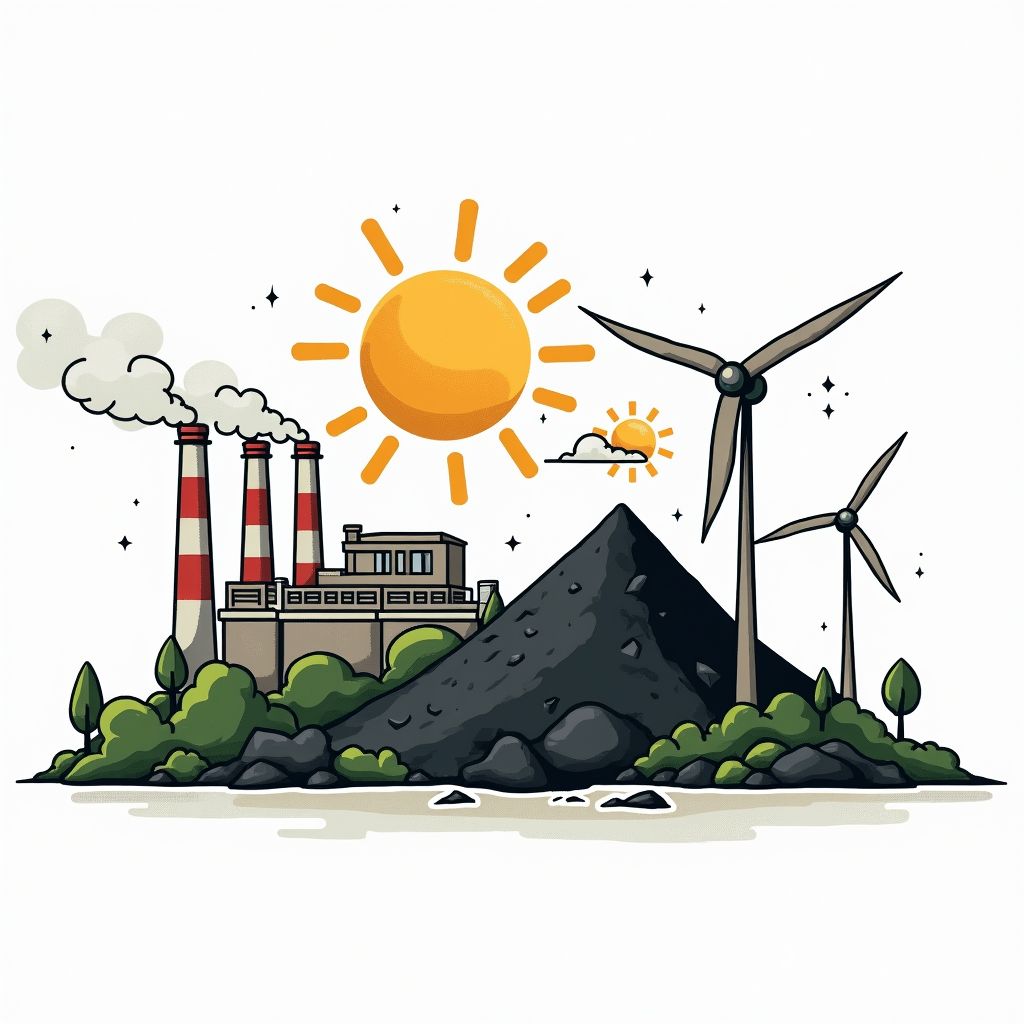
Despite leading the world in renewables, China accounts for 93% of global new coal construction, locking in fossil fuels to power its industrial grid under the 2026 five-year plan.
The 15th Five-Year Plan and the Coal Paradox
The recent annual meeting of the National People’s Congress, held from March 5 to March 12, 2026, officially launched China’s 15th Five-Year Plan, setting the nation’s economic and environmental trajectory through 2030 [1]. Despite remaining the undisputed global leader in renewable energy deployment, China’s broader energy strategy reveals a deep-seated reliance on fossil fuels [1]. The nation installed an unprecedented 300 gigawatts of solar and 100 gigawatts of wind power in 2025 alone, surpassing the combined installations of the rest of the world [1]. Data released on March 25, 2026, confirms this momentum, showing that by the end of February 2026, China’s total installed power generation capacity reached 3.95 billion kilowatts, a year-over-year increase of 15.9% [4]. Within this growth, solar capacity surged by 33.2% to 1.23 billion kilowatts, and wind power rose by 22.8% to 650.7 million kilowatts [4].
The “Electro-State” and Industrial Appetite
This dual-track energy strategy is fundamentally driven by China’s immense industrial base. The nation has effectively transformed into an “electro-state,” where cheap electricity and localized upstream materials production create powerful network effects that benefit power-intensive industries [3]. China’s thermal-dominated power system is heavily skewed toward industrial demand, with industrial enterprises accounting for roughly two-thirds of total power consumption [3]. In 2023, the manufacturing sector alone consumed 4,709 terawatt-hours of power, with over 35% dedicated to metals and materials production [3]. Within that subset, 40% was used specifically for aluminum production [3].
Geopolitical Shocks and Energy Security
Global geopolitical tensions are further cementing coal’s position in Asia’s energy mix. The ongoing Iran war has significantly disrupted oil and gas shipments through the Strait of Hormuz, a critical chokepoint that handles approximately a fifth of global oil and natural gas trade [2]. In response to this squeeze on global liquefied natural gas (LNG) supplies, Asian nations—including India, South Korea, and Vietnam—are increasingly turning to coal to stabilize their grids [2]. For China, which has built record coal power generating capacity since 2021 specifically to improve energy security, this crisis validates its strategy of maintaining coal use despite its vast clean energy capacity [2].
Climate Commitments in Jeopardy
China’s relentless coal expansion casts serious doubt on its international climate pledges. In April 2021, President Xi Jinping promised that China would reduce its energy intensity to 65% below 2005 levels by 2030 [1]. However, data from early 2026 indicates that China missed its energy density target for the previous five-year period, achieving only a 12.4% improvement against a 17% target, representing a shortfall of 4.6 percentage points [1]. This missed target implies a 13% increase in emissions over the same timeframe [1].