NASA Scraps Lunar Orbit Station to Build a $20 Billion Moon Base
Washington, Wednesday, 25 March 2026.
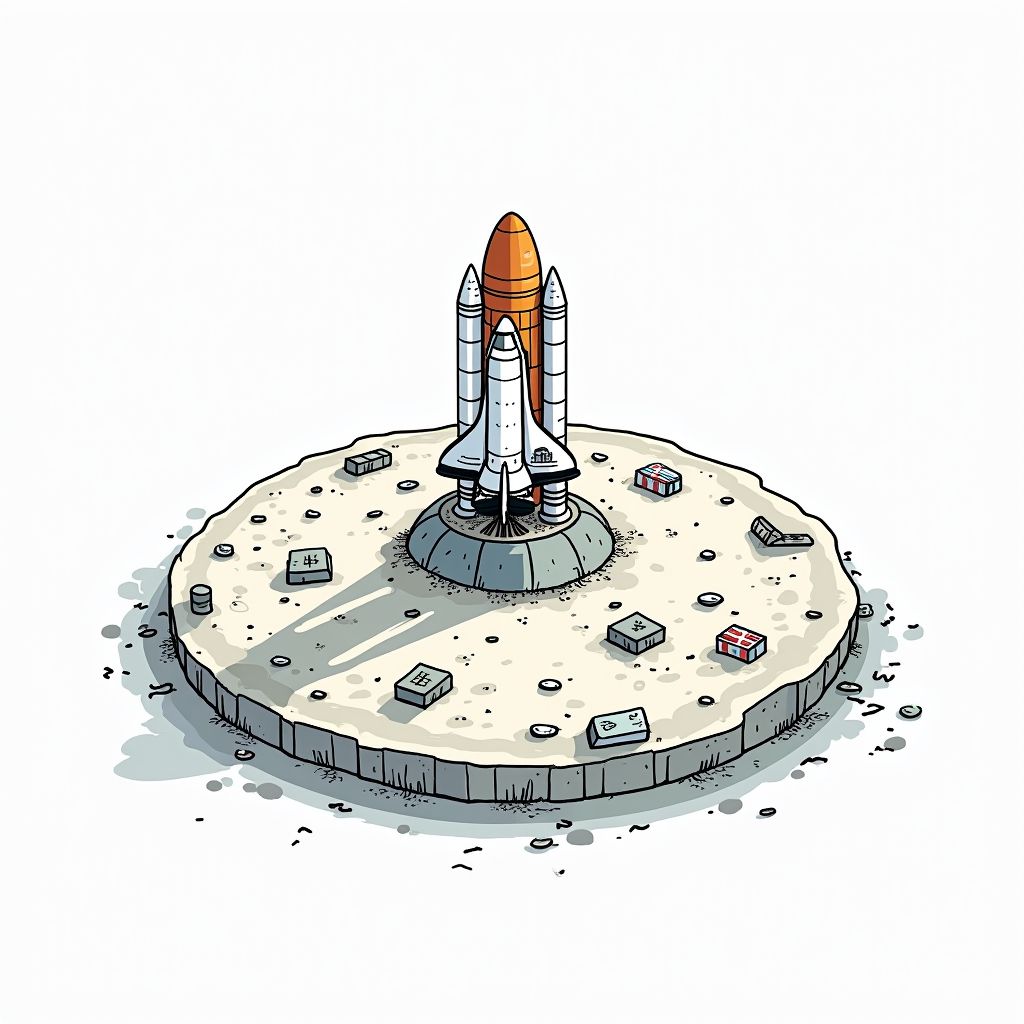
NASA is scrapping its lunar orbit station to construct a $20 billion permanent moon base. This strategic pivot also funds a groundbreaking nuclear-powered spacecraft for future Mars exploration.
A Pivot from Orbit to Surface
On Tuesday, March 24, 2026, NASA officially announced the cancellation of the Lunar Gateway—a planned space station that was intended to orbit the moon [1]. Following initial roadmap reveals at the “Ignition” event in Washington, D.C. on March 17, NASA Administrator Jared Isaacman outlined a bold new vision: redirecting resources to build a permanent outpost directly on the lunar surface [4]. Isaacman, who took the helm of the agency in December 2025 [1][2][3][4], noted that the shift should not come as a surprise, emphasizing a renewed focus on sustained lunar surface operations rather than orbital waystations [1][2][6]. To achieve this, the agency plans to invest approximately $20 billion over the next seven years to construct the base through dozens of targeted missions [4][5].
Realigning the Aerospace Economy
This abrupt strategic realignment is sending immediate ripples through the private aerospace sector [2]. The Lunar Gateway was already well under construction, relying heavily on defense and space contractors such as Northrop Grumman, Vantor (formerly Maxar), and Intuitive Machines’ subsidiary Lanteris Space Systems [1][2]. Rather than scrapping the hardware, NASA intends to repurpose existing components—such as the Power and Propulsion Element and the Habitation and Logistics Outpost—for the surface base [6]. However, this massive pivot from an orbital outpost to a surface-focused mission requires Congressional approval [6]. As of July 2025, a budget reconciliation bill had legally defined the Gateway project as an orbital outpost and allocated $2.6 billion toward it [6]. Repurposing these funds to help cover the new project means the agency must still manage the remaining 17.4 billion required for the $20 billion base, forcing contractors to scramble to accommodate the agency’s new urgency and financial restructuring [2][6].
Phased Construction and Commercial Pressures
NASA’s roadmap for the lunar base is divided into three distinct phases, offering lucrative opportunities and strict deadlines for commercial partners [5][6]. Phase 1, spanning from 2026 to 2028, will utilize a $10 billion budget to evaluate sites at the lunar south pole and develop enabling technologies [6]. Phase 2, running from 2029 to 2031, matches that with another $10 billion to construct essential communications, navigation, and power infrastructure, while aiming for two crewed missions per year [6]. Finally, Phase 3 will begin in 2032 to support long-duration exploration [6]. To meet these aggressive timelines, NASA is demanding peak performance from the private sector. Isaacman warned of “uncomfortable action” if contractors underperform [4], a pointed remark given a March 2026 report from NASA’s inspector general revealing that SpaceX is currently two years behind schedule on the first astronaut moon lander contract awarded in 2021 [1].
Accelerating the Artemis Timeline
The urgency surrounding these aerospace contracts is largely driven by a renewed great-power competition in space, specifically China’s stated goal of landing its own astronauts on the moon by 2030 [1][2]. To ensure American leadership, NASA is accelerating the Artemis program, which aims to return humans to deep space for the first time since the Apollo program ended in 1972 [1][4]. The Artemis II mission is slated to launch on April 1, 2026 [4][5]. Following this, NASA plans to launch Artemis IV—expected to be the first crewed landing since 1972—and Artemis V in 2028 [5]. However, achieving this 2028 target remains uncertain [alert! ‘SpaceX is currently two years behind schedule on the required astronaut moon lander’]. Once Artemis V is completed, the agency intends to land astronauts every six months to aid in base construction [5]. The lunar base will also feature advanced robotics, including a drone named “MoonFall,” which builds upon the legacy of the Ingenuity Mars helicopter [6].
Nuclear Ambitions and the Martian Horizon
Beyond the moon, NASA is laying the groundwork for deeper solar system exploration through significant investments in nuclear technology [1]. A critical component of the lunar base will be a fission surface power reactor, which the agency intends to launch by 2030 [4]. Steve Sinacore, NASA’s program executive for Fission Surface Power, acknowledged the need to educate the public on the technology, assuring that the reactor remains completely inactive and emits no radiation until it is safely deployed in space [4]. Findings from these lunar power systems will directly inform NASA’s broader interplanetary goals, acting as a technological stepping stone [4].
Powering the Journey to Mars
The ultimate objective of this multibillion-dollar expansion is to establish a reliable, high-speed pathway to Mars [3][4]. NASA plans to launch a nuclear-powered Mars vehicle, dubbed Space Reactor 1 (SR-1) Freedom, before the end of 2028 [1][4]. By testing mobility, power, and scientific tools on the lunar surface first, the agency hopes to create an evolutionary path toward humanity’s first permanent off-world outpost [3][5]. As Isaacman stated, the goal of this new era of space exploration is no longer just “flags and footprints,” but rather establishing an enduring presence that will fundamentally change the aerospace economy and humanity’s reach into the cosmos [5].