Tech Billionaire Buys Massive Swedish Forest Raising Local Questions
Stockholm, Wednesday, 30 September 2026.
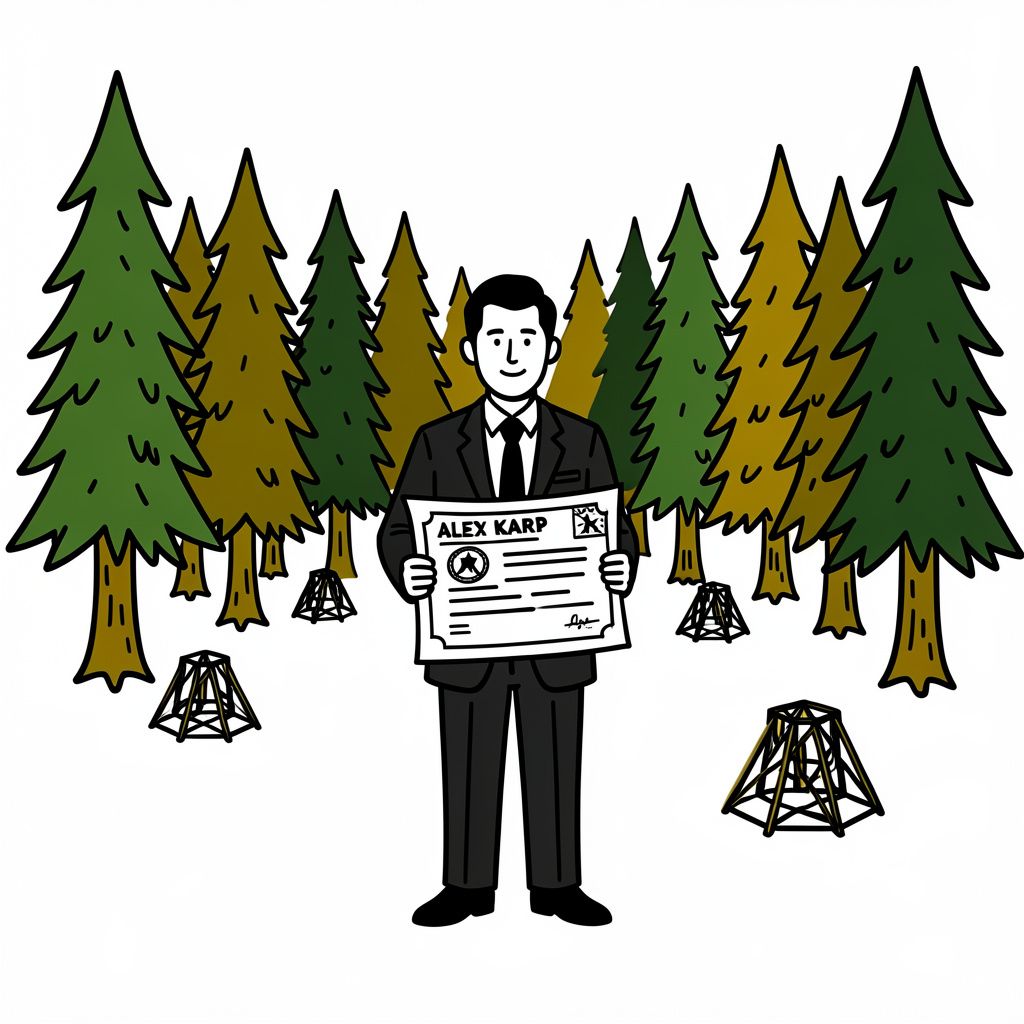
Palantir CEO Alex Karp purchased 15,000 hectares of Swedish woodland for $22 million in September 2026, revoking local hunting rights and sparking debate over foreign landownership.
A Quiet Acquisition in Northern Sweden
Alexander Caedmon Karp, the Chief Executive Officer and co-founder of the data analytics giant Palantir Technologies (NYSE: PLTR) [1][2], has quietly acquired approximately 15,000 hectares (roughly 37,000 acres) of contiguous mountain forest land in Sweden [1][2][4]. The massive property, located south of Storsjö Kapell in the Bergs Municipality of Härjedalen [2][4], was purchased for 235 million Swedish kronor (SEK), which is equivalent to approximately $22 million [1][2]. Local Swedish news outlet SVT reported the transaction value at 250 million SEK, with the seller noting a figure of 240 million SEK [4]. The acquisition was finalized in September 2026 through Cladonia Skog AB, a newly established Swedish entity registered in mid-August 2026 with administrative support from Scandinavian Trust [1][4].
Suboptimal Forestry and Conservation Claims
The vast tract of land was sold by Swedish forestry group Svenska Cellulosa Aktiebolaget (SCA), which decided to divest the property because it was deemed suboptimal for its commercial timber operations [1][2]. According to SCA press spokesperson Robert Östholm, the land is primarily composed of bare mountain and subalpine forest [4]. While SCA noted that the terrain is highly suitable for recreation, skiing, hiking, and hunting [4], Cladonia Skog AB officially registered its corporate purpose as long-term forestry and related activities, explicitly denying public speculation that the site would be used to construct data centers [1][4]. The purchase price of 235 million SEK for 15,000 hectares represents an average cost of 15666.667 SEK per hectare [2].
Friction Over Traditional Hunting Rights
Despite the buyer’s assurances of environmental preservation, the transaction quickly sparked local controversy when long-standing regional hunting agreements were summarily terminated [1][3]. Local hunters near Storsjö Kapell received notifications as early as July 2026 that their hunting leases would not be extended by the outgoing owner, SCA, because the company cannot legally grant hunting rights on land it no longer owns [1][4]. Under the terms of the sale, the new owner will assume full hunting rights across the entire property starting on July 1, 2027 [2]. This transition has already disrupted the local community, with two hunting teams losing their leases immediately and a third scheduled to lose access in 2027 [2].
Corporate Reassurance and Public Backlash
In an effort to manage public relations and address regional concerns, representatives from Scandinavian Trust—acting on behalf of Cladonia Skog AB—stated that Karp intends to manage the forest property with deep respect for local Swedish outdoor traditions [4]. Board member Jenny Lopes Da Silva emphasized that the new owner is deeply committed to preserving the natural beauty of the landscape, providing valuable habitats for local flora and fauna while leaving the area open for public recreation and restoration [1][2]. However, local critics point out that the abrupt cancellation of hunting leases via mail was the primary reason the public discovered the backroom deal, which was executed through a Stockholm nominee firm to shield the identity of the foreign billionaire [3].
Beyond Trees: AI Infrastructure and Geopolitics
The scale and location of the acquisition have fueled significant speculation that the “forestry” explanation serves as a convenient cover story for more strategic ambitions [3]. The acquired land lies in Northern Sweden, a region characterized by a cold climate and access to cheap electrical power—both of which are highly prized assets for hosting energy-intensive AI data center infrastructure [3]. While representatives for Cladonia Skog AB have firmly dismissed these theories as groundless [4], industry observers point to Palantir’s deep integration into Sweden’s national security apparatus [3]. Palantir, which currently holds a stock-market valuation of approximately $460 billion [2], has operated in Sweden for 14 years, providing advanced data-fusion and surveillance software to both the Swedish Police and the Swedish Armed Forces [2][3].
Palantir’s Deepening Footprint in Sweden
This land deal also coincides with broader geopolitical alignments between Sweden and the United States [3]. In March 2026, Sweden signed the “Pax Silica” agreement, a Washington-led initiative designed to secure “trusted” AI supply chains, including critical minerals, energy, chips, and data infrastructure [3]. Furthermore, Swedish Prime Minister Ulf Kristersson held a classified meeting with Karp and Palantir co-founder Peter Thiel at a Bilderberg meeting in 2025 to discuss Palantir’s strategic role in Sweden’s artificial intelligence framework [3]. This close relationship between Palantir’s leadership and Swedish state authorities has intensified local anxieties that the massive land purchase represents a long-term option to secure physical nodes for state-aligned data processing and surveillance networks [3].
The Growing Allure of Tangible Assets
Karp’s Swedish acquisition highlights a broader, accelerating trend of high-profile technology executives diversifying their portfolios into tangible real estate and natural resources amid global economic volatility [1]. For example, Meta Platforms CEO Mark Zuckerberg famously owns a 1,618.74-hectare (4,000-acre) ranch in Kauai, Hawaii, while Reddit co-founder Alexis Ohanian has operated a family farm in Jupiter, Florida, for six years as of 2026 [1]. These moves reflect the growing institutional and private appetite for agricultural and forest lands, which have evolved into highly stable asset classes [1]. In the United States, farmland is now estimated to be a $4.3 trillion asset class, with land values rising 4.3% year-over-year in 2025 to an average of $4,350 per acre, according to data from the U.S. Department of Agriculture [1].
Environmental Offsets and Sovereign Resources
Beyond serving as personal recreational retreats, large-scale forestry assets have become financially lucrative due to the emergence of carbon credit markets, which allow owners to trade emissions offsets [1]. As Steve Bruere, president of Peoples Company, noted, high-net-worth investors increasingly appreciate the dual financial and non-financial benefits of owning land, where they can enjoy hiking, fishing, and hunting while holding a resilient physical asset [1]. Whether Karp’s 15,000-hectare estate remains a dedicated nature preserve or eventually transitions into a technological hub, the transaction underscores the evolving intersection of billionaire wealth, environmental conservation, and sovereign land resources in the digital age [1][3].