Saudi Aramco Suspends Major Refinery Operations After Drone Strike, Jolting Oil Markets
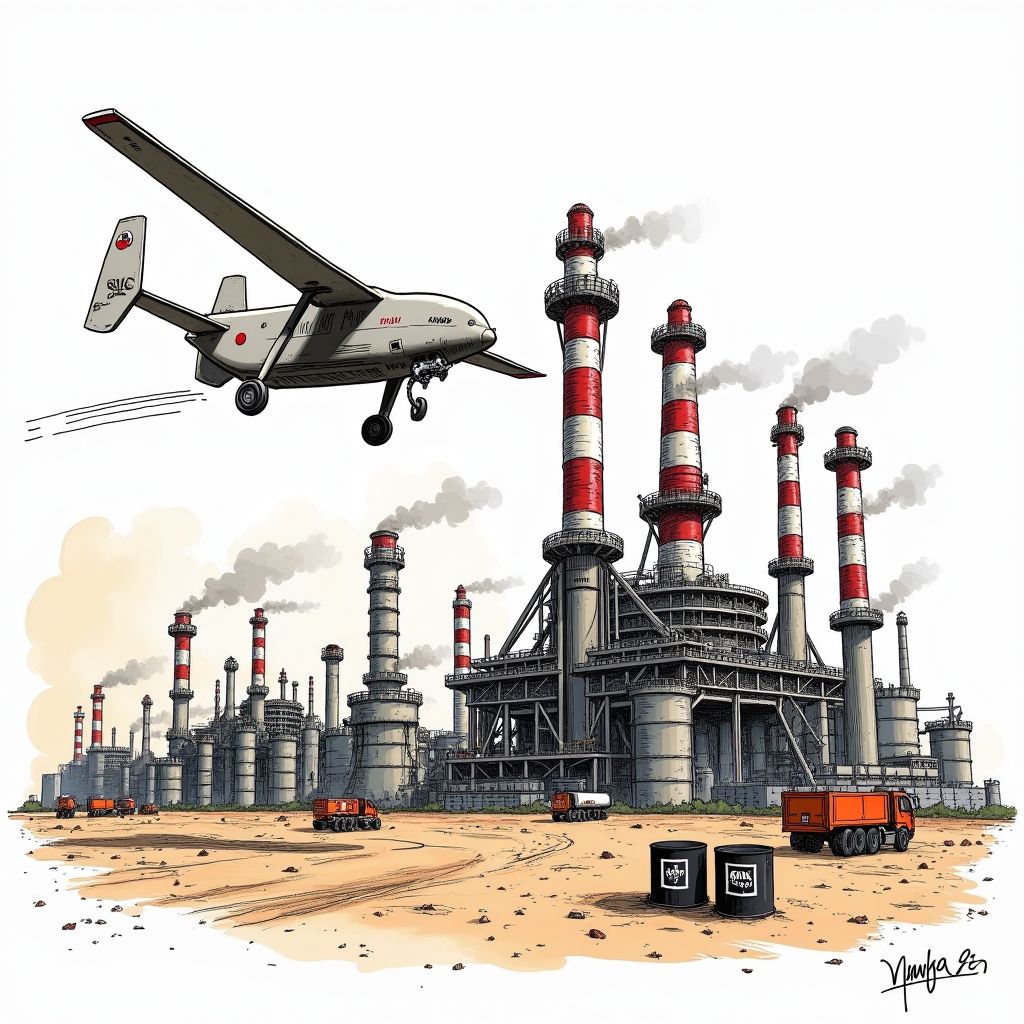
Ras Tanura, Monday, 2 March 2026.
Operations at the pivotal Ras Tanura refinery halted following a drone strike, driving Brent crude to $80 per barrel as the expanding Iran-Israel conflict threatens global energy supply lines.
Energy Infrastructure Under Fire
The geopolitical instability in the Middle East has transitioned from military engagement to a direct threat against global energy security. Just 24 hours after reports confirmed U.S. combat casualties in Operation Epic Fury, the conflict has expanded to target critical oil infrastructure. On Monday, March 2, 2026, Saudi Aramco suspended operations at its Ras Tanura refinery following a drone strike [1]. Located on the Persian Gulf, Ras Tanura is a linchpin in the global energy supply chain, capable of processing 550,000 barrels of crude oil per day [1]. While initial reports suggest the shutdown was a precautionary measure and that a fire at the facility was quickly brought under control [1][2], the psychological and logistical impact on the market has been immediate.
Market Volatility and Price Surges
The suspension of such a vital export terminal, combined with fears of prolonged disruption, sent shockwaves through commodities markets early Monday. Brent crude, the international benchmark, spiked approximately 8.975% to trade at $79.41 per barrel, marking a significant jump from Friday’s trading price of $72.87 [3]. Similarly, West Texas Intermediate (WTI) rose 8.642% to reach $72.79 per barrel [3]. These price movements reflect growing anxiety among traders that energy flows from the region could slow to a trickle, particularly as the Strait of Hormuz—a waterway responsible for transporting a fifth of the world’s daily oil supply—faces severe congestion following reported drone attacks on at least three oil tankers [3].
The Widening Theater of Conflict
The strike on Ras Tanura is part of a broader escalation that unfolded over the weekend, challenging the assumption that Gulf cooperation states would remain insulated from the conflict between Iran and Israel. Between February 28 and March 1, Iranian retaliatory strikes targeted civilian and military locations across the region, including international airports in Dubai and Kuwait [6]. In Kuwait alone, defense systems intercepted 97 ballistic missiles and 283 drones on Saturday [6]. The sheer volume of projectiles and the targeting of civilian infrastructure in the UAE, Saudi Arabia, and Bahrain signal a shift toward total regional engagement, complicating the security landscape for multinational corporations operating in the Gulf [6].
Supply Policy vs. Security Reality
The timing of these physical disruptions presents a stark paradox for energy policymakers. Only a day prior to the attacks, on March 1, eight OPEC+ nations—including Saudi Arabia, Russia, and the UAE—met virtually to review market conditions [5]. Citing a steady global economic outlook, the group agreed to resume unwinding 1.65 million barrels per day of voluntary production adjustments starting in April 2026 [5]. However, the feasibility of this planned supply increase is now in question. While the cartel reaffirmed its commitment to market stability [5], the physical security of the production facilities and transit routes required to deliver that stability is currently under its most severe test in years.
Sources
- www.bloomberg.com
- m.economictimes.com
- www.hindustantimes.com
- www.marketscreener.com
- www.opec.org
- time.com