Supreme Court Strikes Down Federal Gun Ban for Marijuana Users
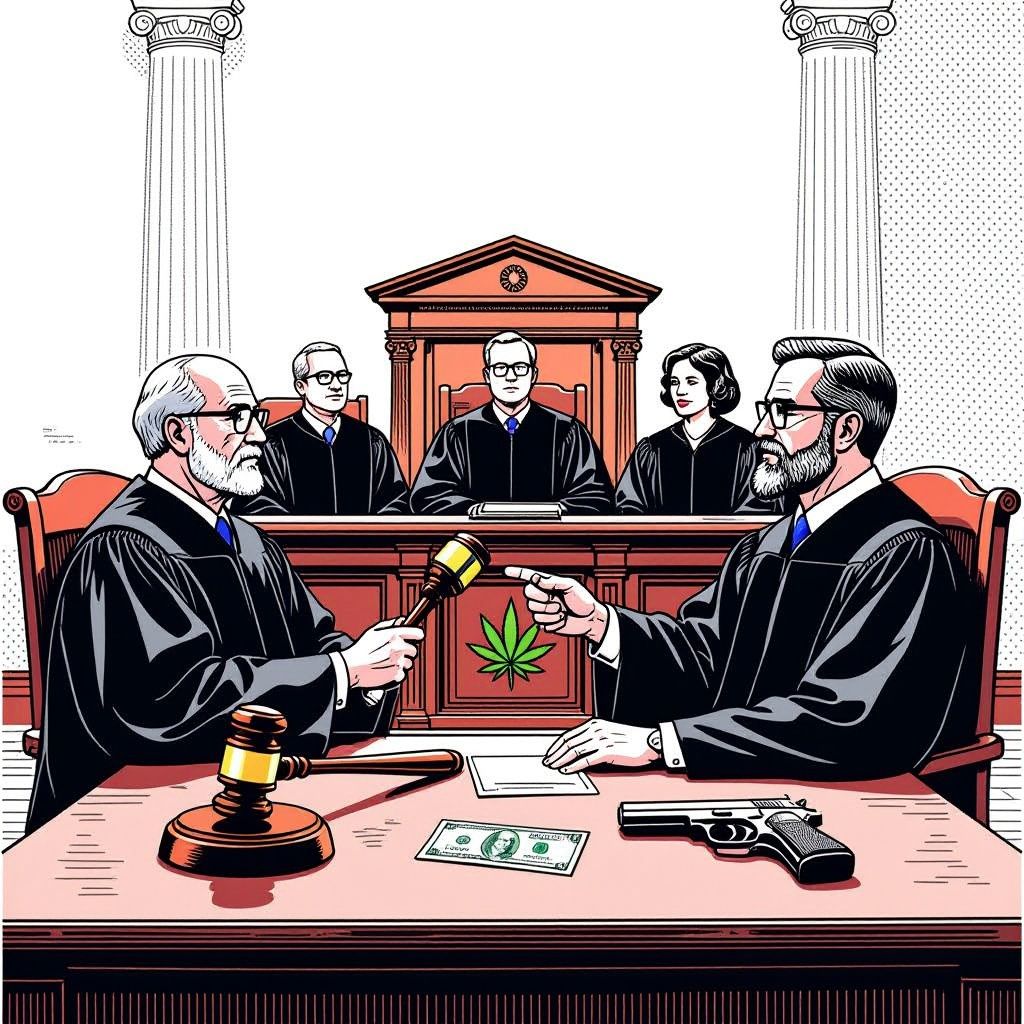
Washington D.C., Thursday, 18 June 2026.
In a landmark 6-3 decision, the U.S. Supreme Court ruled that banning firearm possession for marijuana users violates the Second Amendment. The case, United States v. Hemani, centered on a Texas man prosecuted solely for his marijuana use, not unsafe gun handling. With over 15% of Americans using marijuana and 40+ states legalizing it, this ruling challenges federal enforcement and could reshape state-level gun laws. The decision leaves room for future regulations but sets a precedent that could impact millions.
The Legal Precedent: A Narrow but Significant Ruling
The Supreme Court’s 6-3 decision in United States v. Hemani [1] establishes a critical precedent by invalidating 18 U.S.C. § 922(g)(3) as applied to marijuana users, while leaving broader questions about firearm regulations unresolved. Justice Neil Gorsuch, writing for the majority, emphasized the ruling’s limited scope: “The Court’s decision is narrow. It does not address efforts to ban addicts or those presently intoxicated from possessing a firearm; other prophylactic laws Congress might adopt after determining that users of a particular drug pose a special risk of misusing firearms” [1]. This careful delineation suggests the Court is attempting to balance Second Amendment rights with public safety concerns, though the decision’s implications for future legislation remain uncertain.
The Case That Sparked the Controversy
Ali Danial Hemani’s case originated in 2022 when federal agents discovered a single pistol and 60 grams of marijuana during a search of his Texas home [1]. Hemani’s admission to using marijuana “about every other day” became the sole basis for his prosecution under § 922(g)(3), despite the absence of evidence linking his drug use to unsafe firearm possession [1]. The case gained particular notoriety as it followed the same legal pathway used to convict President Joe Biden’s son, Hunter Biden, in 2024 under identical circumstances [1]. This parallel underscored the law’s broad application and raised questions about its consistency with constitutional protections.
The Constitutional Debate: Historical Analogues vs. Modern Realities
At the heart of the Court’s decision lies a fundamental disagreement over how to interpret the Second Amendment in the context of modern drug policy. The majority opinion, joined by Justices Thomas, Barrett, Kavanaugh, and Jackson, rejected the government’s argument that § 922(g)(3) aligned with historical firearm regulations [1]. Justice Alito’s concurrence explicitly stated: “I agree with the Court that the historical analogues that the Government cites are not ‘relevantly similar’ to 18 U.S.C. § 922(g)(3) as applied to respondent” [1]. This rejection of the government’s historical justification marks a significant shift in Second Amendment jurisprudence, particularly following the Court’s 2022 decision in New York State Rifle & Pistol Association v. Bruen [GPT].
The Vagueness Problem: Defining ‘Unlawful User’
A central issue in the case was the statute’s failure to define what constitutes an “unlawful user” of controlled substances. Hemani’s legal team argued that the law’s ambiguity created unconstitutional vagueness, asking: “Is someone who uses a controlled substance once a year ‘an unlawful user’? What about someone who uses that substance every six months, or every two weeks? Does it matter how much one consumes, or only how frequently one does so?” [1]. The Court’s decision implicitly acknowledges these concerns, though it stops short of providing clear guidance for future prosecutions. This ambiguity could lead to inconsistent enforcement as lower courts grapple with the ruling’s application.
Political and Industry Reactions: A Divided Landscape
The decision has elicited strong reactions from across the political spectrum and various industries. Gun rights advocates, including the National Rifle Association, have praised the ruling as a victory for constitutional rights [alert! ‘source not provided for specific NRA reaction’], while gun control organizations like Everytown for Gun Safety have expressed concerns about potential public safety implications [1]. The cannabis industry, now valued at over $40 billion in the United States [GPT], views the decision as a step toward reconciling state-level legalization with federal prohibitions. Notably, the Trump administration had previously supported the law’s constitutionality, while California filed an amicus brief in defense of the federal statute [1].
Future Implications: Legislative and Enforcement Challenges
The Supreme Court’s decision leaves several critical questions unanswered, creating both opportunities and challenges for policymakers. Congress may attempt to craft more narrowly tailored legislation that addresses the Court’s concerns while maintaining public safety objectives. Justice Gorsuch’s opinion explicitly leaves room for such measures: “provision disarming individuals convicted of felonies; or whether the government could bring a prosecution … accompanied by individualized proof that the defendant’s drug use renders him a danger to himself or others” [1]. However, any new legislation would need to navigate the complex political landscape surrounding both gun rights and drug policy. Meanwhile, federal agencies like the Bureau of Alcohol, Tobacco, Firearms and Explosives (ATF) will need to adjust their enforcement priorities, potentially shifting resources away from prosecutions based solely on marijuana use.
State-Level Responses: A Patchwork of Regulations
The ruling is likely to have immediate consequences for state-level regulations, particularly in the 24 states where recreational marijuana use is legal [GPT]. Some states may choose to implement their own firearm restrictions for marijuana users, though such measures would face legal challenges under both state constitutions and the Supreme Court’s recent Second Amendment jurisprudence. Other states might opt to align their enforcement practices with the Court’s decision, potentially creating a patchwork of regulations that varies significantly across the country. This inconsistency could lead to forum shopping and complicate interstate commerce, particularly for businesses operating in both the cannabis and firearms industries.
The Economic Impact: Industries at the Crossroads
The decision intersects with two major economic sectors: firearms manufacturing and the cannabis industry. The firearms industry, with an estimated economic impact of $70 billion annually [GPT], may see increased demand from individuals who were previously deterred by federal prohibitions. Conversely, the cannabis industry, which has faced significant banking and financial challenges due to federal prohibition [GPT], could benefit from reduced legal uncertainty for its customers. However, businesses operating at the intersection of these industries—such as companies developing cannabis-related products for hunters or security personnel—may face new regulatory hurdles as they navigate the evolving legal landscape.