Surging Fuel Prices Expose a Deepening Economic Divide Among American Consumers
Washington D.C., Thursday, 7 May 2026.
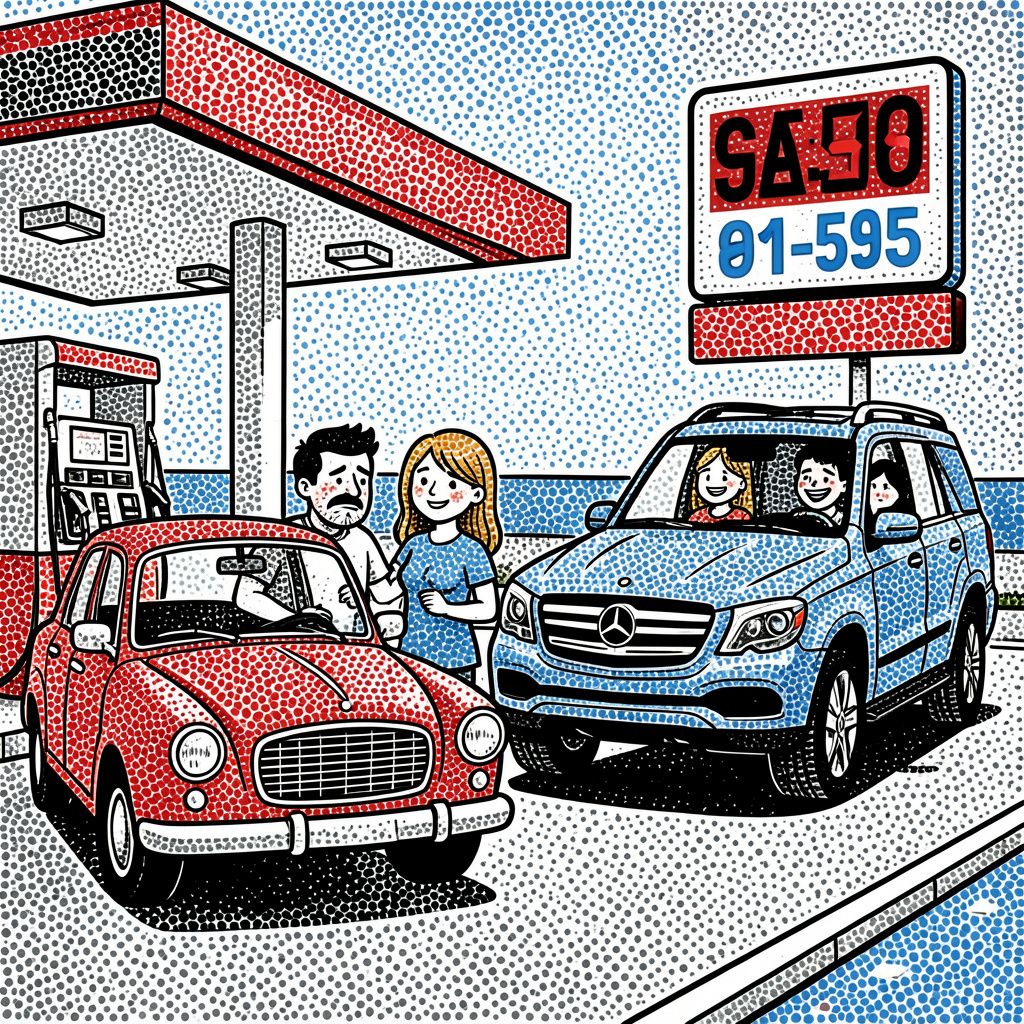
As national fuel prices hit four-year highs, a stark economic divide emerges: rising energy costs force lower-income Americans to cut consumption while wealthier households continue spending.
Geopolitical Tensions Drive Costs Upward
Geopolitical conflict, specifically the ongoing war in Iran, has caused a surge in crude oil and gasoline futures [1][2]. As of Wednesday, May 6, 2026, the national average for a gallon of gasoline reached $4.53, according to data from the American Automobile Association (AAA) [1]. This represents a significant financial pressure on American households, echoing the energy crisis observed in 2022 following the Russian invasion of Ukraine [1]. The commodity markets reflect this stress, with crude oil prices jumping by $6.95 to settle at $106.88 per barrel after the trading session on April 30, 2026 [5].
The K-Shaped Consumer Reality
Macroeconomic data reveals a starkly divided consumer base, characterized by economists as a “K-shaped” dynamic [1]. In March 2026, consumption patterns showed that lower-income households significantly reduced their gasoline usage in response to the price hikes, while high-income households made minimal adjustments [1]. Despite the inflationary pressure, National Economic Council Director Kevin Hassett stated on May 6, 2026, that the American consumer is “really, really firing on all cylinders” [1]. Hassett observed that while Americans are spending more on gasoline, credit card spending is “through the roof” as consumers continue to spend across other categories [1].
Regional Disparities and Mitigation Strategies
The financial burden of fueling vehicles is not distributed evenly across the country. While the national average price saw a weekly hike of $0.34, regions like Western Pennsylvania experienced a sharper increase of $0.49, bringing the local average to $4.654 per gallon [5]. This regional average represents an increase of 11.875% over the previous week’s average of $4.160 [5]. Within Florida, localized disparities are also apparent; the West Palm Beach-Boca Raton metropolitan area recorded the state’s most expensive gas at $4.50 per gallon on May 3, 2026, whereas Pensacola offered the cheapest rates at $3.96 per gallon [2][3][4].