Gold Prices Poised to Hit $6,000 by 2027 as Economic Uncertainty Grows
New York, Thursday, 18 June 2026.
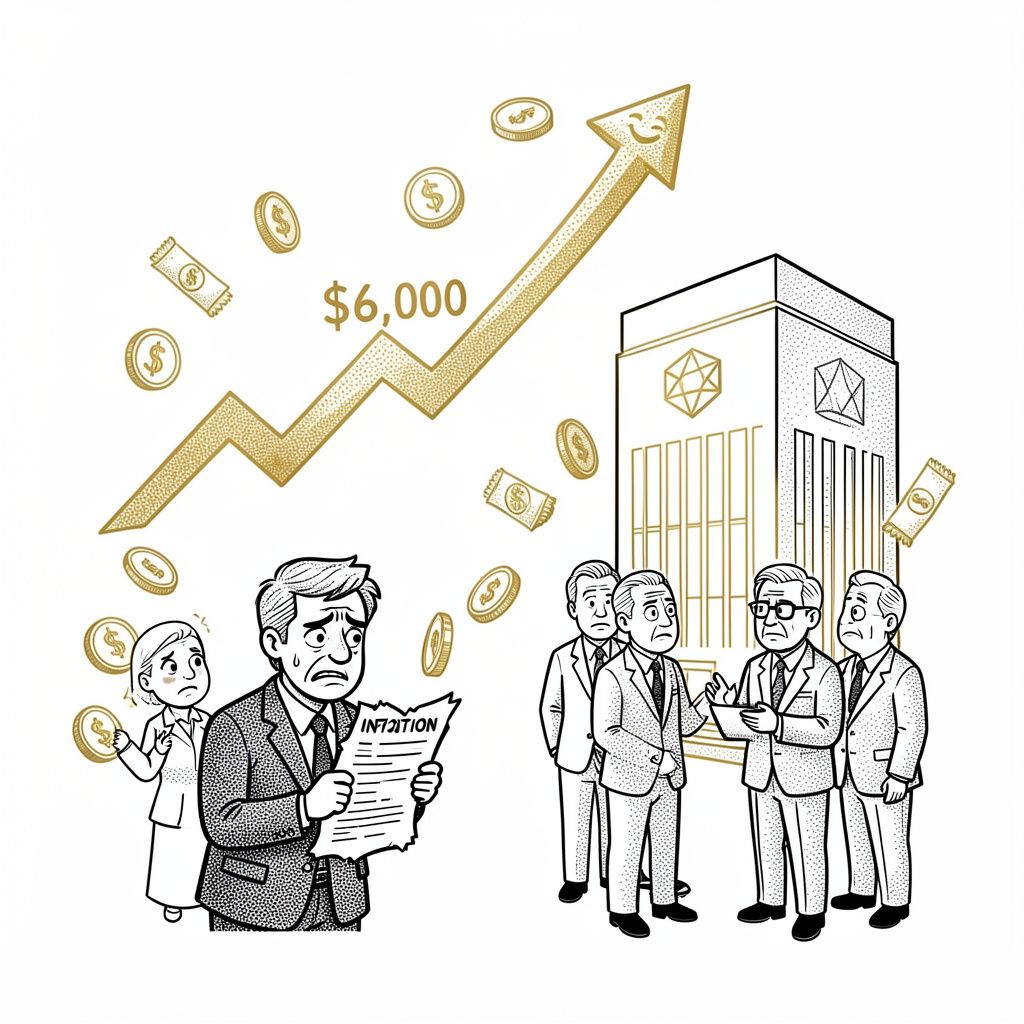
Major financial institutions, including Wells Fargo and J.P. Morgan, are revising gold price forecasts sharply upward, projecting a surge to $6,000 per ounce by 2027. This unprecedented rally is fueled by persistent inflation, expanding fiscal deficits, and escalating geopolitical tensions, making gold a critical hedge against economic instability. Analysts highlight structural drivers—such as central bank reserve diversification and sustained demand—that suggest this bull market has room to run. While short-term volatility remains a risk, the long-term outlook is compelling, with some experts even eyeing $17,000 by 2037. The most striking fact? Gold’s trajectory is now tied to global policymakers’ reluctance to rein in deficits, creating a rare asymmetric opportunity for investors.
Wells Fargo Leads Upward Revision with $6,000 Target
On 17 June 2026, Wells Fargo became the latest major financial institution to revise its gold price forecasts upward, setting a year-end 2026 target range of $5,300 to $5,500 per troy ounce and projecting further growth to $5,800 to $6,000 by the end of 2027 [1]. This represents a significant upward adjustment from previous estimates and aligns with a broader trend among investment banks to reassess gold’s long-term potential. The bank’s strategists argue that the forces driving gold’s rally are structural rather than cyclical, suggesting the current bull market still has substantial room to run [1]. As of 18 June 2026, spot gold traded at $4,357.10 per ounce, up 0.61% on the day but still more than 20% below its January 2026 record high of $5,595.42 [1][2].
Structural Drivers Behind the Gold Rally
Wells Fargo’s Chief Investment Officer Darrell Cronk described 2026 as being driven by what he termed ‘geopolitics, geography and geology,’ highlighting ongoing conflicts in the Middle East and Eastern Europe alongside intensifying competition for critical resources [1]. These factors are reshaping global investment flows and supporting demand for real assets like gold. The bank sees persistent inflation pressures, rising government debt, and elevated geopolitical uncertainty continuing to support the precious metal through 2027 [1]. Sameer Samana, Head of Global Equities and Real Assets Strategy at Wells Fargo, emphasized gold’s role as a portfolio diversifier, stating: ‘More and more in this highly uncertain world, central banks are looking around for something in addition to U.S. Treasuries and cash with respect to where to park their reserves’ [1]. This sentiment reflects a growing trend among central banks to diversify reserves away from traditional dollar-denominated assets.
Inflation and Fiscal Concerns Create Asymmetric Opportunity
While Wells Fargo expects inflation to moderate somewhat in the second half of 2026, the bank does not anticipate a return to the low-inflation environment that characterized the decade before the pandemic [1]. Inflation has been supported by tariffs, higher energy costs, and growing artificial intelligence-related demand [1]. This inflation outlook is one reason Wells Fargo remains skeptical that long-term Treasury yields will fall significantly from current levels. Cronk argued that markets continue to underestimate the impact of persistent inflation and rising fiscal deficits on bond yields, stating: ‘I think the market has gotten interest rates wrong for some time now’ [1]. These dynamics create what Samana described as a ‘compelling asymmetric opportunity’ for gold investors, noting that ‘for gold to not do well, you would need countries around the world to rein in their deficits and defend price stability’ [1].
Consensus Builds Among Major Financial Institutions
Wells Fargo is not alone in its bullish outlook. J.P. Morgan revised its gold price forecast in February 2026, projecting that gold could reach $6,000 to $6,300 per troy ounce by the end of 2026, up from a December 2025 forecast of $4,250 [3]. This revision represents an approximate 44.706% increase in their year-end target. Goldman Sachs also reaffirmed its price target of $5,400 per troy ounce by the end of 2026 following a more than 10% decline in gold prices in March 2026 [3]. The consensus among these institutions suggests that gold’s trajectory is increasingly tied to global economic fundamentals rather than short-term market fluctuations.
Market Dynamics and Short-Term Volatility
Despite the bullish long-term outlook, analysts caution that short-term volatility remains a significant risk. Wells Fargo’s Samana acknowledged that there is still a risk that gold prices could fall below $4,000 per ounce in the near term [1]. This warning comes as gold continues to recover from a sharp correction after posting strong gains over the past two years. The World Gold Council reported record demand of 1,231 tonnes in Q1 2026, with private investment reaching 535.6 tonnes, though this represented an 11% quarter-on-quarter decline [4]. The market’s sensitivity to geopolitical developments was evident in late February 2026 when gold prices declined amid concerns about Middle East tensions and energy price surges [4].
Long-Term Projections Extend Beyond $6,000
Looking beyond 2027, some analysts project even more dramatic gains for gold. LongForecast, an independent forecasting service, projects gold prices could reach $6,532 per ounce by December 2027 and $8,830 by December 2030 [5]. CoinPriceForecast takes an even more bullish view, projecting gold prices could reach approximately $17,370 per ounce by 2037 [6]. These long-term projections reflect expectations of continued economic uncertainty, persistent inflationary pressures, and ongoing geopolitical risks. However, analysts caution that such long-term forecasts come with significant uncertainty, particularly given the potential for shifts in central bank policies and global economic conditions [alert! ‘Long-term forecasts inherently uncertain due to unpredictable macroeconomic factors’] [6].
Investment Implications and Portfolio Strategies
The revised gold price forecasts have significant implications for investors and portfolio managers. Wells Fargo’s Samana described gold as ‘one of the highest-convexity ideas’ in the current environment, suggesting that the potential upside outweighs the downside risks [1]. This view is particularly relevant for asset managers and central banks seeking to diversify reserves in an environment of persistent inflation and currency fluctuations. The bank is also constructive on industrial metals, arguing that artificial intelligence infrastructure spending, data center construction, and global electrification trends should continue to support demand for copper and other key materials [1]. This suggests a broader commodities bull market may be developing alongside the rally in precious metals.
Technical Analysis Points to Key Resistance Levels
Technical analysts are closely monitoring several key price levels in the gold market. As of 18 June 2026, gold was approaching resistance B at $4,390 to $4,357 per ounce [7]. LiteFinance’s technical analysis suggested that if this resistance level is breached, long trades targeting $4,490 to $4,468 per ounce could be viable, with a stop loss at $4,282.22 [7]. Conversely, if gold fails to break through resistance, short trades targeting $4,206 to $4,023 per ounce were recommended [7]. The 14-day Relative Strength Index (RSI) stood at 41.29, indicating neutral market sentiment, while the price remained below both the 50-day Simple Moving Average ($4,502.88) and the 200-day Simple Moving Average ($4,664.79) [8]. These technical indicators suggest that while the long-term trend remains bullish, short-term market movements could be volatile.
Sources
- www.kitco.com
- www.goldrepublic.com
- www.goldrepublic.com
- www.litefinance.org
- longforecast.com
- www.litefinance.org
- www.litefinance.org
- coincodex.com