Arrest Over Sidewalk Delivery Robot Sparks Fight Over Public Spaces
Philadelphia, Saturday, 31 October 2026.
A retired professor’s arrest for blocking a food delivery robot highlights growing legal friction, as Pennsylvania law controversially grants autonomous commercial machines the same legal rights as human pedestrians.
Philadelphia’s Sidewalk Robots and the Legal Gray Zone
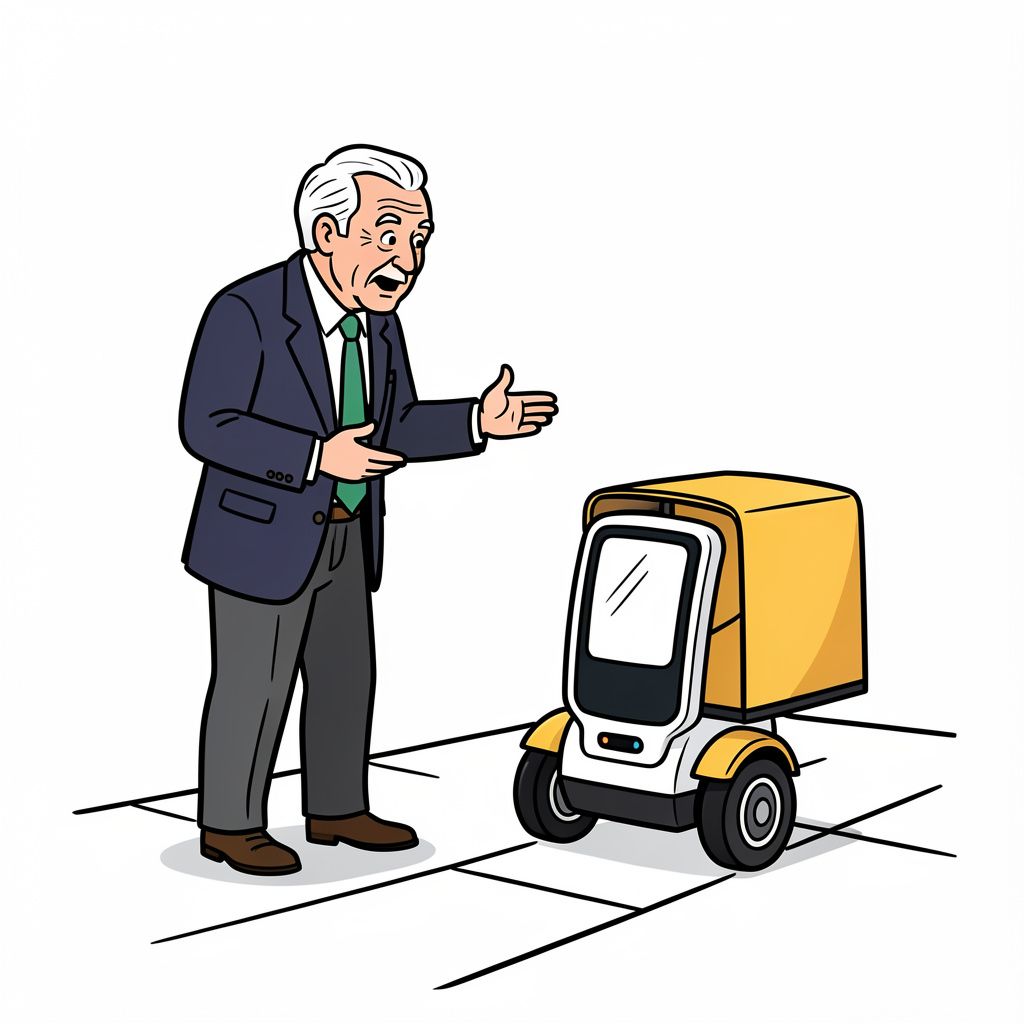
On October 14, 2026, 78-year-old Carolyn Marvin, a retired University of Pennsylvania communications professor and First Amendment scholar, was arrested in Philadelphia for disorderly conduct after she deliberately obstructed an autonomous delivery robot operated by Avride—an incident that underscores escalating tensions over who controls public sidewalks in an era of rapid automation. Marvin’s protest, which she has repeated multiple times in recent weeks, is framed as a challenge to Pennsylvania’s 2020 law classifying autonomous delivery robots as pedestrians, granting them the same sidewalk rights as human walkers. Her argument rests on the assertion that her actions constitute protected free speech under the First Amendment, a claim she intends to litigate as she fights the disorderly conduct citation issued by Philadelphia police following reports of ‘criminal mischief involving a robot’ [1][3][8]. Marvin’s position reflects broader concerns about corporate encroachment on public spaces, the displacement of gig-economy workers, and the unchecked expansion of automated technologies into urban infrastructure [1][3][8].
A City Divided: The Rise of Autonomous Delivery and Public Backlash
Philadelphia’s sidewalk robot ecosystem began in March 2026 when Avride, in partnership with Uber Eats, launched one of the first municipal deployments of autonomous ground delivery robots in the United States. The fleet initially served Center City and Chestnut Street before expanding to include Grubhub and Wonder as additional restaurant partners—marking a rapid acceleration in automated last-mile logistics within a densely populated urban core. By October 2026, the robots, identifiable by their distinctive design and embedded cameras, have become a polarizing presence: some residents see them as a harbinger of innovation and efficiency, while others view them as intrusive machines that obstruct sidewalks, threaten jobs, and erode pedestrian accessibility [4][9]. Social media documentation from September 2026 already showed widespread public engagement with the robots, with users posting videos of encounters in Center City, Old City, and Rittenhouse Square, where small autonomous machines now navigate sidewalks alongside pedestrians [7][9]. The expansion coincides with rising incidents of vandalism—robots have been kicked, sat upon, and graffitied—drawing comparisons to hitchBOT, the hitchhiking robot famously destroyed in Philadelphia in 2015. Despite these challenges, Avride has stated that vandalism has not deterred expansion plans, reaffirming commitment to scaling robot delivery in the city [4].
Pennsylvania’s Controversial Law: Pedestrians or Profit Machines?
At the heart of the legal and ethical debate is Pennsylvania’s 2020 legislation—HB 2352—which reclassified autonomous delivery robots not as vehicles, but as pedestrians, conferring on them the same rights and protections under state sidewalk law. The law was passed with bipartisan support but faced opposition from labor unions, disability rights advocates, and municipal governments concerned about sidewalk congestion and accessibility. Critics argued that by granting robots the status of pedestrians, the state had effectively prioritized commercial automation over human needs, creating a regulatory environment where corporations like Avride could deploy fleets with minimal oversight. Marvin’s arrest has reignited criticism of the law, with opponents now calling for its repeal or amendment to explicitly define the rights and limitations of autonomous delivery devices in public spaces [4][8]. Meanwhile, Councilmember Jim Harrity has introduced a proposed bill to tax robot deliveries and rides in driverless vehicles, signaling a potential shift toward municipal revenue generation from automated services that currently operate in a legal gray zone [3].
The Professor’s Protest: Civil Disobedience or Criminal Conduct?
Marvin, a scholar of communication and constitutional law, has framed her repeated interventions as acts of civil disobedience intended to draw attention to what she describes as the ‘privatization of public sidewalks’ and the erosion of human labor in delivery services. She insists that her actions are constitutionally protected speech, stating, ‘I wasn’t impeding any persons. I was impeding a machine,’ and invoking the longstanding right to protest corporate activity in public spaces [1][3][6][8]. Philadelphia police, responding to a report of ‘criminal mischief involving a robot,’ issued multiple commands for her to move before citing her for disorderly conduct—an arrest that Marvin has vowed to challenge in court. Her legal strategy hinges on First Amendment protections, arguing that the sidewalk is a traditional public forum and that blocking a robot is a symbolic act against corporate encroachment. Legal experts, including attorney John Mattiacci, have noted that while personal delivery devices must yield to pedestrians and cyclists in pedestrian areas, the broader question of whether obstructing a robot qualifies as expressive conduct remains untested in Pennsylvania courts [1][6]. Marvin’s case, therefore, may set a precedent not only for sidewalk robotics but for the scope of protest rights in the age of automation [alert! ‘Marvin’s First Amendment challenge has not yet been adjudicated as of October 31, 2026’].
What Comes Next: Innovation, Regulation, and Public Will
As Philadelphia grapples with the consequences of its robot delivery boom, the city stands at a crossroads between innovation and regulation. Avride’s expansion into partnerships with Grubhub and Wonder suggests that autonomous delivery is not a passing trend but a rapidly growing sector, with potential implications for traffic patterns, sidewalk design, and urban employment. Yet the growing backlash—exemplified by Marvin’s arrest and the introduction of tax legislation—indicates that public tolerance may be wearing thin. The proposed robot tax, if enacted, could serve as a model for other cities seeking to monetize automated services while addressing concerns about equity and accessibility. Meanwhile, Marvin’s ongoing protests, though sporadic, have galvanized local activists and drawn national attention to the broader debate over who governs public space in the 21st century. Whether through litigation, legislation, or public pressure, Philadelphia’s delivery robots are no longer just a novelty—they are a catalyst for redefining the boundaries of urban life, labor, and liberty [3][4][8].
Sources
- www.cnn.com
- www.uppermichiganssource.com
- www.facebook.com
- philadelphia.today
- www.facebook.com
- www.instagram.com
- www.kptv.com
- www.instagram.com
- philadelphia.today