Trump Demands Fort Knox Audit, Sparking Push to Verify America's Gold Reserves
Washington, Sunday, 31 May 2026.
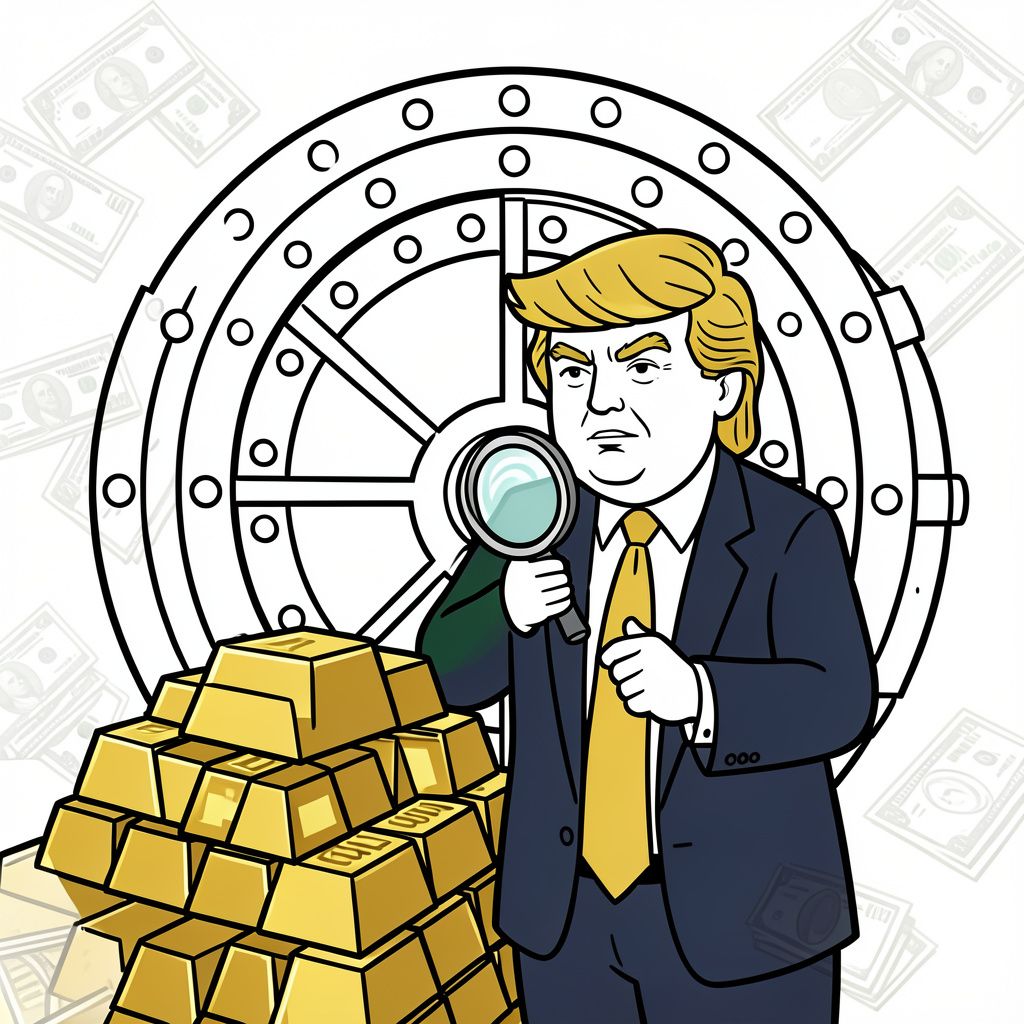
Amid reports of an ex-CIA official’s $40 million gold plot, President Trump’s demand for a Fort Knox audit has triggered an urgent legislative push to verify America’s reserves.
A Presidential Push for Transparency
On May 30, 2026, the Sound Money Defense League formally urged the United States Congress to act on pending transparency legislation following a direct demand from President Donald Trump [1]. Taking to Truth Social, the Republican leader proclaimed that it was “TIME TO AUDIT FORT KNOX,” a statement that followed bizarre reports of a former Central Intelligence Agency official being discovered with $40 million in clandestine gold bars [1][4]. This social media declaration amplified remarks President Trump made earlier in May 2026 during an appearance on Full Measure with Sheryl Attkisson, where he openly questioned whether the nation’s gold remained secure [1]. “I want to see if the gold is there, which I’m sure it will be,” he stated, highlighting a growing political intent to verify America’s foundational monetary assets [1].
The Gold Reserve Transparency Act Explained
To address these systemic concerns, Republican lawmakers have advanced the Gold Reserve Transparency Act, designated as S. 3218 and H.R. 3795 [1]. Sponsored by Representative Thomas Massie in the House and Senator Mike Lee in the Senate, the proposed legislation was officially referred to committee for consideration on May 28, 2026 [5]. If enacted, the bill would mandate the Comptroller General to hire an independent, third-party auditor to conduct a comprehensive physical inventory, purity assay, and security review within nine months of the bill’s passage [5]. The audit would span multiple highly secure locations, including Fort Knox, United States Mint facilities, and the Federal Reserve Bank of New York [5].
Geopolitical Context and Sound Money Momentum
The push for a physical audit arrives at a critical juncture in global monetary policy [GPT]. Stefan Gleason, president of Money Metals Depository, emphasized that with central banks worldwide stockpiling gold at unprecedented rates, verifying America’s gold is a matter of paramount national security [1]. This international context is further complicated by shifting dynamics in other precious metals; for instance, silver was recently added to the United States Critical Minerals List amid record strategic imports by China [2]. Against this backdrop, economists like Judy Shelton have even floated proposals that would link long-term Treasury bonds to a verified Fort Knox audit, illustrating how foundational these assets remain to macroeconomic strategy [2].
The Path Forward for American Monetary Policy
The necessity of the Gold Reserve Transparency Act is bolstered by historical discrepancies in official record-keeping [1]. Money Metals analyst Jan Nieuwenhuijs has previously documented significant shortcomings in past government audits, pointing to broken vault seals, gold bar movements that occurred without full re-inventories, and generally incomplete documentation [1]. These historical lapses have fueled unverified theories that the nation’s gold may be missing, overstated, secretly sold, or heavily rehypothecated through international agreements and central bank swaps [5].