Tech Giants Build Private Natural Gas Plants to Bypass Strained Public Grids
Austin, Saturday, 21 February 2026.
Driven by AI demands, companies are constructing private power stations; notably, a single Texas project requires generation capacity comparable to the entire city of Chicago.
The Rise of the ‘Shadow Grid’
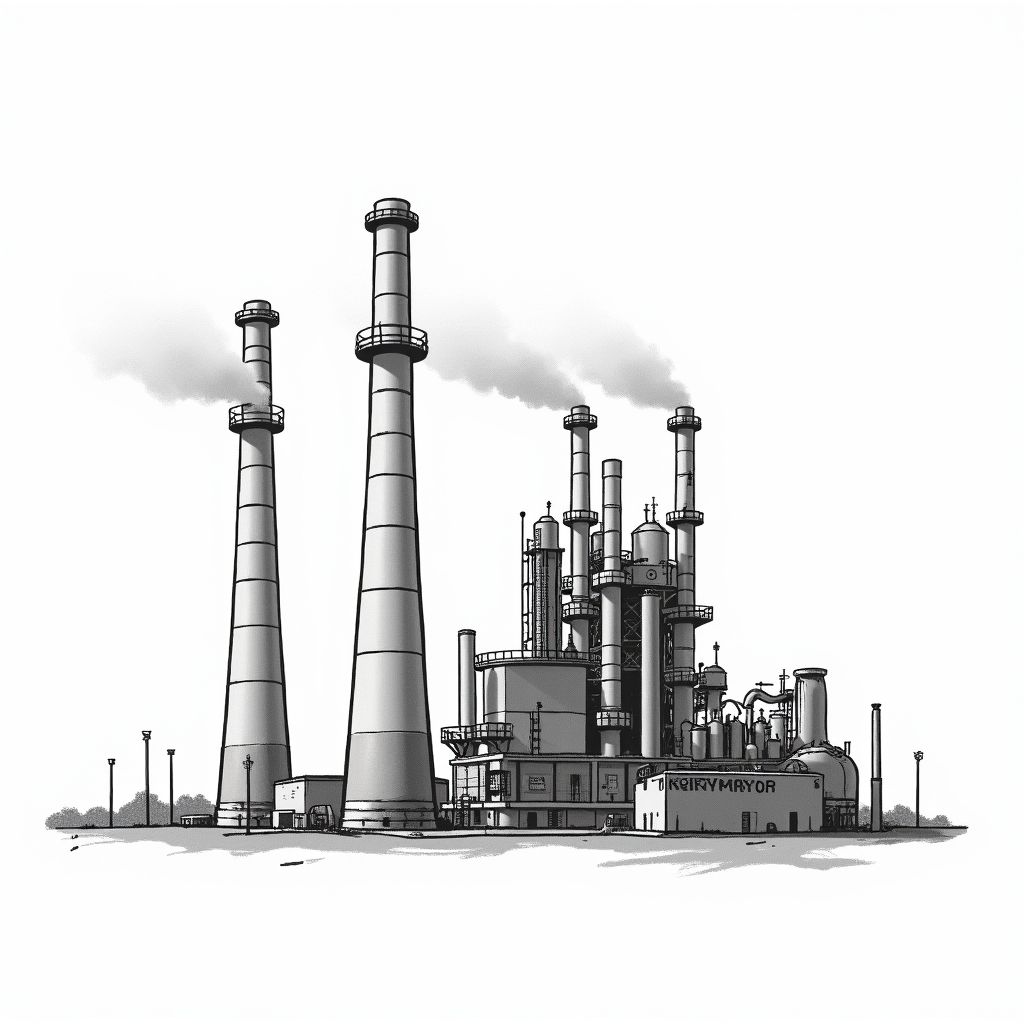
As artificial intelligence accelerates demand for electricity, technology giants are increasingly decoupling from public utilities to establish what industry observers call a “Shadow Grid.” As of February 2026, at least 47 data center buildouts across the United States are circumventing traditional grid connections in favor of private power generation [1]. This shift is exemplified by the GW Ranch project in West Texas, a massive facility combining natural gas and solar arrays that is reported to require as much power as the entire city of Chicago [1][2]. Similarly, in Mason County, West Virginia, projected gas demand for data center infrastructure is sufficient to serve 1.5 million residences, a figure that could potentially quadruple to cover every home in the state [1]. This rush to secure independent power has depleted the market for critical machinery; natural gas turbines are reportedly sold out through 2030, forcing companies to scramble for older equipment or portable generators to meet immediate needs [1].
Major Players and Strategic Shifts
The push for energy independence is led by major technology firms including Meta, OpenAI, and Oracle, which are planning dozens of off-grid projects across states such as Texas, New Mexico, and Ohio [2]. Operational continuity has become the primary driver; for instance, xAI previously utilized portable gas generators for a data center in Memphis to bypass grid delays, a move that subsequently drew scrutiny from the EPA regarding emissions violations [2]. Looking further ahead, industry leaders are exploring advanced propulsion and nuclear solutions. Sam Altman of OpenAI has invested in Boom Supersonic to adapt jet engine technology for data centers, while companies simultaneously pour capital into Small Modular Reactors (SMRs) and fusion research to secure long-term, carbon-free baseload power [1][2].
The Interconnection Bottleneck
The pivot to private generation is a direct response to a paralyzed public grid interconnection process. In the ERCOT (Electric Reliability Council of Texas) region alone, interconnection requests in the large-load queue have surged by 269% year-over-year as of February 17, 2026, totaling more than 233 GW of potential demand [3]. Data centers now dominate this backlog, accounting for approximately 77% of all requests [3]. This congestion has turned the interconnection queue into one of the most significant barriers to energy transition and reliability, creating systemic backlogs across major grid operators including SPP and MISO [4]. While renewable capacity is growing—highlighted by Clearway’s February 18, 2026, commissioning of a $685 million solar-plus-storage hub in Texas—the pace of public grid expansion cannot match the immediate velocity of AI infrastructure deployment [5].
Environmental Costs and Local Pushback
The environmental implications of this fossil-fuel-heavy “Shadow Grid” are drawing sharp criticism. Michael Thomas, founder of Cleanview, has described the trend as “catastrophic for climate goals,” noting that gas turbines operate with significant downtime and lower efficiency compared to centralized plants [1][2]. Beyond carbon emissions, local communities are increasingly resisting the resource intensity of these facilities. In Texas, concerns over water consumption and energy stability have led to political action; the State Republican Executive Committee passed a resolution in February 2026 calling for a pause on “open loop” data centers, and State Rep. David Cook has committed to filing legislation to address these developments [7]. Residents in towns like Harlingen and College Station have opposed projects due to fears that data centers will monopolize local water supplies while offering limited long-term employment [7].
Economic Realities
The economic argument for these massive developments is also facing scrutiny. While construction phases offer temporary employment, operational data centers are not labor-intensive; the Government of Virginia estimates a typical facility employs only about 50 people [6]. Furthermore, tax incentives designed to attract these projects often result in minimal return on investment for the public. An audit in Virginia revealed that for every dollar of sales tax revenue forgone to attract data centers, the state generated only 48 cents in new revenue [6]. As the “Shadow Grid” expands, the disparity between the private benefits of AI infrastructure and the public costs to local resources and climate targets is becoming a defining economic conflict of 2026.
Sources
- www.tomshardware.com
- mumbaimirror.indiatimes.com
- www.yesenergy.com
- www.linkedin.com
- list.solar
- www.policyalternatives.ca
- www.governing.com