Supreme Court Pauses Fast-Track Order on Lower Political Television Ad Rates
Washington, Thursday, 8 October 2026.
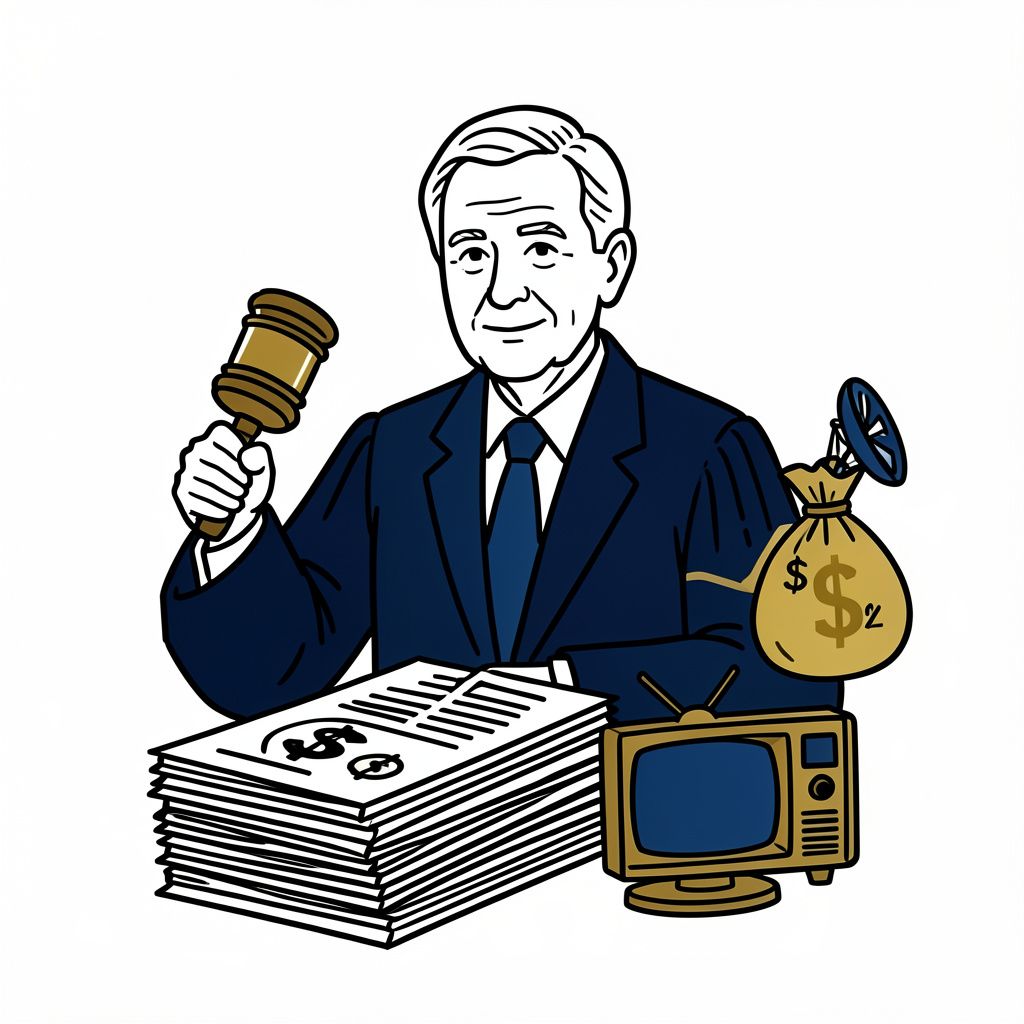
Chief Justice John Roberts paused a deadline forcing federal regulators to review discounted political ad rates, preserving cheap advertising access for cash-heavy party committees ahead of November elections.
Chief Justice Roberts Issues Temporary Stay
On Thursday, 8 October 2026, Chief Justice John Roberts issued a temporary stay halting a deadline that would have required the Federal Communications Commission to rule on a Democratic challenge regarding television ad pricing rules [1][4]. The stay prevents a 4th Circuit Court of Appeals order from taking effect, which had mandated the FCC to finalize its review by noon on Friday, 9 October 2026 [5][7]. This legal intervention preserves the current policy allowing political party committees to access lower advertising rates typically reserved for individual candidates [1][5]. The Trump administration requested the stay through the Supreme Court’s emergency docket, arguing the lower court’s deadline was an abuse of process [1][6]. Chief Justice Roberts ordered the Democratic challengers to submit a response by 5 p.m. on Saturday, 10 October 2026 [4][5].
Dispute Over Lowest Unit Charge Rates
The core legal battle concerns the interpretation of federal mandates requiring broadcast stations to offer their lowest-available advertising rate to campaigns in the 60 days preceding a general election [1][5]. While individual candidates are universally agreed to qualify for this discount, the eligibility of political parties and joint fundraising committees remains contested [1][4]. In March 2026, the FCC Media Bureau issued guidance extending these rates to party committees, a move challenged by Democratic candidates including North Carolina’s Roy Cooper [5][7]. The Supreme Court previously ruled on 4 September 2026 that Democrats must wait for the FCC to rule on their challenge before pursuing litigation, though the FCC had not yet completed this review [1][5]. The 4th Circuit had accused the agency of dragging its feet, leading to the expedited deadline now stayed by Chief Justice Roberts [1][5].
Financial Stakes for Political Committees
The outcome of this dispute carries significant financial implications for media networks and political campaign spending ahead of the upcoming midterm elections [1][7]. Following a June 2026 Supreme Court ruling that struck down coordinated spending limits, Republican committees exceeded former national caps by over $48 million in July and August 2026 [7]. In comparison, Democratic counterparts exceeded the limits by just under $4 million during the same period [7]. As of the end of August 2026, national Republican committees held approximately $233 million in cash, while Democratic counterparts held roughly $130 million [7]. The cash advantage held by Republican committees amounts to 103 million dollars, providing greater flexibility in purchasing advertising inventory [7]. Democratic committees also carried nearly $18 million in debt at that time, further constraining their spending capacity [7].
Judicial Timeline and Next Steps
The procedural history involves multiple layers of judicial review spanning several months in 2026 [5][7]. On 25 August 2026, a 4th Circuit panel ruled 2-1 in favor of Democrats, challenging the FCC’s March 2026 notice [5]. However, on 4 September 2026, the Supreme Court issued an 8-1 stay blocking that ruling, citing potential jurisdictional issues [5][7]. The recent 4th Circuit writ of mandamus on 7 October 2026 was issued by a 2-1 vote, accusing the FCC of gamesmanship to evade judicial scrutiny before the 3 November 2026 election [5][7]. Solicitor General John Sauer characterized the 4th Circuit’s order as a “flagrant abuse” of the extraordinary writ of mandamus [5][8]. The Supreme Court’s stay remains in effect pending further order, leaving the policy allowing party committees to access cheaper rates in place with 26 days remaining until the midterms [1][5].
Sources
- thehill.com
- www.facebook.com
- electionlawblog.org
- www.nytimes.com
- www.carolinajournal.com
- news.bloomberglaw.com
- wtaq.com
- www.law.com