Key Report Supporting Australia's Social Media Ban Contained Fake AI Sources
Canberra, Monday, 17 August 2026.
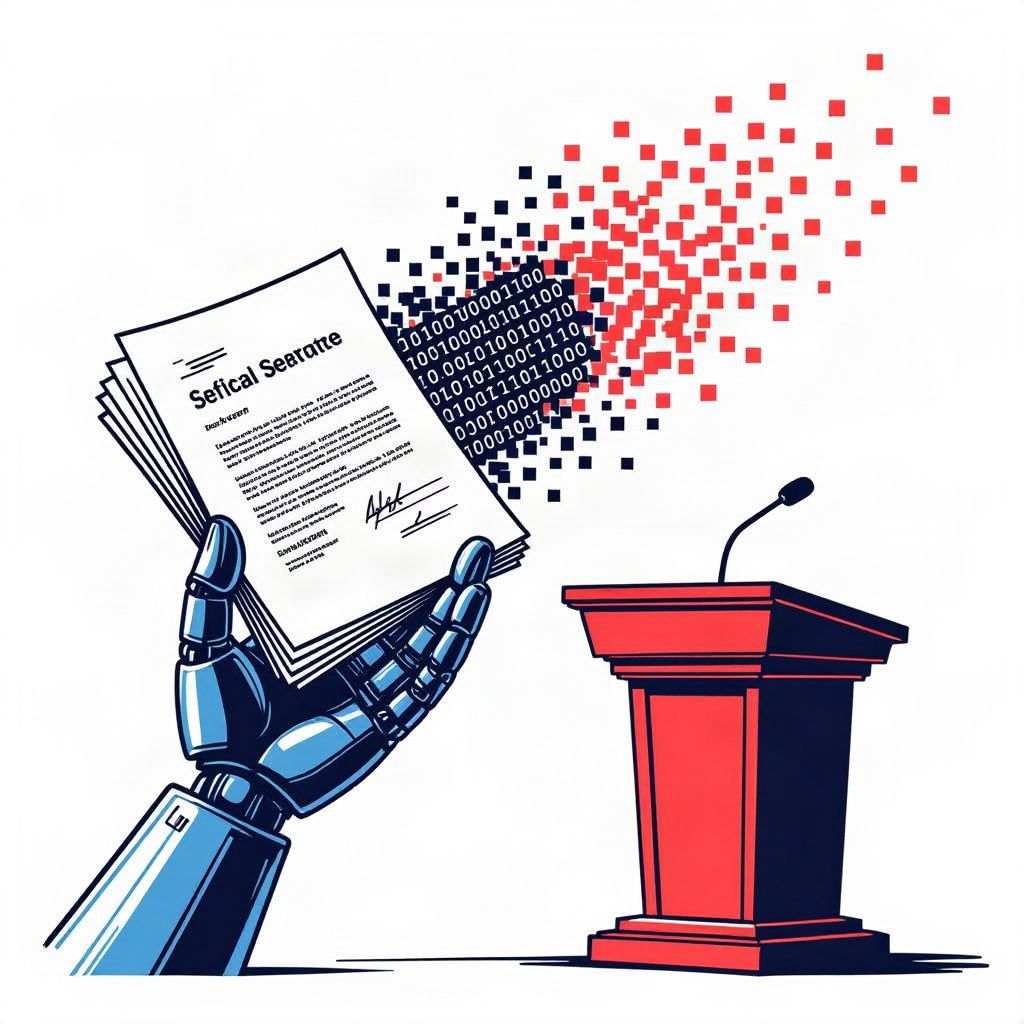
A UK firm admitted using AI to edit a report supporting Australia’s teenage social media ban, which led to non-existent academic citations being presented to a Senate inquiry.
Senate Inquiry Reveals AI Hallucinations in Policy Report
Australia’s landmark proposal to restrict social media access for teenagers faces intense legislative scrutiny after a key evidentiary report presented to the Senate was found to contain apparent AI-generated hallucinations [1]. A media analysis revealed that several academic citations within the supporting documentation do not exist, raising serious regulatory and policy concerns regarding the reliance on generative AI tools in crafting federal technology governance and tech platform compliance mandates [1]. The Age Check Certification Scheme (ACCS), a UK-based firm, conceded in August 2026 that ChatGPT was used to edit its $3.48 million age assurance technology trial report, following allegations of AI-generated citation errors revealed by a Senate inquiry submission [1]. The report, published in August 2025, evaluated age-verification technologies to support Australia’s under-16 social media ban, which took effect in December 2025 [1]. Guardian Australia analysis identified six erroneous references in the report’s “emerging technologies” chapter, including non-existent Digital Object Identifiers (DOIs), mismatched author and journal data, and inaccurate summaries of cited research [1]. A lead author of a cited study confirmed that the ACCS report incorrectly listed the lead author as “Jamil” and claimed the paper was accessed in March 2025, despite the study not being publicly accessible until June 2025 [1].
Government and Contractor Responses to Citation Errors
During a Senate inquiry hearing on Friday, 14 August 2026, Department of Social Services officials stated they met with ACCS regarding the errors, which ACCS attributed to broken links [1]. Officials noted they have not independently verified this claim, deeming it “very difficult” to audit a 1,000-page report [1]. ACCS provided a list of corrected journal citations to the Guardian, but these contained further errors, including incorrect years, authors, and journal titles [1]. An ACCS spokesperson stated, “We did not use AI in the generation of the report or the cited materials … Each one of them were checked as genuine links and reports and that they were relevant to the specific issue being cited” [1]. However, a Senate inquiry submission noted that citations appear to be AI hallucinated, rather than being based on real sources [1]. This incident follows a similar occurrence in October 2025, where Deloitte refunded part of a $440,000 government contract after admitting to using AI in a report that contained errors [1]. Independent Senator Fatima Payman remarked that the saga of last year’s Deloitte AI report should have marked the end of slack referencing in reports by government contractors [1].
Tech Platform Compliance and Penalty Enhancements
While the report controversy unfolds, tech giants including Meta, TikTok, Google, and Snapchat testified before a Senate committee in Canberra regarding the Online Safety Amendment (Strengthening Enforcement for the Social Media Minimum Age) Bill 2026 [5]. Platforms admitted they lack the ability to verify the number of users under 16 remaining on their services, as existing compliance systems only track account removals rather than performing population audits [5]. Meta reported deactivating 756,000 accounts, though they cannot quantify the total number of under-16 users still present [5]. The proposed bill aims to increase the maximum civil penalty for systemic non-compliance to AUD $99 million, representing a 100 percent increase from the current AUD $49.5 million [5]. As of 13 August 2026, the eSafety Commissioner has issued 23 information-gathering notices to 10 platforms, with five platforms currently under investigation for systemic non-compliance [5]. The Senate committee examining the bill is scheduled to deliver findings on 25 August 2026 [5].