Conservative Fractures Over Iran Conflict Ignite New Economic and Foreign Policy Risks
Washington, D.C., Friday, 10 April 2026.
President Trump’s unprecedented clash with prominent conservative commentators over the Iran war exposes deep political fractures, introducing critical uncertainties for global markets and U.S. foreign policy stability.
A Right-Wing Schism Over Middle Eastern Strategy
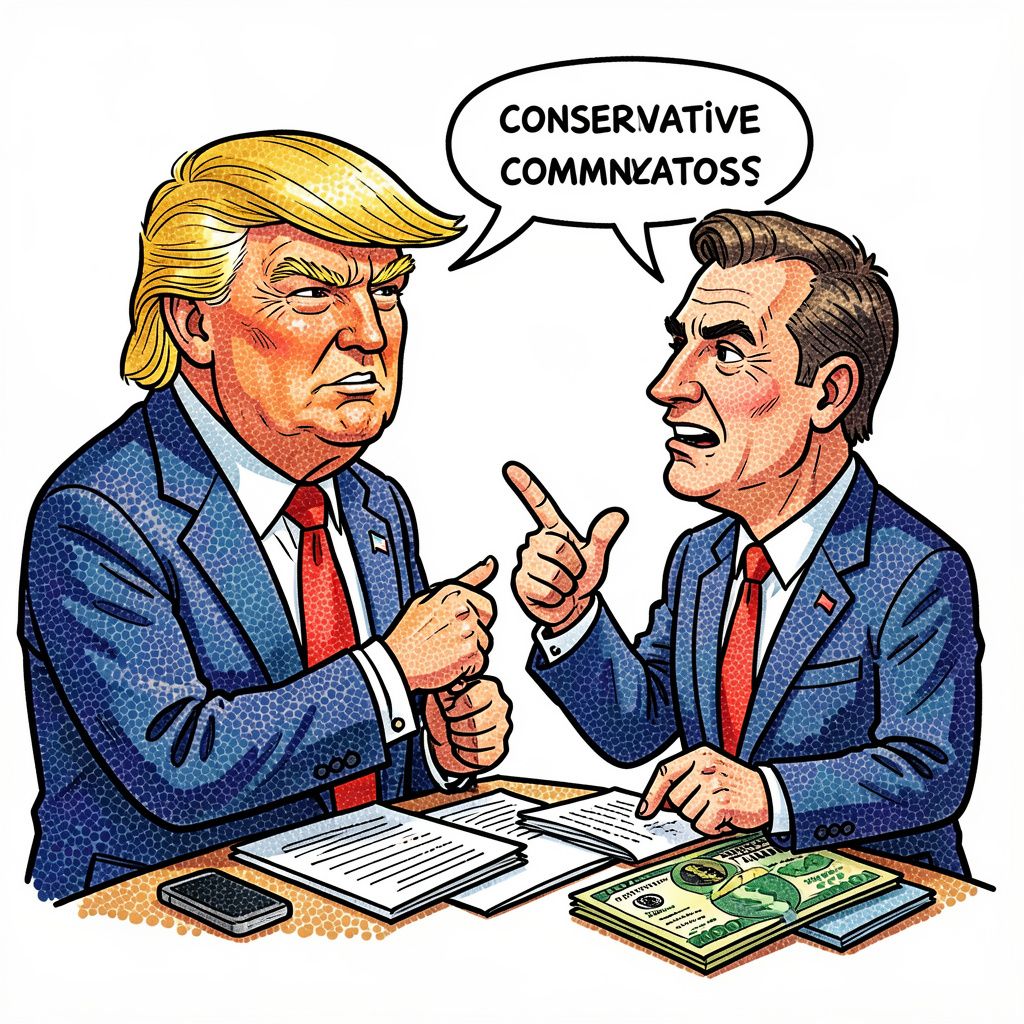
Between April 2 and April 8, 2026, President Donald Trump unleashed a barrage of insults on his Truth Social platform, targeting prominent conservative figures who have openly criticized his military campaign in Iran [1][3]. Trump directed his ire at commentators Tucker Carlson, Megyn Kelly, Candace Owens, and Alex Jones, labeling them “NUT JOBS,” “TROUBLEMAKERS,” and “LOSERS” who host “Third Rate Podcasts” [1][2][3]. The public feud escalated when Trump hurled deeply personal attacks, mocking Carlson as a “Hand Flailing Fool” who failed to graduate from college, referencing Kelly’s questioning during the 2016 election cycle, and deriding Owens’ physical appearance [1][3]. The rift expanded into the political sphere when Trump branded Representative Marjorie Taylor Greene as “Marjorie ‘Traitor’ Brown” [1].
The Economic and Strategic Toll of the Conflict
Beyond the domestic political theater, the underlying conflict presents a complex matrix of military and economic realities. On April 7, 2026, Trump announced a two-week suspension of bombing operations to allow for negotiations, declaring a “Total and complete victory” [4]. Defense Secretary Pete Hegseth echoed this sentiment, stating that “Operation Epic Fury” had decimated the Iranian military [4]. According to military officials, U.S. and Israeli forces struck over 13,000 targets, successfully destroying 90% of Iran’s naval fleet and weapons factories, alongside 80% of its air defense systems [4]. The human cost includes 13 U.S. military personnel killed and an estimated 1,665 Iranian civilian casualties, of which children account for approximately 14.895% [4].
Ceasefire Chaos and Media Clashes
The fragility of the April 7 ceasefire became immediately apparent. On April 8, 2026, the very first day of the diplomatic pause, Iran launched missiles and drones across the region, striking at least five Gulf Arab nations and reporting an attack on its own Lavan Island oil refinery [6]. The administration’s struggle to control the narrative surrounding the ceasefire has also sparked conflicts with mainstream media. When CNN reported on an Iranian Supreme National Security Council statement claiming a “crushing defeat” for the United States, Trump demanded an immediate retraction and full apology, claiming authorities were investigating the network [8].
Assessing the Long-Term Geopolitical Fallout
For financial markets and international observers, the combination of internal U.S. political fractures and an unstable Middle Eastern ceasefire presents a volatile outlook. The financial burden of the conflict is already mounting, with the U.S. and its allies facing significant expenses to rebuild depleted stocks of interceptors and long-range munitions [4]. More alarmingly, experts warn that the conflict may inadvertently accelerate global nuclear proliferation. As analysts point out, Iran was targeted precisely because it lacked a nuclear deterrent—a stark lesson that other nations are currently evaluating [4]. As the U.S. navigates this tenuous two-week negotiation window, the deep divisions within the conservative movement suggest that the administration’s foreign policy will face as much scrutiny from its traditional allies as it does from its adversaries [1][3][GPT].
Sources
- www.rollingstone.com
- komonews.com
- variety.com
- www.pbs.org
- www.bbc.com
- www.nytimes.com
- www.facebook.com
- www.thedailybeast.com