Global Oil Price Spike Shields Canada From United States Trade Tariff Damage
Ottawa, Monday, 14 September 2026.
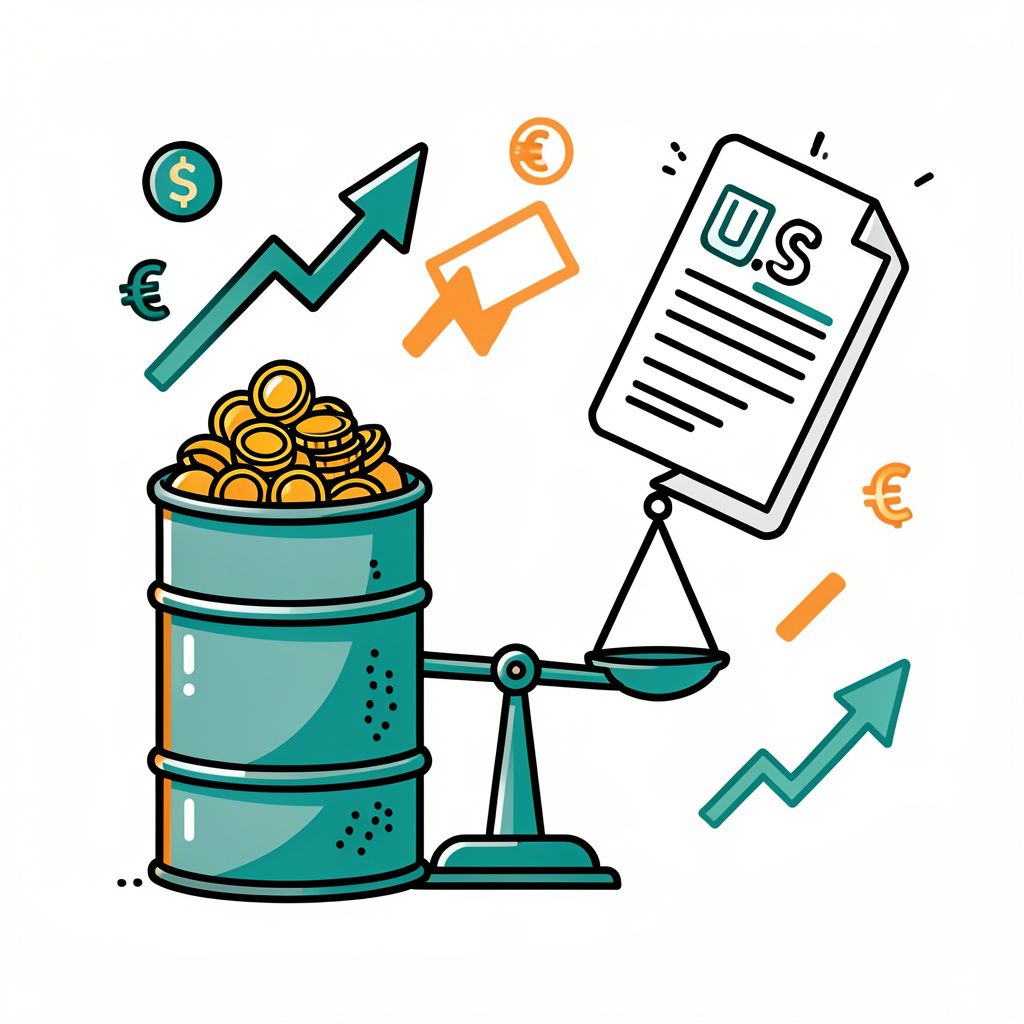
Middle East supply disruptions pushed crude past $100 per barrel in September 2026, generating energy revenues that fully offset Canada’s economic losses from new United States trade tariffs.
Global Oil Price Spike Shields Canada From United States Trade Tariff Damage
Middle East supply disruptions pushed crude past $100 per barrel in September 2026, generating energy revenues that fully offset Canada’s economic losses from new United States trade tariffs [1]. An economic analysis indicates that Canada’s projected GDP losses of roughly 0.5 percent due to newly proposed United States tariffs may be offset by surging global crude prices [1]. With crude returning to over $100 per barrel driven by Middle Eastern conflict and supply chain disruptions, energy-exporting revenues are set to bolster Canada’s fiscal outlook, providing a crucial buffer for North American trade dynamics [1].
Global Oil Price Spike Shields Canada From United States Trade Tariff Damage
The total cost of Trump’s tariffs to Canada’s GDP is estimated at about 0.5 per cent, a figure that could well be outweighed by the positive effects of oil topping $100 US per barrel [1]. U.S. President Donald Trump has implemented tariffs targeting approximately $27.6 billion in Canadian products, utilizing Section 338 of the Tariff Act of 1930 [1][2]. These measures became effective August 19, 2026, following the decline of the United States-Mexico-Canada Agreement (USMCA) renewal on July 1, 2026 [2].
Economic Offset Mechanisms
Analysts estimate total U.S. tariffs cost Canada’s GDP between $10 billion and $20 billion annually, representing 0.3% to 0.6% of economic output [1]. Conversely, oil at $100 US per barrel compared to $80 is projected to increase Canadian GDP by $16 billion to $32 billion, representing 0.5% to 1.0% growth [1]. Every $10 increase in the price of a barrel of oil provides roughly $2 billion in additional federal revenue, suggesting significant fiscal relief [1].
Economic Offset Mechanisms
Based on the price rebound from $72 US in late July 2026 to nearly $110 US on September 11, 2026, the potential revenue increase is substantial [1]. The calculation for additional federal revenue based on this price surge is approximately 7.6 billion [1]. Oil futures remain at $100 US per barrel through the end of 2026, stabilizing the projection for the remainder of the fiscal year [1].
Geopolitical Drivers of Volatility
High prices that declined over the summer are back as peace recedes, and recent successes by Iran’s Houthi allies suggest that high prices are here to stay [1]. On Wednesday, September 9, 2026, Houthi rebels seized the port city of Mokha, Yemen, escalating regional tensions [1]. On Thursday, September 10, 2026, Houthi forces captured the strategic Perim Island in the Bab al-Mandab strait, threatening Saudi oil maritime routes [1].
Geopolitical Drivers of Volatility
Also on September 10, 2026, drone strikes, potentially launched by Iraqi militias, hit the Saudi Petroline pipeline, halting oil flow to the Red Sea and threatening a global supply of 7 million barrels per day [1]. Brent crude oil prices rose to nearly $110 US upon market opening on September 11, 2026, rebounding to levels seen during the earlier Hormuz crisis [1]. This contrasts with prices that had dipped to $72 US by July 31, 2026, before rising again due to renewed hostilities [1].
Regional Fiscal Shifts and Outlook
Rising oil revenues have significantly improved provincial finances, with Alberta shifting from a projected $9.4-billion deficit to a $2-billion surplus [1]. Newfoundland and Labrador expects a $500-million increase in government revenues, reducing its projected $668-million deficit [1]. Finance Minister Craig Pardy noted regarding the upswing in oil, stating 500 million plus to our coffers as a result [1][3].
Regional Fiscal Shifts and Outlook
Canada implemented a 50 percent retaliatory tariff on U.S. goods on September 5, 2026, matching U.S. tariffs dollar for dollar [2]. While the U.S. is set to ban most Canadian-made alcohol imports on September 29, 2026, the energy sector remains a critical leverage point [3]. Prime Minister Mark Carney’s office released a video on September 8, 2026, stating U.S. trade negotiators sought increased Canadian reliance on the U.S., highlighting the strategic importance of energy independence [1].