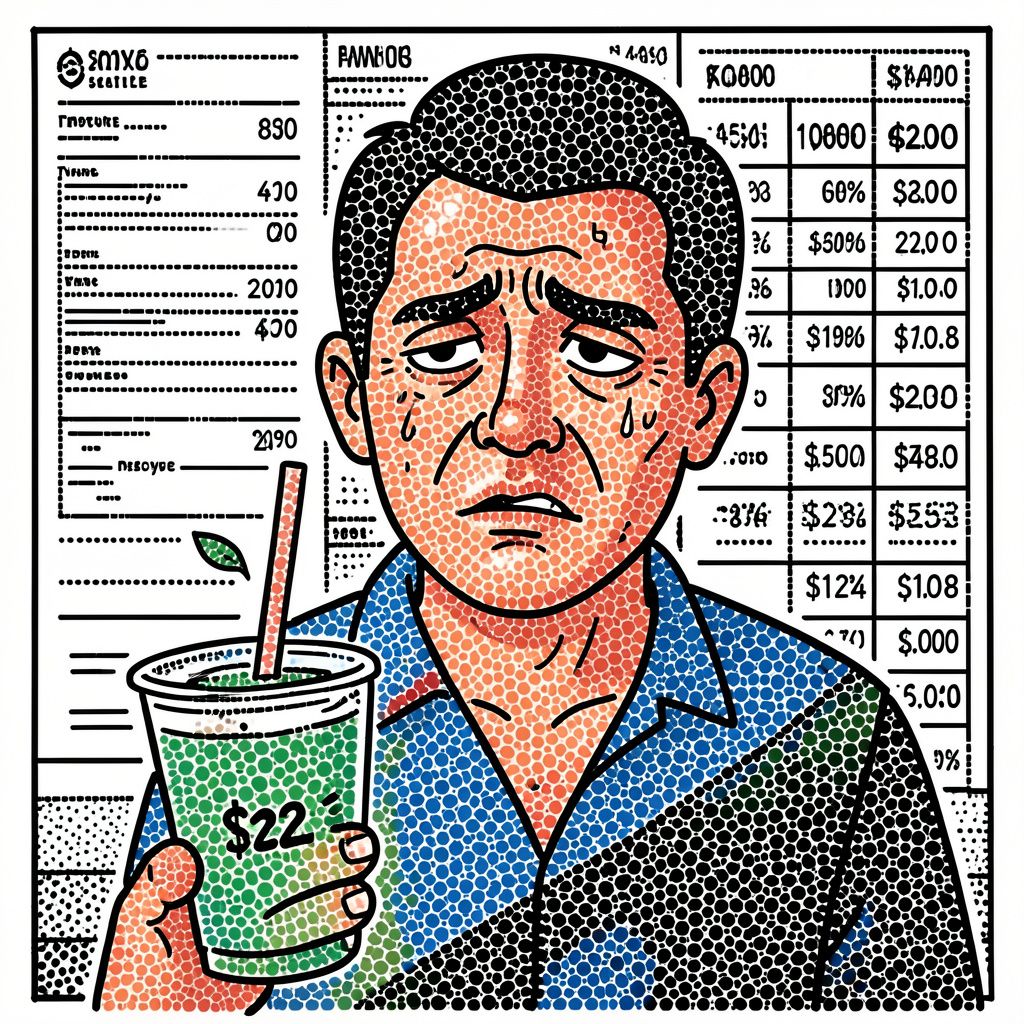
The Rise of Small Luxuries: Why Economic Stress is Driving Sales of $22 Smoothies
Los Angeles, Friday, 10 April 2026.
Amid early 2026 economic anxiety, Americans are abandoning major purchases for $22 smoothies. This modern “lipstick effect” reveals consumers using premium daily treats to regain control.
Running on Fumes: The Macroeconomic Reality
To understand why consumers are prioritizing premium groceries over traditional big-ticket items, one must first examine the broader macroeconomic landscape of early 2026. According to Gregory Daco, Chief Economist at EY-Parthenon, American households are “increasingly running on fumes” [3]. While nominal consumer spending rose by a seemingly healthy 0.5% month-over-month in February 2026, real spending—adjusted for price increases—eked out a mere 0.1% gain [3]. Furthermore, inflation-adjusted disposable income dropped by 0.5% during the same period, forcing consumers to draw down their savings to sustain their lifestyles [3]. The personal saving rate has plummeted to 4.0%, down from 4.5% the previous month, tying it for the lowest level recorded since 2008 when excluding post-pandemic anomalies [3].
The Modern ‘Lipstick Index’ and Premium Food
With major purchases out of reach or deemed too financially risky, consumers are engaging in what psychologists call “compensatory consumption” [1]. This behavioral phenomenon occurs when individuals feel they have lost control over significant life aspects and, in response, seek agency through smaller, attainable luxuries [1]. Historically, this was observed as the “lipstick index,” a term coined by Estée Lauder Chairman Leonard Lauder in 2001 after lipstick sales surged by 11% following the September 11 attacks [1]. Today, however, premium food has become the preferred medium for this coping mechanism [1]. Since 2019, food prices have surged by nearly 30%, outpacing the 23% increase in overall consumer prices measured by the Bureau of Labor Statistics—a gap of 7 percentage points [1]. Despite this inflationary pressure, the U.S. specialty food market has boomed, surpassing $219 billion, which represents a growth of nearly 150% over the past decade [1].
Gen Z and the Institutionalization of Treat Culture
This shift toward micro-luxuries is particularly pronounced among younger demographics, who have institutionalized the habit into what is colloquially known as “treat culture” [2]. A Bank of America report from late July 2025 revealed that 57% of Generation Z consumers purchase a small treat for themselves at least once a week [2]. However, this frequent indulgence comes at a cost: nearly 60% of Gen Z individuals admit to overspending as a result of these micro-transactions [2]. A separate study by Credit Karma found that Gen Z increasingly views historically non-essential purchases, such as premium skincare and streaming services, as absolute necessities, with more than half prioritizing their hobbies over long-term financial goals [2]. For many younger consumers facing climate anxiety, economic instability, and social upheaval, these small purchases serve as a vital coping mechanism to reclaim agency and ground themselves in the present [2].
Navigating Future Inflationary Pressures
Looking ahead through the remainder of 2026, the economic pressures driving this behavior are expected to intensify. Inflationary metrics reaccelerated in February 2026, with both headline and core Personal Consumption Expenditures (PCE) [GPT] prices rising by 0.4% month-over-month [3]. Year-over-year, headline PCE inflation held steady at 2.8%, while core inflation eased slightly to 3.0% [3]. However, Daco warns that an impending energy shock driven by Middle East tensions, combined with rising food prices, is projected to push headline PCE inflation toward 4% [3]. Consequently, EY-Parthenon has revised its year-end 2026 forecast upward, anticipating headline PCE to settle at 3.0% year-over-year and core PCE to end the year around 2.8% [alert! ‘The forecast anticipates a temporary spike toward 4% before settling at the revised 3.0% year-end target’] [3]. With job growth stagnating near zero and wage growth easing, consumers will likely continue to rely on tighter budgeting, cementing the premium smoothie as one of their few remaining accessible luxuries in a volatile economy [3].