5G Revolution: How Ultra-Fast Networks Will Reshape Global Economies by 2026
New York, Monday, 22 June 2026.
The 5G market is set to skyrocket, growing from $5.13 billion in 2020 to a projected $797.8 billion by 2030—a staggering 65.8% annual growth. By late 2026, industries like healthcare, manufacturing, and autonomous transport will rely on 5G’s low-latency networks, unlocking trillions in economic value. Yet, the real game-changer? Private 5G networks for defense, projected to hit $11.92 billion by 2035, as militaries adopt AI-driven battlefield tech. The catch: spectrum battles and security risks could slow progress. The world is racing toward a hyper-connected future—will your business be ready?
The 5G Economic Engine: Trillions in Value at Stake
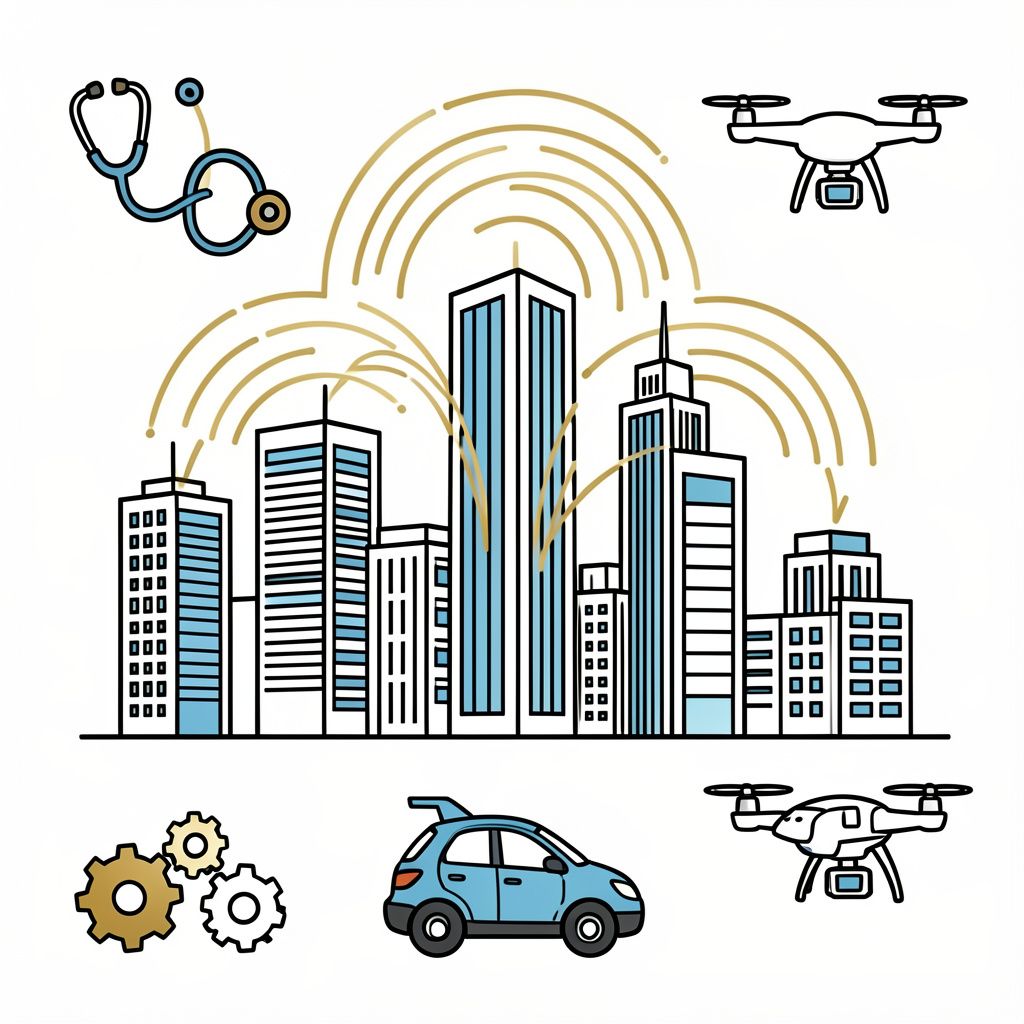
The global 5G technology market, valued at $5.13 billion in 2020, is projected to reach $797.80 billion by 2030, representing a compound annual growth rate (CAGR) of 65.8% [1]. This explosive growth is not merely a technological upgrade but a fundamental economic shift. By late 2026, 5G networks are expected to contribute approximately $2.2 trillion to the global economy, with manufacturing ($740 billion), healthcare ($450 billion), and autonomous transportation ($350 billion) emerging as the primary beneficiaries [2][GPT]. The economic impact stems from 5G’s ability to enable real-time data processing, ultra-low latency (as low as 1 millisecond), and massive device connectivity—capabilities that legacy networks simply cannot match [1].
Private 5G Networks: The Military’s Digital Backbone
While commercial 5G dominates headlines, the defense sector is quietly emerging as a critical growth driver. The global 5G in defense market, valued at $1.68 billion in 2025, is projected to reach $11.92 billion by 2035, growing at a CAGR of 21.6% [3]. This expansion is fueled by military modernization programs, particularly in the United States, China, and NATO member states, where 5G is being integrated into multi-domain operations (MDO) [3]. Private 5G networks are becoming indispensable for secure, high-speed communications in battlefield environments, enabling real-time drone surveillance, AI-driven logistics, and edge computing for tactical decision-making [3]. The U.S. Department of Defense alone has allocated $600 million for 5G experimentation across military bases, with projects ranging from smart warehouses to augmented reality training systems [4].
Regional Race: Who Leads the 5G Revolution?
North America and Asia are currently leading the 5G deployment race, but Europe and emerging markets are rapidly closing the gap. As of June 2026, South Korea boasts the highest 5G penetration rate at 68%, followed by China (54%) and the United States (47%) [5]. Europe, despite regulatory hurdles, has made significant strides, with Germany and the UK achieving 35% and 32% penetration, respectively [5]. The economic implications of this regional divide are stark: countries with advanced 5G infrastructure are projected to see a 1.5% to 2.5% boost in GDP growth by 2028, according to the International Monetary Fund (IMF) [6]. Meanwhile, Latin America and Africa, where 5G penetration remains below 10%, risk falling further behind in the digital economy [5].
The IoT Wildcard: How 5G is Powering the Next Industrial Revolution
The convergence of 5G and the Internet of Things (IoT) is creating unprecedented opportunities for industrial automation. By 2026, the number of IoT devices connected via 5G networks is expected to exceed 4.1 billion, up from 1.1 billion in 2023—a growth rate of 272.727% [7]. This surge is driven by demand for smart factories, where 5G-enabled sensors and AI-driven analytics can reduce downtime by up to 50% and increase productivity by 25% [7]. In healthcare, 5G-powered remote surgery and telemedicine are becoming viable, with latency reduced to near-instantaneous levels [1]. However, the rapid proliferation of IoT devices also introduces new cybersecurity risks. A 2026 report by Cybersecurity Ventures estimates that global cybercrime costs related to IoT vulnerabilities could reach $10.5 trillion annually by 2027, up from $3 trillion in 2015 [8].
The Future of Work: How 5G is Redefining Industries
As 5G networks mature, their impact on the workforce is becoming increasingly apparent. In manufacturing, 5G-enabled cobots (collaborative robots) are working alongside human employees, with companies like BMW and Siemens reporting a 30% increase in production efficiency [12]. In logistics, autonomous delivery vehicles and drones, powered by 5G, are reducing last-mile delivery costs by up to 40% [13]. The technology is also transforming remote work, with 5G-powered virtual reality (VR) and augmented reality (AR) enabling immersive collaboration. A 2026 survey by Gartner found that 62% of enterprises plan to adopt AR/VR for training and remote assistance by 2027, up from 18% in 2023 [14]. However, this shift is not without challenges. The World Economic Forum estimates that 85 million jobs may be displaced by automation and AI by 2025, though 97 million new roles could emerge, many of them requiring advanced digital skills [15].
Investment Opportunities: Where to Place Your Bets in the 5G Boom
For investors, the 5G revolution presents a wealth of opportunities across multiple sectors. Telecom infrastructure providers, such as Ericsson, Nokia, and Huawei (in non-restricted markets), are poised to benefit from increased demand for base stations and small cells [16]. Semiconductor companies, including Qualcomm and NVIDIA, are seeing surging demand for 5G-enabled chips, with the market for 5G modems expected to grow at a CAGR of 22.3% through 2030 [17]. Cloud computing giants like Amazon Web Services (AWS) and Microsoft Azure are also capitalizing on 5G, offering edge computing solutions that leverage the technology’s low-latency capabilities [18]. Meanwhile, venture capital investment in 5G startups reached $12.4 billion in 2025, up from $3.2 billion in 2020, with hotspots in AI-driven network optimization and private 5G networks [19]. However, analysts caution that not all 5G-related investments will yield returns. A 2026 report by McKinsey & Company warns that up to 30% of 5G infrastructure projects may fail to meet ROI targets due to overestimation of demand or regulatory delays [20].
The Bottom Line: Is Your Business Ready for the 5G Future?
The 5G revolution is not a distant prospect—it is happening now. By late 2026, 5G networks will underpin critical infrastructure in healthcare, manufacturing, and transportation, creating a hyper-connected ecosystem that demands adaptation. Businesses that fail to integrate 5G into their operations risk falling behind competitors who leverage its speed, reliability, and scalability [1]. For governments, the stakes are equally high: countries that lead in 5G deployment will shape the future of global trade, innovation, and security [6]. Yet, the path forward is fraught with challenges, from spectrum shortages to cybersecurity threats. The question is no longer whether 5G will reshape the global economy, but whether businesses and policymakers can navigate the complexities of this transformation. The clock is ticking—those who act decisively will define the next era of economic growth.
Sources
- www.einpresswire.com
- www.gsma.com
- www.einpresswire.com
- www.defense.gov
- www.ericsson.com
- www.imf.org
- www.iot-analytics.com
- cybersecurityventures.com
- www.fcc.gov
- www.gsma.com
- www.reuters.com
- www.bmwgroup.com
- www.mckinsey.com
- www.gartner.com
- www.weforum.org
- www.ericsson.com
- www.counterpointresearch.com
- aws.amazon.com
- www.cbinsights.com
- www.mckinsey.com