SpaceX IPO Shatters Records: How a $2.6 Trillion Valuation Reshapes Markets
New York, Friday, 19 June 2026.
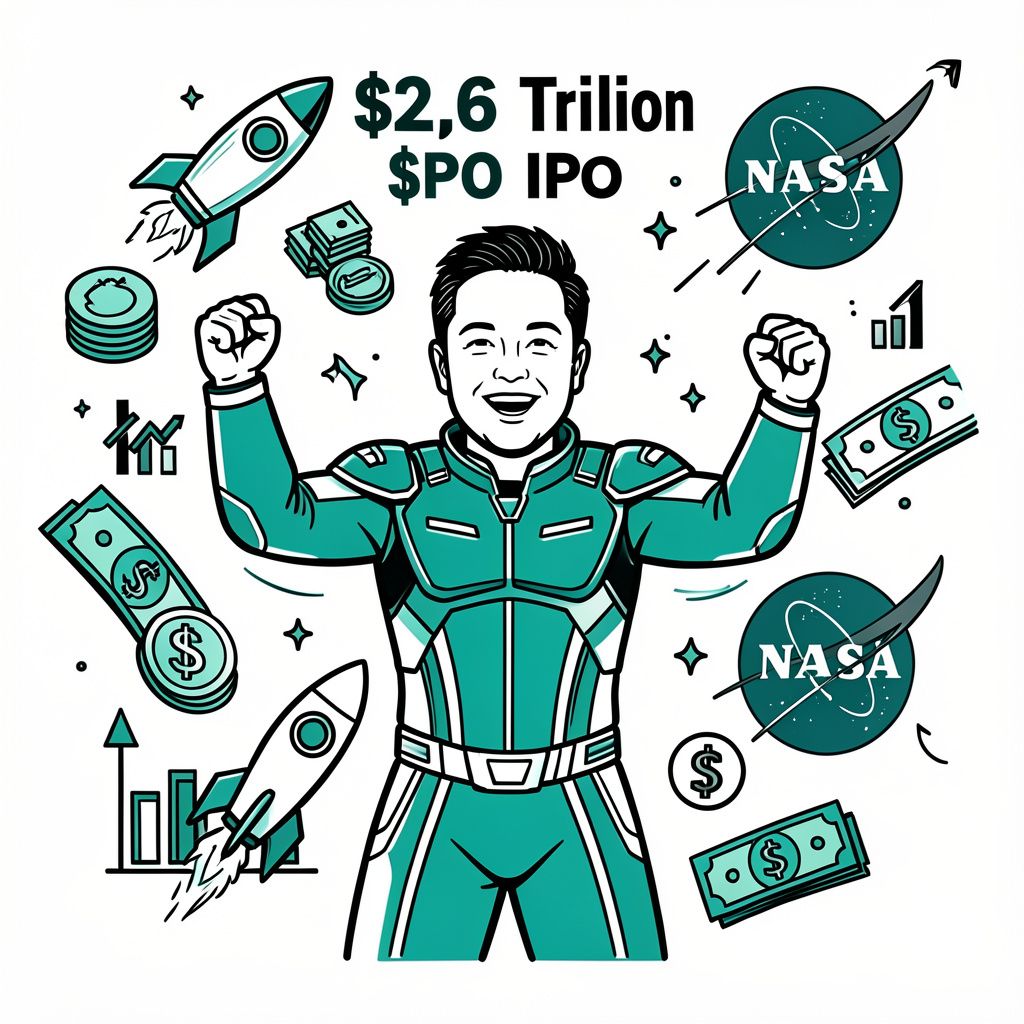
SpaceX’s Nasdaq debut as SPCX on 12 June 2026 marked the largest IPO in history, raising $85.7 billion and catapulting its market cap to $2.6 trillion—briefly surpassing Microsoft. The stock surged nearly 50% in its first week, pushing Elon Musk’s net worth past $1 trillion. This milestone reflects soaring investor confidence in commercial space exploration, but analysts warn of volatility ahead as $200 billion in insider shares unlocks and index funds begin passive buying. The IPO’s ripple effects extend beyond aerospace, signaling a new era for AI infrastructure, satellite internet, and interplanetary travel—while redefining global capital markets.
From Private Venture to Public Titan: The IPO That Changed Everything
SpaceX’s transition from a private aerospace pioneer to a publicly traded behemoth reached its climax on 12 June 2026, when the company debuted on the Nasdaq under the ticker symbol SPCX [1]. The IPO, which raised a record $85.7 billion, didn’t just break financial barriers—it obliterated them. At an initial offering price of $135 per share, SpaceX’s valuation stood at approximately $1.75 trillion 0 [1]. By the close of trading on 16 June, the stock had surged to $202 per share, pushing the company’s market capitalisation past $2.6 trillion 0 and briefly surpassing Microsoft as the world’s fourth-most valuable public company [2]. This meteoric rise reflects not only investor enthusiasm but also the culmination of over two decades of private growth, during which SpaceX revolutionised space transportation and satellite internet [1].
The Green Shoe That Grew Into a Giant
The IPO’s scale expanded dramatically on 16 June, when underwriters Goldman Sachs and Morgan Stanley exercised their ‘green shoe’ option, purchasing an additional 83.3 million shares [3]. This move, typically reserved for stocks demonstrating strong post-IPO performance, increased the total funds raised from $75 billion to $85.7 billion 0 [3]. The green shoe mechanism, named after the Green Shoe Manufacturing Company where it was first used, allows underwriters to stabilise stock prices by buying additional shares at the IPO price. SpaceX employees celebrated this milestone by wearing green shoes to work on 13 June, a gesture Elon Musk shared on X (formerly Twitter) [3]. The additional capital brings SpaceX’s total valuation to approximately $1.77 trillion 0 [3], a figure that underscores the company’s ambition to dominate multiple high-growth sectors simultaneously.
Elon Musk: The World’s First Trillionaire
The IPO’s immediate impact on Elon Musk’s net worth was nothing short of historic. With SpaceX’s valuation soaring past $2.6 trillion, Musk’s 42% stake in the company—valued at approximately $1.1 trillion 0—catapulted him past the $1 trillion net worth threshold, making him the world’s first trillionaire [2][3]. This milestone arrives just eight years after Musk became the world’s richest person in 2018, and it solidifies his status as a defining figure of the 21st century’s technological and financial landscapes. However, Musk’s wealth is not merely a personal achievement; it reflects the market’s valuation of SpaceX’s potential to disrupt industries ranging from telecommunications to artificial intelligence and interplanetary travel [3].
The Three Pillars of SpaceX’s Growth Strategy
SpaceX’s prospectus outlines three core business segments that justify its astronomical valuation. First, the company’s space launch services, including the Falcon 9, Falcon Heavy, and the under-development Starship, have already captured 65% of the global commercial launch market as of 2025 [4]. Starship, despite a failed test flight on 22 May 2026 that triggered an FAA investigation, remains central to SpaceX’s long-term vision of enabling human settlement on Mars [3]. Second, Starlink, SpaceX’s satellite internet constellation, has emerged as a revenue powerhouse, generating $11.4 billion in 2025 revenue from 10.3 million subscribers across 164 countries as of March 2026 [4]. The company aims to connect over 3 billion people currently without reliable internet access, positioning Starlink as a critical infrastructure provider for the digital age [4]. Third, SpaceX’s acquisition of xAI in February 2026 signals its entry into the AI infrastructure race. The merger, structured as an all-stock deal, is expected to drive capital expenditures from $5.6 billion in 2024 to $20.7 billion in 2026, with $12.7 billion earmarked for AI-related projects, including orbital data centres and a planned chip factory in Texas [4].
The $200 Billion Lock-Up Cliff: A Volatility Time Bomb
While SpaceX’s IPO has been celebrated as a triumph, analysts warn of significant volatility in the coming months due to two critical events: index inclusion and lock-up expirations. Approximately $200 billion worth of insider shares are subject to lock-up agreements, which will begin expiring in phases starting in September 2026 [5]. These agreements, designed to prevent early investors and employees from flooding the market with shares, typically result in downward pressure on stock prices as supply increases. Additionally, SpaceX is expected to be added to major indices such as the Russell 1000 and Russell 3000 in the coming weeks, triggering passive buying from index-tracking funds [5]. While this could provide short-term support, the combined effect of index inclusion and lock-up expirations may lead to heightened volatility, particularly if the broader market experiences a downturn.
The $28.5 Trillion Question: Can SpaceX Justify Its Valuation?
SpaceX’s prospectus cites a total addressable market (TAM) of $28.5 trillion, a figure that encompasses satellite internet, space-based AI infrastructure, and interplanetary travel [1]. To put this in perspective, the global AI market is projected to reach $1.8 trillion by 2030, while the satellite internet market is expected to grow to $18.5 billion by 2027 [GPT]. SpaceX’s ambition to dominate these sectors simultaneously is both its greatest strength and its most significant risk. The company’s capital expenditure plans, which include building orbital data centres and a chip factory in collaboration with Tesla and Intel, are unprecedented in scale and complexity [3]. While these projects could redefine industries, they also carry substantial execution risks. For instance, SpaceX’s orbital data centres, which Musk has touted as a solution to AI’s energy consumption challenges, remain unproven and face regulatory hurdles [3]. Similarly, the Starship program, despite its potential to revolutionise space travel, has yet to complete a successful orbital test flight [3].
The Ripple Effect: How SpaceX’s IPO Reshapes Global Markets
SpaceX’s IPO is not merely a milestone for the company—it is a watershed moment for global capital markets. The $85.7 billion raised surpasses the previous record held by Saudi Aramco’s $29.4 billion IPO in 2019 by nearly threefold [3][GPT]. This influx of capital into the space economy is expected to accelerate innovation across multiple sectors, including satellite technology, AI infrastructure, and space tourism. For example, SpaceX’s Starlink constellation has already disrupted the telecommunications industry, forcing traditional providers to invest in satellite internet capabilities [4]. Additionally, the IPO has sparked a surge of interest in space-related stocks, with Taiwanese suppliers such as Foxconn and TSMC seeing increased demand for components used in satellite and rocket manufacturing [6]. However, the IPO also raises questions about the sustainability of such massive valuations in the space sector. With SpaceX trading at a price-to-sales ratio of approximately 228 0 based on its 2025 revenue, investors are betting on future growth that may take decades to materialise [4].
The Next Frontier: SpaceX’s $200 Billion Debt Raise
Just days after its historic IPO, SpaceX is reportedly planning to issue $200 billion in investment-grade bonds, the largest corporate debt offering in history [7]. According to sources cited by Reuters, underwriters could begin investor calls as early as 23 June 2026 to discuss the bond sale [7]. This move underscores SpaceX’s aggressive growth strategy, which requires massive capital infusions to fund projects such as Starship, Starlink, and its AI initiatives. The bond offering, if successful, would provide SpaceX with additional liquidity to pursue its ambitious roadmap without diluting existing shareholders. However, it also increases the company’s leverage, raising concerns about its ability to service debt if revenue growth fails to meet expectations. For comparison, Apple’s largest bond offering to date was $17 billion in 2013, while Tesla’s largest was $2 billion in 2020 [GPT]. SpaceX’s proposed debt raise dwarfs these figures, reflecting both its confidence in future cash flows and the scale of its ambitions.
Sources
- www.globenewswire.com
- k.sina.com.cn
- www.etnet.com.hk
- www.businessweekly.com.tw
- m.cnyes.com
- www.threads.com
- www.facebook.com