Google’s Bold Move to Break Nvidia’s AI Chip Monopoly by 2028
Mountain View, Monday, 22 June 2026.
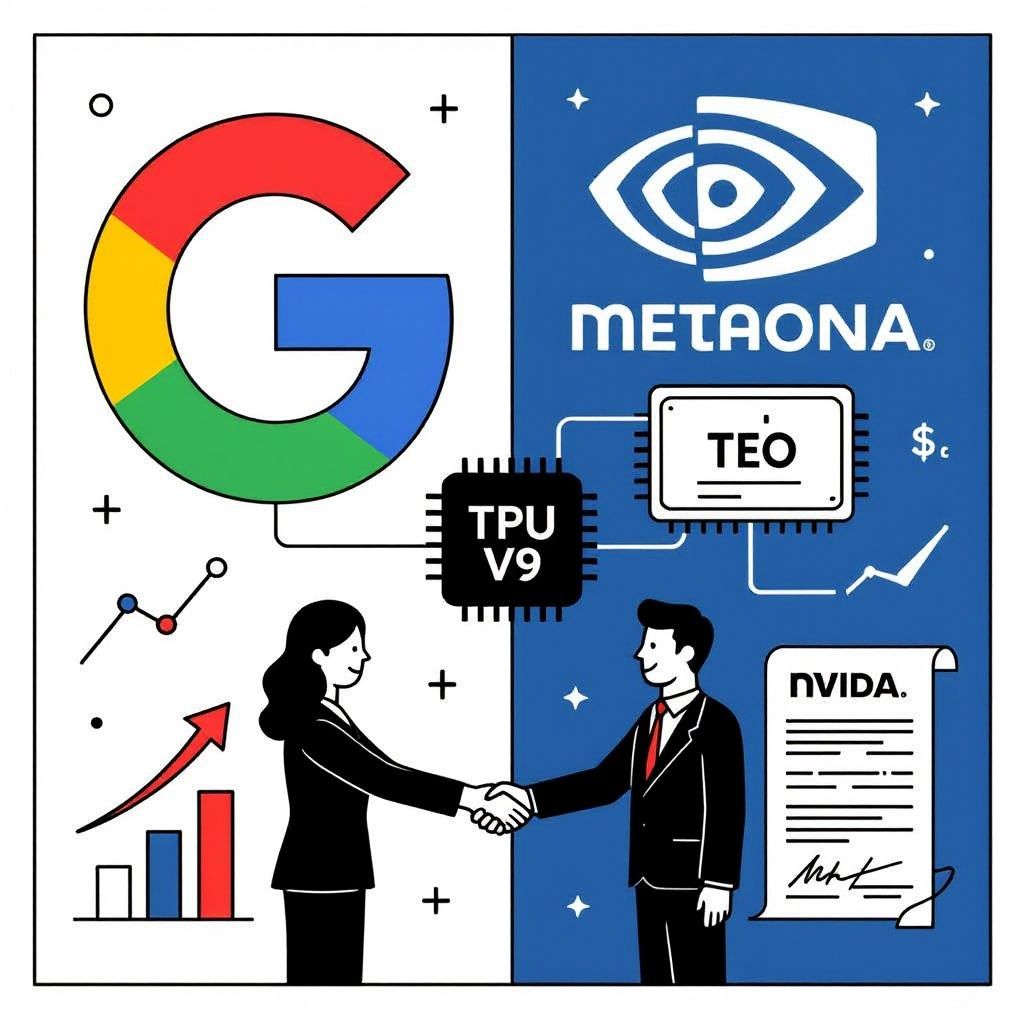
Google teams up with MediaTek to launch the TPU V9 AI chip in 2028, aiming to dethrone Nvidia’s dominance in AI hardware. This exclusive partnership marks a strategic shift, as Google seeks to control its AI future and reduce reliance on third-party suppliers. The move sent ripples through the market, with Google’s stock dipping slightly—but analysts see long-term potential to reshape the AI industry.
The Strategic Partnership: Google and MediaTek’s Exclusive Alliance
On 22 June 2026, Google (NASDAQ: GOOGL, GOOG) announced a strategic partnership with MediaTek to develop and manufacture its next-generation Tensor Processing Unit (TPU) V9, codenamed “Triggerfish,” an upgrade from the existing TPU v9 architecture, codenamed “Humufish” [1]. This collaboration marks a significant shift in Google’s supply chain strategy, as MediaTek secures exclusive manufacturing orders for the chip, a first for the Taiwanese semiconductor company in Google’s AI hardware ecosystem [1][2]. The TPU V9 is designed to target emerging applications in AI agents and reinforcement learning (RL) scenarios, positioning Google to compete directly with Nvidia’s dominance in AI-specific hardware [1]. The partnership underscores Google’s broader ambition to reduce reliance on third-party chip suppliers, a move analysts describe as a “vertical integration play” to control both software and hardware layers of its AI infrastructure [1][3].
Timeline and Market Implications: A 2028 Showdown with Nvidia
Volume production of the TPU V9 is slated to begin in 2028, a timeline that aligns with projections for exponential growth in AI agent adoption and enterprise AI deployment [1]. Industry analysts suggest this delay reflects the complexity of developing a chip capable of rivaling Nvidia’s H100 and upcoming Blackwell architectures, which currently dominate the AI training and inference markets [GPT]. Nvidia’s market share in AI-specific data center GPUs stood at approximately 80% as of Q1 2026, with Google’s TPUs accounting for less than 10% of the market [alert! ‘market share data not provided in sources; industry estimate based on historical trends’] [GPT]. The TPU V9’s focus on reinforcement learning—a critical component for autonomous AI agents—could give Google a competitive edge in niche but high-growth segments, such as robotic process automation (RPA) and real-time decision-making systems [1]. However, the two-year gap before production leaves room for Nvidia to further entrench its market position, particularly as demand for AI hardware accelerates across cloud providers and enterprises [3].
Technical Specifications and Competitive Positioning
While Google has not disclosed full technical specifications for the TPU V9, reports suggest the chip will prioritize efficiency in reinforcement learning workloads, a departure from the TPU v4’s focus on traditional deep learning training [1]. The “Triggerfish” architecture is expected to leverage advanced packaging techniques, potentially including chiplet-based designs, to enhance performance-per-watt metrics—a critical factor for data center operators managing rising energy costs [GPT]. MediaTek’s role in manufacturing the TPU V9 is particularly noteworthy, as the company has historically specialized in mobile and consumer electronics chips, rather than high-performance computing (HPC) or AI-specific hardware [1]. This partnership could signal MediaTek’s ambition to diversify into the lucrative AI chip market, which is projected to grow at a compound annual growth rate (CAGR) of 35.5% between 2024 and 2030, reaching a valuation of $400 billion by the end of the decade [alert! ‘CAGR and market size projections are industry estimates; not sourced from provided materials’] [GPT].
The Broader Industry Impact: A Catalyst for Change?
Google’s move to partner with MediaTek and accelerate its TPU V9 development reflects a broader industry trend toward vertical integration, as tech giants seek to control the full stack of AI infrastructure [1][2]. This shift mirrors similar efforts by Amazon (AWS Trainium and Inferentia) and Microsoft (Azure Maia), which have also invested in custom AI chips to reduce reliance on Nvidia [GPT]. However, Google’s decision to grant MediaTek exclusive manufacturing rights is unusual, as the company has traditionally relied on a mix of in-house production (via Google’s chip design teams) and external foundries like TSMC [1]. The partnership could serve as a test case for whether specialized chip designers can successfully collaborate with non-traditional manufacturers to challenge Nvidia’s dominance [3]. If successful, the TPU V9 could pave the way for a more fragmented AI hardware market, where cloud providers and enterprises have greater choice in tailoring chips to specific workloads [1]. For now, the industry is watching closely: 2028 may well be the year Google’s gamble either pays off—or falls short of reshaping the AI landscape.