United States Threatens Imminent Strike on Heavily Fortified Iranian Nuclear Site
Washington, Wednesday, 22 July 2026.
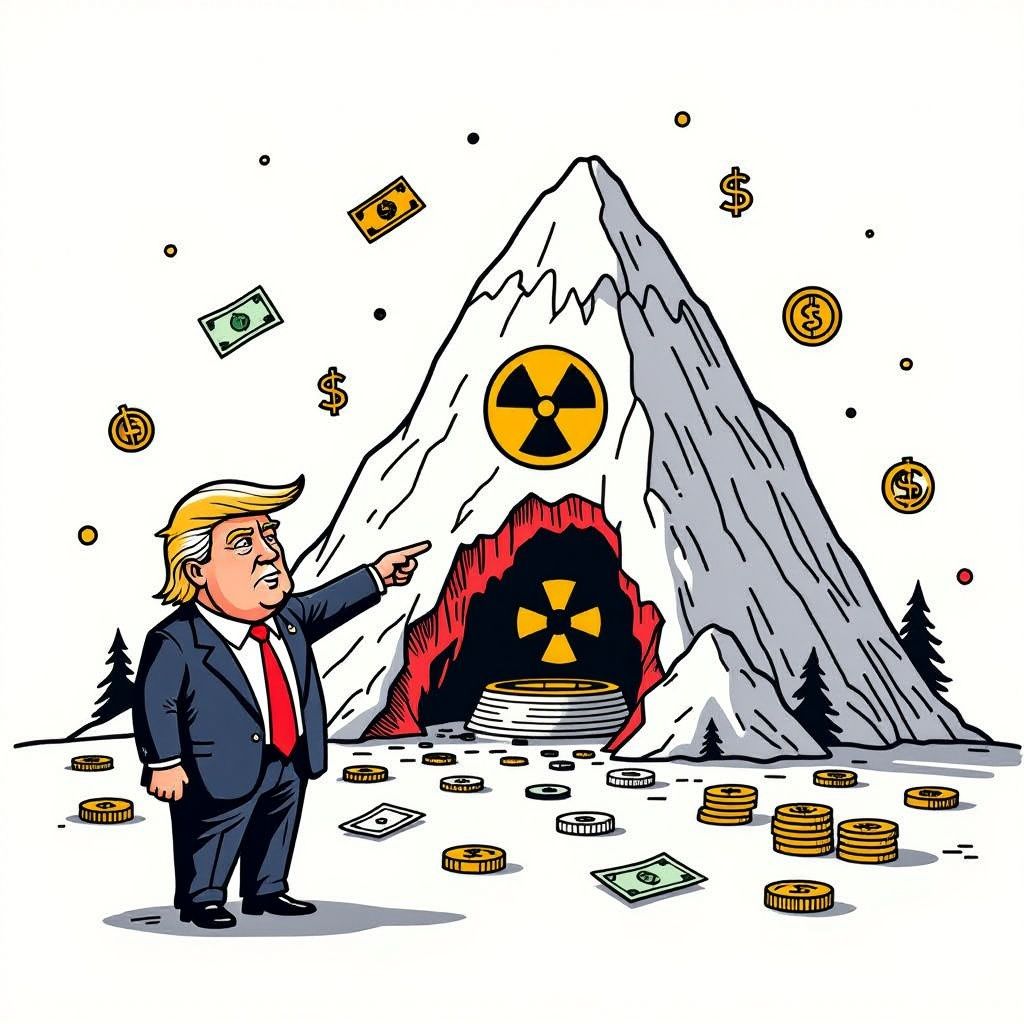
President Trump announced plans to strike Iran’s Pickaxe Mountain, a nuclear site buried 100 meters underground, significantly escalating geopolitical tensions and risking global energy market stability.
A Rapidly Escalating Regional Conflict
This critical juncture follows a series of aggressive military exchanges in the region. On July 18, 2026, the United States launched retaliatory airstrikes against Iranian targets following a fatal attack on American troops stationed in Jordan [3]. This latest cycle of violence is part of a broader conflict that erupted in February 2026 [1], which has recently intensified into a relentless campaign, marking ten consecutive days of active strikes as of July 20, 2026 [1]. The transition from regional proxy skirmishes to direct threats against Iran’s sovereign, highly fortified territory signals a dangerous new phase in Western-Middle Eastern relations.
Inside the Pickaxe Mountain Complex
The focal point of this escalation is Pickaxe Mountain, also known as Kūh-e Kolang, located near Natanz, Iran [1]. Buried 100 meters deep underground, the heavily fortified facility was declared by Iran in 2021 as a centrifuge assembly site following the destruction of an above-ground Natanz facility [1]. On July 21, 2026, President Donald Trump dramatically raised the stakes by announcing plans to strike this specific site ‘very soon’ and ‘very heavily’ [1]. Trump emphasized that the United States would target any location where Iranian authorities are even suspected of reconstituting or thinking about nuclear capabilities [1].
Intelligence Assessments and Nuclear Capabilities
Western and regional intelligence agencies have long monitored the subterranean development at Pickaxe Mountain. In autumn 2025, Israeli intelligence assessed that Iran had successfully transferred uranium-enrichment centrifuges into the underground facility [1]. Currently, experts estimate that Iran possesses approximately 1,000 pounds of highly-enriched uranium [1], which translates to 453.59 kilograms of fissionable material. While satellite imagery captured on June 21, 2026, confirmed ongoing vehicle activity at the tunnel entrances [1], the true extent of the subterranean progress remains obscured. This opacity has worsened since international oversight collapsed, as International Atomic Energy Agency (IAEA) inspectors have been completely barred from Iranian nuclear sites since the early 2026 U.S. strikes [1].
The Calculus of Deterrence
Historically, both American and Israeli military planners have hesitated to strike the Pickaxe Mountain site. During previous coordinated airstrikes in June 2025, which targeted three other Iranian nuclear sites, as well as during the early 2026 campaigns, Pickaxe Mountain was notably left untouched [1]. Kelsey Davenport, the director for nonproliferation policy at the Arms Control Association, noted that while the location of the site poses significant concern, the previous reluctance to target it suggests that intelligence agencies did not previously view Pickaxe as an imminent threat [1]. However, the Trump administration’s latest warnings indicate that Washington’s threshold for tolerance has dramatically shifted [1][2].
Military Options and Global Reach
To bypass the 100-meter rock ceiling protecting the centrifuges, the United States is considering specialized military options. Potential strategies include deploying massive precision-guided bunker busters, known as Massive Ordnance Penetrators (MOPs), to collapse the facility’s tunnel entrances, or executing high-risk ground operations involving sabotage [1]. Highlighting the military’s readiness, Defense Secretary Pete Hegseth asserted on July 14, 2026, that the United States military possesses the unparalleled capability to reach and destroy any target globally [1]. Security experts like Aaron Cohen suggest that the U.S. has entered an active ‘exploitation phase’ against Iranian assets [2].
Economic Warfare and the Regional Blockade
The threat of kinetic strikes on Pickaxe Mountain is reinforced by an aggressive economic strategy. As of July 16, 2026, the United States had resumed a strict maritime blockade on Iran following a series of hostile attacks in the strategically vital Strait of Hormuz [2]. Retired Lt. Gen. Keith Kellogg explained on July 16, 2026, that the administration’s overarching strategy involves exerting absolute control over Iran’s economy to induce a structural collapse of the regime [2]. This economic choking mechanism, executed via U.S. Air Force assets and naval carrier groups [2], is designed to force Tehran’s compliance before a full-scale kinetic conflict becomes inevitable.
Energy Market Impact and Regional Repercussions
The escalating confrontation has sent shockwaves through global energy markets, prompting immediate defensive measures from regional players. In response to the ongoing U.S. blockade and Iran’s subsequent threats to lash out at neighboring Arab states, oil producers began actively planning new pipeline infrastructure on July 17, 2026, to bypass the volatile Strait of Hormuz entirely [2]. With global supply chains highly sensitive to any disruption in the Persian Gulf, the potential for a localized strike on Pickaxe Mountain to trigger a broader regional war remains a primary concern for international financial managers and commodity traders [GPT].