Surprise Crop Harvest Reductions Spark Rebound in Grain Prices
Chicago, Saturday, 14 November 2026.
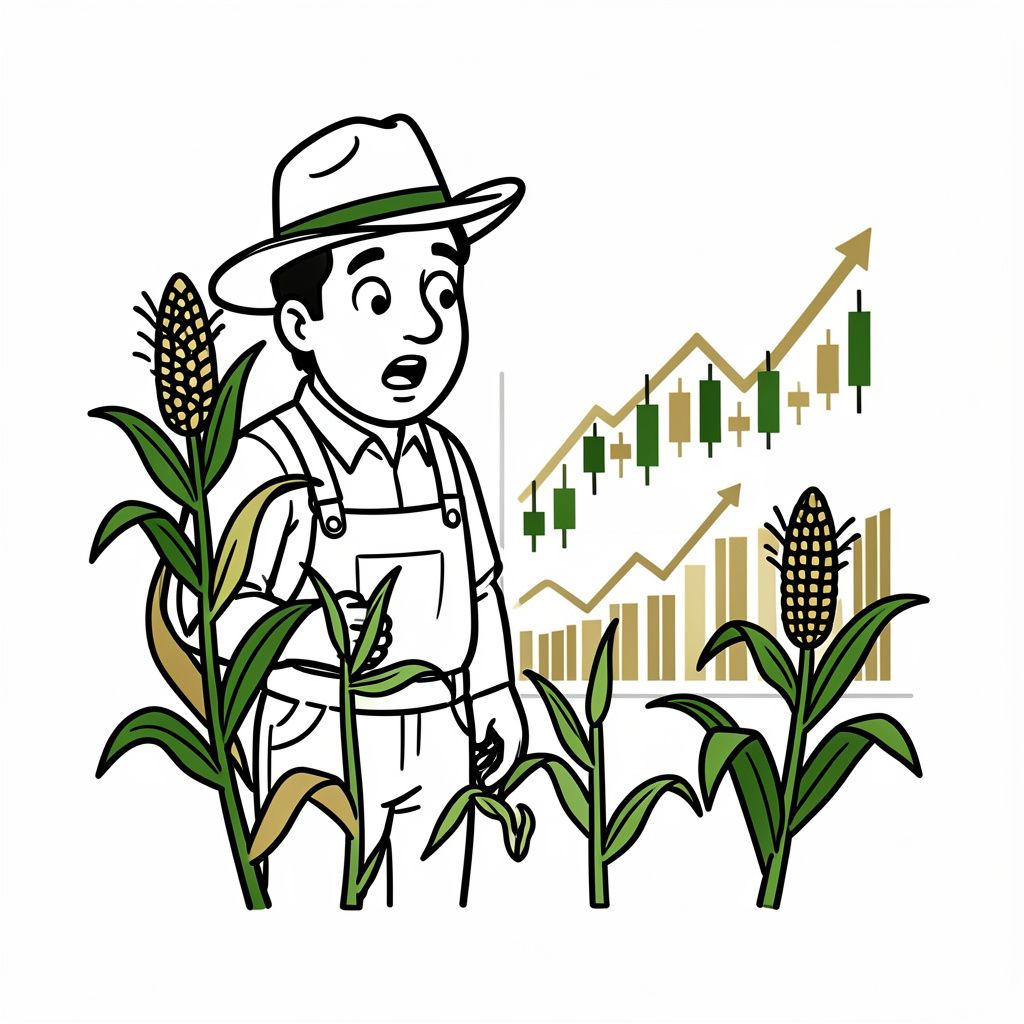
Unexpectedly steep cuts to domestic corn harvest projections and tighter soybean supplies sparked a sharp price recovery, presenting growers with critical new hedging and forward-contracting opportunities.
USDA Report Triggers Sharp Market Reversal
Grain markets experienced a dramatic reversal on Tuesday, November 10, 2026, when the U.S. Department of Agriculture released its monthly World Agricultural Supply and Demand Estimates (WASDE) report. The report delivered unexpected supply-side shocks to corn and soybeans, with corn production cuts exceeding analyst expectations by 1.6 bushels per acre (bpa) to 179.6 bpa, translating to a 141 million bushel reduction in total output to 15.893 billion bushels [5]. Concurrently, soybean ending stocks were slashed by 15 million bushels to 300 million bushels as the USDA raised its yield estimate by 0.3 bpa to 53.3 bpa [5]. These adjustments catalyzed a broad-based market rally, erasing weeks of bearish sentiment that had weighed on prices prior to the report’s release.
Price Surge and Market Mechanics
The immediate market reaction was pronounced, with CBOT corn futures surging from a December 2026 contract low of $4.25¾ to settle at 445.50¢/bu on November 13, 2026, before peaking at 493.50¢/bu for March 2028 contracts [2]. Soybean futures mirrored the momentum, climbing from $12.10/bu to $12.6450/bu at Mississippi River barge loading elevators by November 13 [2][5]. Analysts attributed the rebound to both the supply-side corrections and heightened geopolitical risk premiums, particularly as Russia-Ukraine peace talks in the UAE remained unresolved, casting uncertainty over Black Sea grain export corridors [4][6]. Central Illinois cash prices for corn jumped to $4.26/bu (-19Z) while soybeans reached $12.02/bu (-29F), reflecting the tight supply conditions [2].
Strategic Implications for Agribusiness
For agribusiness executives and supply chain managers, the sudden price recovery presents a critical window for strategic risk management. Industry analysts such as Allison Thompson of The Money Farm emphasize that the volatility underscores the importance of proactive hedging strategies, particularly as storage costs and interest expenses accumulate during winter holding periods [1]. The USDA’s November 10 report not only adjusted domestic supply figures but also raised concerns about global wheat markets, where ending stocks rose by 3 million bushels to 743 million bushels amid production increases in Argentina and Australia [5]. With South American crop development—particularly Brazil’s harvest—poised to influence global supply dynamics in the coming weeks, market participants are closely monitoring export business trends with China and domestic ethanol blending margins, both of which have been supported by firmer energy prices [3][4].
Forward Outlook and Key Variables
Looking ahead, market participants face a complex interplay of variables that will determine whether the recent price surge is sustainable. USDA’s next major yield update is not scheduled until January 2027, meaning traders will rely on weekly export sales data, South American weather patterns, and geopolitical developments for near-term direction [4][6]. The upcoming APEC meeting, where U.S., Chinese, and Russian leaders are expected to convene, could provide fresh insights into trade negotiations or sanctions relief that may impact grain flows [4]. Additionally, the U.S. Federal Reserve’s Producer Price Index (PPI) release on November 13, 2026, contributed to a stronger U.S. dollar, which typically exerts downward pressure on dollar-denominated commodity prices, though this effect was offset by the supply-side fundamentals [5]. For producers, the calculus remains binary: capitalize on current prices through forward contracting or retain inventory in anticipation of potential rallies driven by weather disruptions or policy shifts.