Why Strong U.S. Jobs Data Could Rattle Wall Street This Week
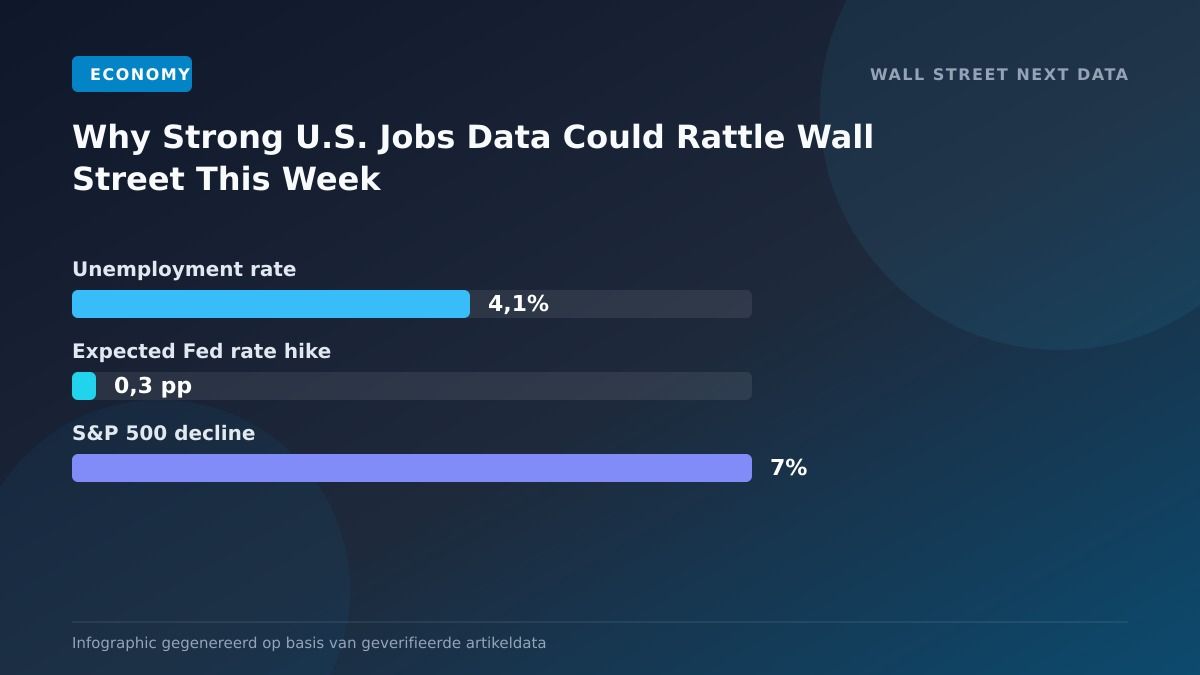
New York, Sunday, 29 November 2026. Wall Street faces a pivotal week as investors brace for Friday’s November nonfarm payrolls report, where strong hiring could paradoxically weigh on stock prices. Economists expect the U.S. economy added 90,000 jobs in November, down from October’s 165,000, with unemployment holding at 4.1%. However, a hotter-than-expected reading would signal persistent economic strength and give the Federal Reserve room to tighten monetary policy further. Markets already price in a 25-basis-point—or 0.25 percentage point—interest rate hike at the Fed’s December 8–9 meeting, while Governor Christopher Waller recently floated a half-point increase or faster tightening in 2027. Equities remain fragile after a recent correction, with the S&P 500 down 7% from its October record and the VIX volatility index hovering near 24. Investors will also watch Tuesday’s manufacturing data, Thursday’s services report, technology earnings from Salesforce and Marvell Technology, and Nvidia CEO Jensen Huang’s Senate testimony.
The Tightening Trap
A robust November payrolls figure would hand the Federal Reserve justification to keep monetary policy restrictive. With inflation still above the central bank’s 2% target, strong hiring reduces the case for rate cuts and strengthens the argument for additional hikes [1]. Governor Christopher Waller recently argued for “either a half-point increase in December or a faster tightening pace in 2027” [1]. In valuation terms, higher interest rates increase the discount rate applied to future corporate earnings, mechanically lowering the present value of equities. Any upside surprise in Friday’s report therefore risks triggering a sell-off as traders price in more aggressive tightening.
Labor Market Signals
The week brings a series of labor market readings beyond Friday’s headline number. On Tuesday, December 1, the Labor Department releases the October Job Openings and Labor Turnover Survey (JOLTS), which tracks hiring and separations across healthcare, retail and manufacturing [2]. Thursday, December 3, brings weekly initial unemployment claims, which have remained historically low [2]. Friday also includes the University of Michigan’s preliminary December consumer sentiment survey [2]. Economists describe the labor market as a “low-hire, low-fire” environment where businesses continue adding workers but at a slower pace [2].
Geopolitical and Corporate Overhangs
External pressures compound the policy risk. An ongoing U.S. war with Iran continues to stifle global oil supplies, keeping energy costs elevated and feeding inflation concerns [2]. In credit markets, S&P Global Ratings placed Nvidia’s rating on CreditWatch Negative, signaling a possible downgrade [1]. The Nasdaq Composite trades roughly 13% below its October peak, reflecting the vulnerability of growth stocks to higher discount rates and tighter financial conditions [1].
Volatility Regime
Fear gauges remain elevated heading into the data. The VIX volatility index trades 36.364% above its long-term median of 17.6, with the futures curve in backwardation—a signal that traders expect near-term turbulence to exceed longer-term expectations [1]. This premium reflects investor concern that strong economic readings will compel the Federal Reserve to tighten more forcefully at its December 8–9 policy meeting.