Warren Buffett’s Blueprint for Navigating an Eventual Bear Market
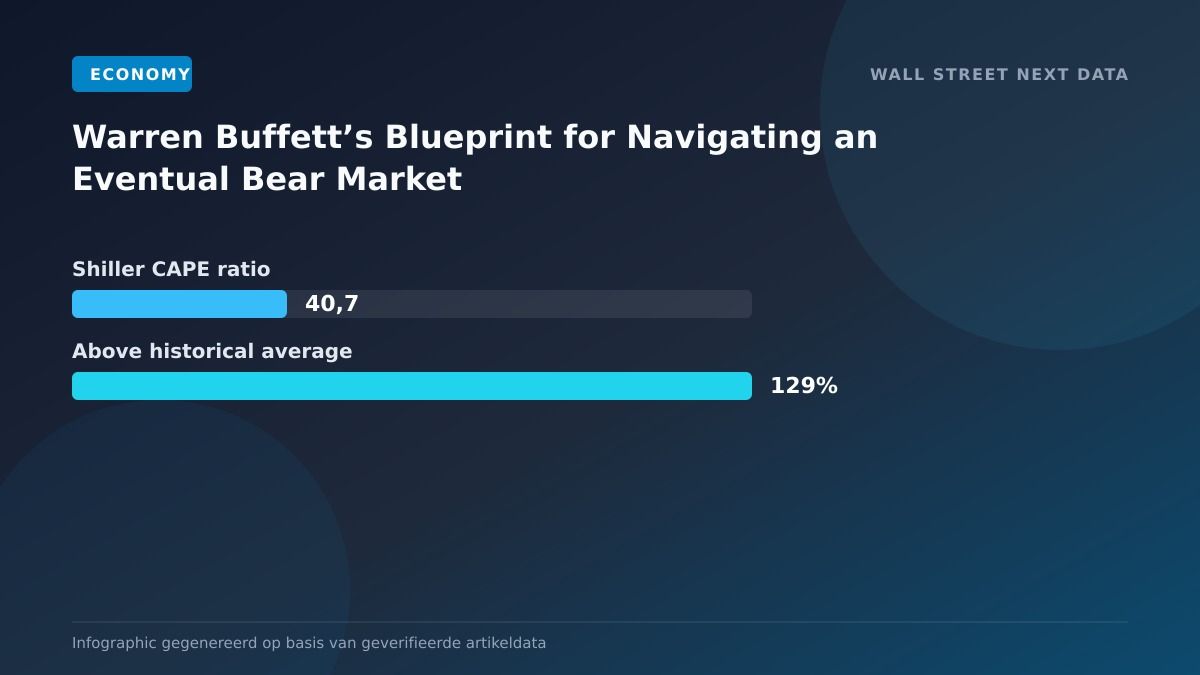
Omaha, Sunday, 29 November 2026. U.S. stock indexes recently entered correction territory, falling more than 10% from October peaks amid a technology selloff. With stretched valuations and record leverage flashing warning signs, investors are revisiting Warren Buffett’s time-tested bear market strategy. The S&P 500’s Shiller CAPE ratio—a valuation metric comparing stock prices to 10-year average earnings—reached 40.7 on November 27, sitting 129% above its historical average. Meanwhile, margin debt, or borrowed money used to buy securities, hit a record $1.502 trillion in June before easing to $1.448 trillion in October. Credit stress has also emerged in artificial intelligence infrastructure, alongside a sharp 5.06% drop in Japan’s Nikkei 225. To weather potential downturns, Buffett advises owning quality businesses with durable competitive advantages rather than chasing speculative hype. Analysts recommend diversifying into defensive sectors like health care and consumer staples, and holding cash reserves—known as dry powder—to buy undervalued assets when market fear peaks.
Valuation Metrics Signal Historical Extremes
Valuation metrics now flash levels seen only six times since 1871. The S&P 500’s Shiller CAPE ratio reached 40.7 on November 27, sitting 128.652% above its historical average of 17.8 [1]. Simultaneously, the Financial Industry Regulatory Authority (FINRA) reported margin debt surged 77% over 14 months to peak in June 2026 [1]. These figures signal that speculative leverage has reached extremes that preceded past downturns.
Credit Markets Show Strain in AI Financing
Credit markets show strain in AI infrastructure financing. CoreWeave’s 2032 bonds saw yields climb above 16% in early November, while Nvidia’s credit default swaps widened 76% in one month [1]. Goldman Sachs reported that hyperscalers posted negative free cash flow in the third quarter of 2026 [1]. These developments suggest funding costs for AI data centers are rising sharply, potentially tightening credit conditions across the broader economy as lenders reassess risk.
Buffett’s Quality-First Framework
Buffett’s framework prioritizes durable competitive advantages over hype. He wrote that investors should determine ’the competitive advantage of any given company and, above all, the durability of that advantage’ rather than assessing how much an industry will grow [1]. He advocates finding quality businesses, buying at attractive prices, and holding long term. The S&P 500 has generated more than 600% in total returns since March 2000, recovering from every bear market including the dot-com bust.
Global Spillovers and Defensive Positioning
Market stress crossed borders on November 20, when Japan’s Nikkei 225 plunged 5.06% to 56,436.65, with SoftBank falling 14.5% and Advantest down 10.3% [1]. Such moves reflect contagion from U.S. tech selling and shifting rate expectations. Analysts recommend diversifying into defensive sectors like health care and consumer staples while holding cash reserves to deploy when fear peaks. Buffett’s maxim applies: ‘be greedy when others are fearful’ [1].