Wall Street Bets on K-Beauty's Surge as Analysts Weigh Long-Term Risks
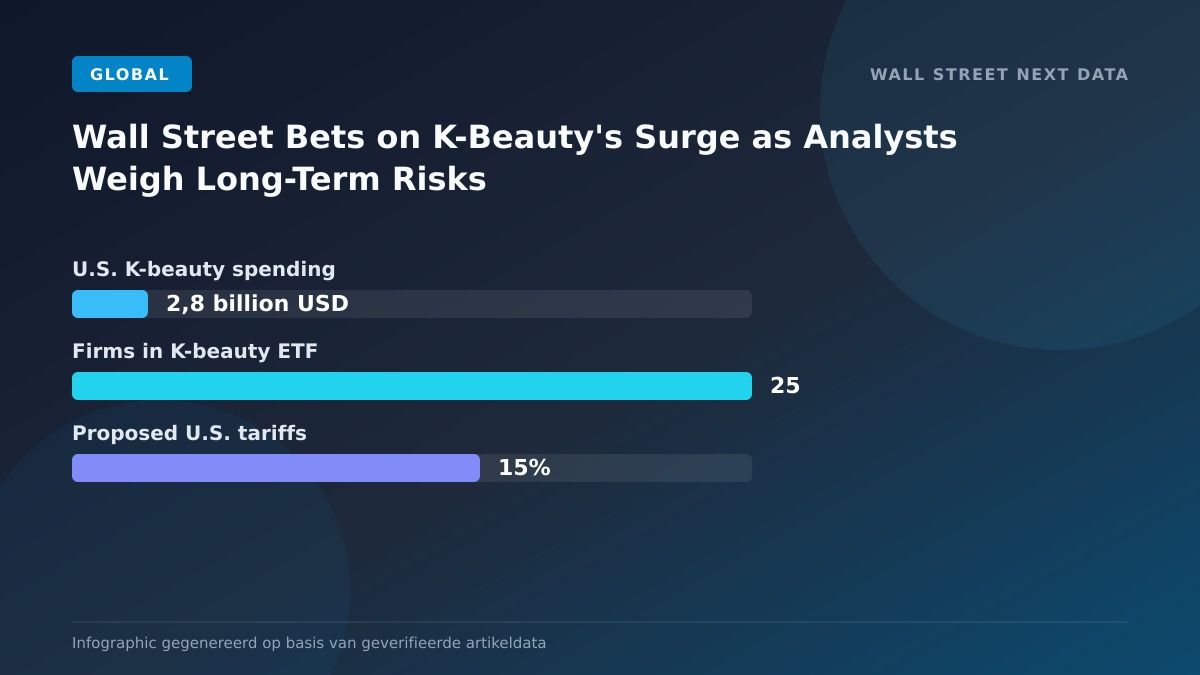
Seoul, Sunday, 29 November 2026. South Korea’s beauty industry is capturing both U.S. shoppers and Wall Street investors. In 2025, South Korea overtook France as the top cosmetics exporter to the United States. U.S. consumers spent $2.8 billion on K-beauty products in the year ending March 2026, and Korean skincare dominated Amazon’s global bestseller lists ahead of Black Friday.
To tap this momentum, U.S. fund manager Guinness Atkinson launched KBTY in November. It is the first exchange-traded fund (ETF)—a basket of stocks traded on an exchange—dedicated to the Korean beauty ecosystem, tracking 25 firms including contract manufacturers Cosmax and Kolmar Korea.
Still, analysts question whether the boom can last. Proposed U.S. tariffs of up to 15% on South Korean goods threaten K-beauty’s core appeal of affordability. Observers also warn that viral social media trends fade quickly, noting a U.S.-listed K-pop ETF was liquidated in 2025 despite global popularity.
The KBTY Bet
Guinness Atkinson’s KBTY ETF, launched in November, tracks 25 firms including Cosmax and Kolmar Korea [1][3]. The fund leverages Korea’s shared manufacturing system, where contract makers provide ready-made formulations and small test orders [1]. It launches as Korean skincare dominates Amazon’s bestseller lists in six markets ahead of Black Friday [1][2]. Cosmax’s market cap hit 3.6 trillion won, up 93% year-to-date, while Kolmar Korea rose 108% to roughly 3 trillion won [1]. APR, valued at about $8.4 billion, saw its stock climb 362% in 2025 [1]. Cosmetics stocks remain just 1% of the Kospi index [1].
Export Records and Retail Expansion
South Korea exported a record $11.43 billion in cosmetics in 2025. The U.S. overtook China as the top destination at $2.19 billion, 19.16% of exports [2]. American shoppers spent $2.8 billion on K-beauty in the year ending March 21, up 48% [1]. U.S. exports surged 197% between 2020 and 2024 [1][3]. Global K-beauty sales rose 53% year-over-year and 131% over two years [1][2]. Target quadrupled its K-beauty assortment to over 150 products, while Olive Young opened its first U.S. store in Pasadena and placed 19 brands in 500-plus Sephora locations [2].
Tariffs and Trend Risks
Analysts warn that U.S. tariffs of up to 15% on South Korean goods threaten K-beauty’s affordability [1]. Mintel’s Andrew McDougall notes that viral social media generates views, but sustained growth requires trade flows and retail distribution [1]. He cautions that tariff-driven price hikes could undermine the innovation, effectiveness, and affordability that drew consumers [1]. Gabriel Debak cites the 2025 liquidation of the U.S.-listed K-pop ETF as proof that popularity does not guarantee fund success [1]. He points to Pop Mart, whose revenue rose 245% to 250% in Q3 2025 before dropping 45% to 50% in Q3 2026, showing viral trends fade [1].