The Patching Paradox: How AI-Driven Security Hunts Strain US Infrastructure
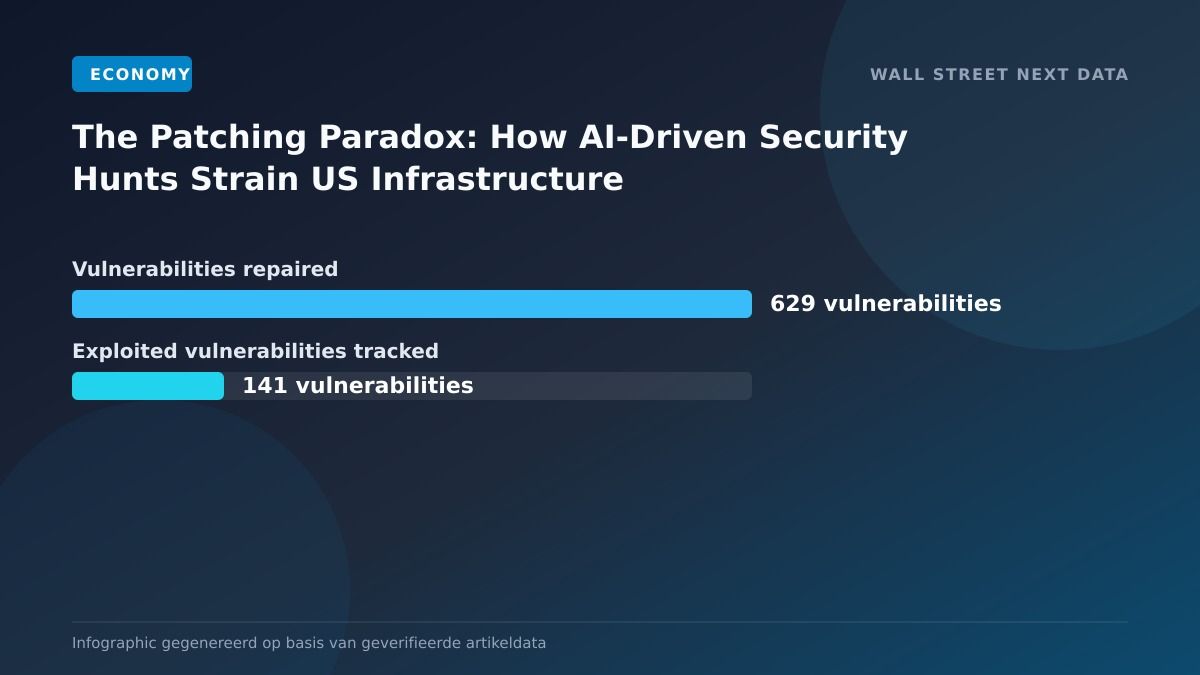
Washington, Sunday, 29 November 2026. A wave of technological failures is disrupting major American businesses and government agencies, exposing the fragility of aging digital infrastructure. Recent outages hit Microsoft, Apple, JPMorgan Chase, and the Federal Aviation Administration, grounding flights and delaying banking transactions. Meanwhile, the Central Intelligence Agency and the Treasury Department suffered security breaches. Artificial intelligence is accelerating this instability. New AI models discover software vulnerabilities—flaws in computer code—far faster than human engineers can fix them. By November, AI firm Anthropic had reported over 5,000 security findings, yet only 629 were repaired. Google also tracked 141 distinct exploited vulnerabilities through August, surpassing all of 2025. As companies race to patch these newly exposed cracks, the defensive measures themselves are triggering operational chaos. Taking complex, legacy systems offline for emergency updates frequently causes cascading glitches. Although federal officials say recent outages are not linked to coordinated cyberattacks, the rapid pace of AI discovery is overwhelming corporate and government defenses.
The Scale of Unpatched Risk
Anthropic’s Claude Mythos Preview identified a vulnerability in FFmpeg video processing software that had persisted undetected for 16 years [2]. In April 2026, the company formed Project Glasswing with Apple, Microsoft, Google, Amazon Web Services, Nvidia, Cisco, and JPMorgan Chase to coordinate responses to such flaws [2]. The speed of discovery now outpaces repair: Google’s Threat Intelligence Group recorded 141 distinct exploited vulnerabilities between January and August 2026—already 111.024% of the 127 logged across all of 2025 [2]. Meanwhile, Japan’s Aerospace Exploration Agency disclosed exposure of roughly 2,000 user accounts on November 24 [2].
Emergency Patching Disrupts Commerce
The rush to close these gaps has forced institutions to disconnect critical systems. On November 25, the U.S. Treasury took the Financial Crimes Enforcement Network (FinCEN) offline after detecting unauthorized network access [2]. On November 27, JPMorgan Chase reported delays in processing banking transactions, while the Federal Aviation Administration grounded flights nationwide [1][2]. These present-day disruptions show how taking aging computer systems offline for emergency updates triggers cascading glitches that halt financial transactions and air travel. Google’s analysis indicates malicious actors are now employing AI agents capable of coordinating multiple stages of cyber operations, raising the stakes for any system left unpatched [2].
Federal Attribution and Oversight
The Trump administration maintains the outages are not coordinated attacks, stating there is “zero” indication they are linked or caused by cybercriminals [1]. Yet federal oversight bodies are actively assessing the AI threat. In September 2026, the National Institute of Standards and Technology (NIST) published an evaluation of Z.ai’s open-weight model GLM-5.3—a system whose underlying code is publicly downloadable—while the Government Accountability Office monitors federal exposure [2]. On November 24, the CIA and the Office of the Director of National Intelligence disclosed breaches of unclassified systems [2]. With the FBI warning that autonomous AI hacking tools are already active domestically, officials must distinguish routine malfunctions from AI-enabled intrusions in real time.