Tech Shares Slide as Fresh Tariff Concerns and Looming Inflation Print Unsettle Wall Street
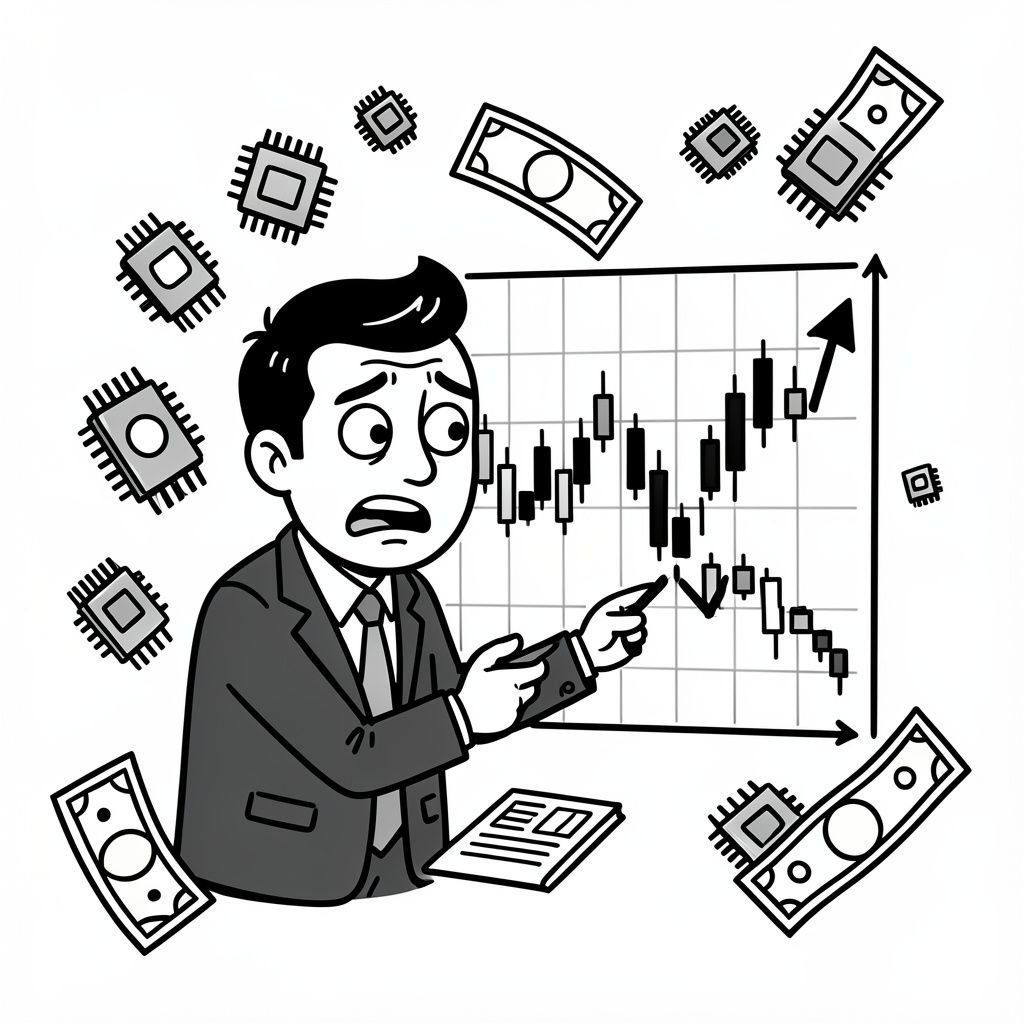
New York, Wednesday, 25 November 2026. U.S. equity futures tumbled on Wednesday, dragged down by semiconductor declines and looming tariff threats, as investors aggressively price in another Federal Reserve interest rate increase.
Futures Plunge as Investors Adopt Risk-Off Stance
Nasdaq 100 futures contracts dropped 14.893 to 2.38% by 06:01 a.m. ET on Wednesday, 25 November 2026, as chipmakers led premarket declines [1][4][5]. Nvidia fell 5.1%, Micron Technology was off 6%, and Advanced Micro Devices and Marvell Technology declined 6.5% and 5.7%, respectively [1]. The broader selloff extended losses in hyperscalers, with Alphabet down 3%, Amazon shedding 3.2%, Microsoft down 1.9%, and Meta declining 1.4% [1]. Anthropic, the AI startup that debuted below its $83 IPO price, fell an additional 5.7% in premarket trading [4]. The sharp decline reflects mounting doubts over whether the AI sector’s debt-fueled boom can generate sufficient returns to justify current valuations, particularly as macroeconomic headwinds intensify [1][5].
Tariff Threats and Inflation Data Shape Market Sentiment
The Trump administration’s potential announcement of new tariffs on imports from 16 major U.S. trading partners added to investor anxiety, compounding concerns over higher interest rates and sustained inflation [1][3]. Reuters reported on Tuesday that the administration could unveil additional duties following a probe into excess industrial capacity, further clouding the outlook for global trade and enterprise spending [1]. The pending release of the October Personal Consumption Expenditures (PCE) report at 8:30 a.m. ET is poised to be a critical inflection point for Federal Reserve policy into 2027 [1][5]. The PCE report, alongside third-quarter GDP data, will provide the final major data points before the Federal Open Market Committee’s December meeting [1].
Fed Policy Expectations and Economic Implications
Fed funds futures traders are pricing in a 97% chance of a rate hike in December and a 63% chance of another increase in January, according to CME Group’s FedWatch tool [1][5]. The prospect of higher borrowing costs poses a significant challenge for capital-intensive AI companies like Nvidia, whose valuations are highly sensitive to interest rate movements [1][5]. Daniela Hathorn, senior market analyst at Capital.com, noted that softer inflation data might offer some relief, but markets remain cautious about the sustainability of AI’s recent gains [1]. The October PCE report is expected to show a 0.3% monthly increase and a 3.8% annual reading, according to economists surveyed by Dow Jones [3]. The Federal Reserve’s policy path into 2027 will hinge on whether inflation continues to accelerate amid rising oil prices tied to the unresolved U.S.-Iran conflict [1].
Broader Market Context and Sector Rotation
The Wednesday selloff follows a volatile month for U.S. equities, with the S&P 500 and Nasdaq on track for their worst November since 2008 [1]. The tech-heavy Nasdaq Composite dropped 1.48% on Tuesday, while the blue-chip Dow Jones Industrial Average rose 0.85%, highlighting a rotation away from high-multiple tech stocks toward more defensive sectors [3]. Hewlett Packard Enterprise’s nearly 17% decline despite beating earnings expectations underscored broader concerns over enterprise spending and macroeconomic stability [2]. Market focus now turns to Dell’s post-close earnings release, where consensus estimates stand at $6.55 per share on $49.24 billion in revenue [2]. The evolving tariff landscape and inflation dynamics are likely to keep investors on edge, with the potential for further volatility in AI-linked equities [1][3].