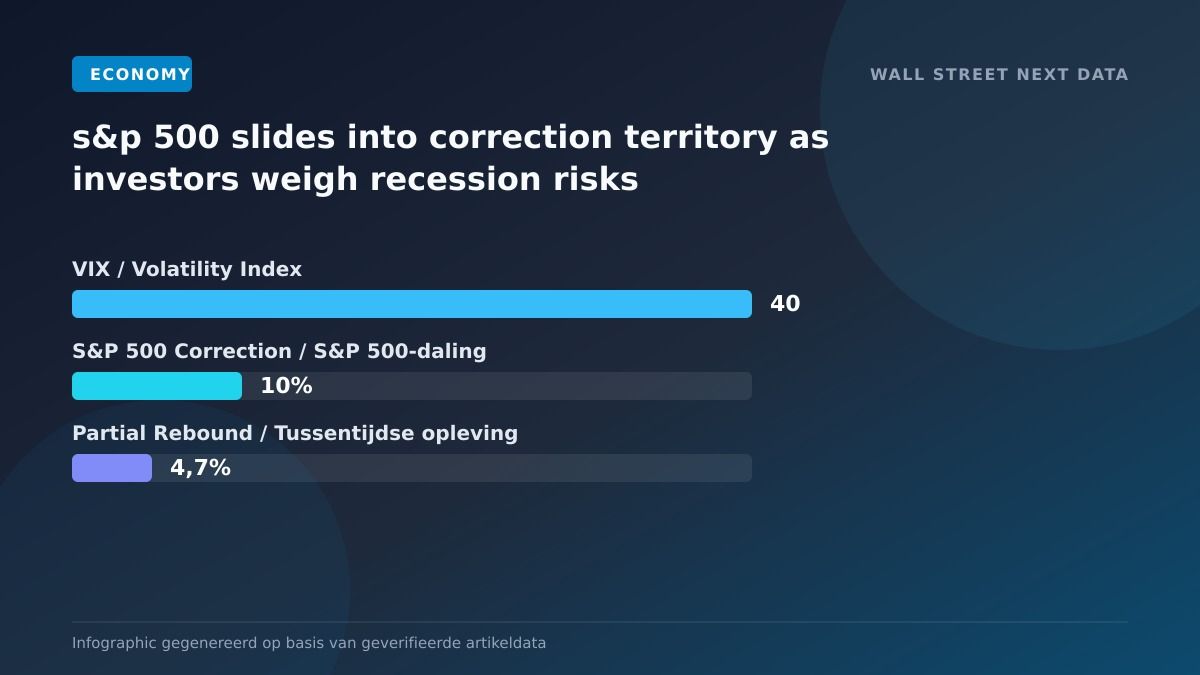
s&p 500 slides into correction territory as investors weigh recession risks
New York, Friday, 27 November 2026. The S&P 500 has officially dropped more than 10% from its recent peak, entering market correction territory alongside the Dow Jones Industrial Average and the Nasdaq Composite. Persistent macroeconomic headwinds, elevated interest rate concerns, and intense pressure across artificial intelligence equities drove the selloff. Market volatility surged sharply, pushing the Cboe Volatility Index to 40 before markets mounted a partial rebound with a 4.7% gain on November 23. The benchmark 10-year Treasury yield also eased from 5.12% to 4.92% as investors adjusted rate expectations ahead of the Federal Reserve’s December meeting. Despite corporate anxiety over potential bear market spillover, historical data shows corrections do not guarantee economic downturns. Portfolio managers are now closely monitoring fourth-quarter earnings and consumer spending metrics to evaluate broader resilience and determine whether the downturn marks a temporary reset or the start of deeper recessionary trouble.
federal reserve meeting looms amid correction
The Federal Reserve’s December 8–9 meeting intensifies focus on monetary policy as the S&P 500 remains in correction, down 0.1 from its peak. Treasury yields eased to 4.92% from 5.12% on November 20, reflecting shifting rate expectations ahead of the central bank’s decision. Investors expect clarity on potential easing or continued restrictive policy, with volatility remaining elevated after the VIX hit 40. Portfolio managers are evaluating whether the correction signals deeper economic trouble or a temporary reset ahead of fourth-quarter earnings reports.
ai sector pressure deepens market downturn
Artificial intelligence equities led the selloff, with Nvidia’s CEO Jensen Huang’s brief departure exacerbating declines. The Nasdaq Composite fell 0.12 from its October 6 high but rebounded 6.5% on November 23 after Huang’s reinstatement. AI infrastructure concerns and the failed Anthropic IPO added to selling pressure. Analysts note that corrections often precede sector rotations, with defensive stocks outperforming during past downturns [1].
historical data offers mixed signals on recovery
Historical analysis shows rapid Nasdaq corrections were followed by gains 0.85 times, with a median return of +23.8% one year later. The S&P 500’s 4.7% gain on November 23 followed extreme volatility, but sector rotation suggests potential for stabilization. Corrections do not guarantee economic downturns, though elevated VIX levels historically precede extended volatility periods. Investors are monitoring whether this correction marks a temporary reset or the start of a deeper bear market.
orbital ai data centers add long-term uncertainty
The FCC approved SpaceX’s plan for up to 1 million satellites to build orbital AI data centers, a move critics call “ridiculous” and technically daunting. While the announcement coincided with the market selloff, its long-term economic impact remains unclear. Analysts suggest the project could redefine tech infrastructure but may not immediately alleviate terrestrial data center pressures driving current stock declines.