Sanders Urges AI Pause as Wall Street Fears Mount Over Debt and Valuations
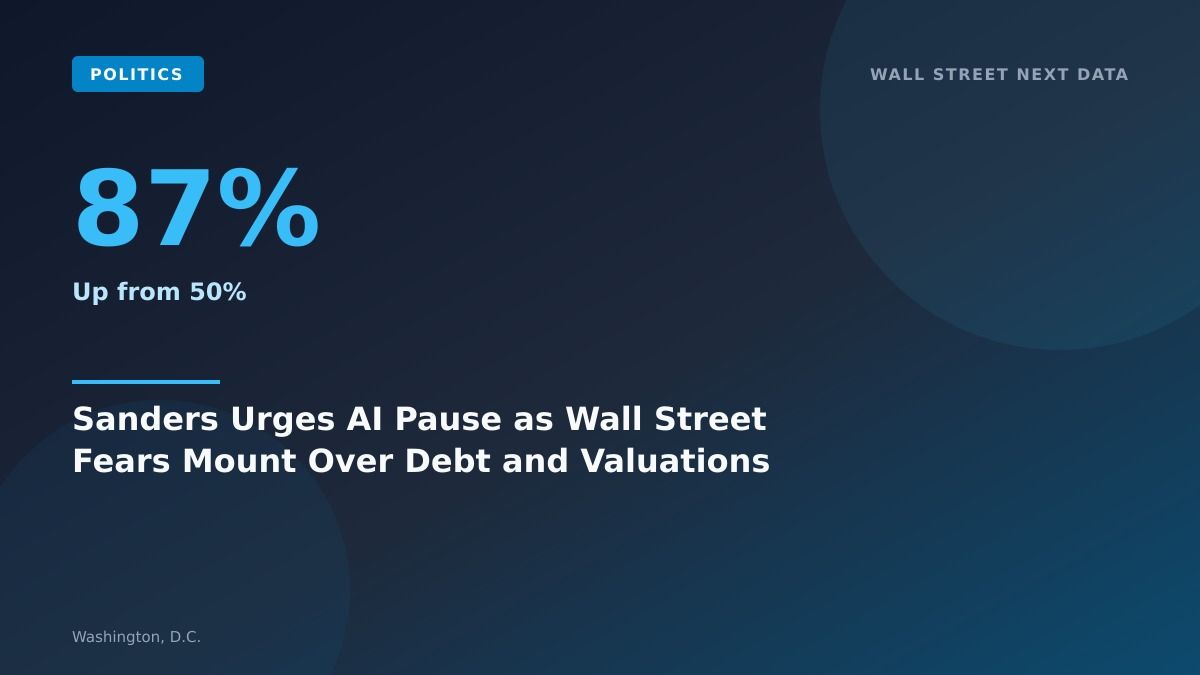
Washington, D.C., Sunday, 29 November 2026. U.S. Senator Bernie Sanders has urged policymakers to “hit the brakes” on artificial intelligence, calling the technology the “greatest threat” to the American financial system. In a weekend post on X, the Vermont independent cited the Federal Reserve’s November 2026 Financial Stability Report, which found that 87% of surveyed market participants flagged AI as a primary risk, up from 50% in the spring. Those concerns center on stretched tech stock valuations, heavy borrowing, and more than $680 billion in data center debt. Prominent investors, including Michael Burry, have also highlighted rising credit default swap spreads—a measure of debt default risk—at major tech firms like Nvidia, Meta, and Oracle. Beyond market stability, Sanders warned that AI threatens jobs, privacy, mental health, and the environment. However, some economists push back on labor fears, with Apollo Global Management’s Torsten Sløk noting zero evidence of widespread AI-driven job losses.
Fed Survey Signals Growing Alarm
The Federal Reserve’s November 2026 Financial Stability Report surveyed 23 contacts across banks, broker-dealers, investment funds, and advisory firms, finding that 87% identified AI-related risks as a primary concern [1]. That marks a 37 percentage-point jump from the spring survey’s 50% reading—a 74% increase in the share of respondents flagging the technology [1]. The report highlighted stretched valuations in tech stocks, heavy borrowing, and more than $680 billion in data center debt [1][3]. Investor Michael Burry has separately pointed to widening credit default swap spreads at Nvidia, Meta, and Oracle as evidence of rising default risk in the sector [1].
Intent Versus Enacted Policy
Sanders, an Independent who caucuses with Democrats, posted on X on November 28 urging policymakers to “hit the brakes on AI before it is too late” [1][2][3]. This remains a statement of political intent rather than enacted law. The Vermont senator previously introduced bills with Rep. Greg Casar (D-Tex.)—S.5493 and H.R.10538, unveiled September 23—to define and restrict “super intelligence” systems capable of planning the disempowerment of humanity. The Trump administration is pushing in the opposite direction, promoting “super intelligence” terminology while the White House science office owed proposed legislative language under Executive Order 14434, due Saturday.
Experts Divided on Labor and Existential Risk
Economists and researchers remain split on the immediate impact. Torsten Sløk, chief economist at Apollo Global Management, stated there is “zero evidence” of widespread AI-driven job losses [1]. Conversely, Anthropic researcher Evan Hubinger estimated the probability of AI wiping out humanity within a decade at “above 10%” [1]. An MIT professor predicted that by the end of 2027, U.S. officials would regard highly advanced AI as a greater national security threat than any foreign power, citing opposition from figures as ideologically disparate as Sanders and former Trump adviser Steve Bannon.