Iranian Rial Plunges Toward Three Million Per Dollar as Blockade Bites
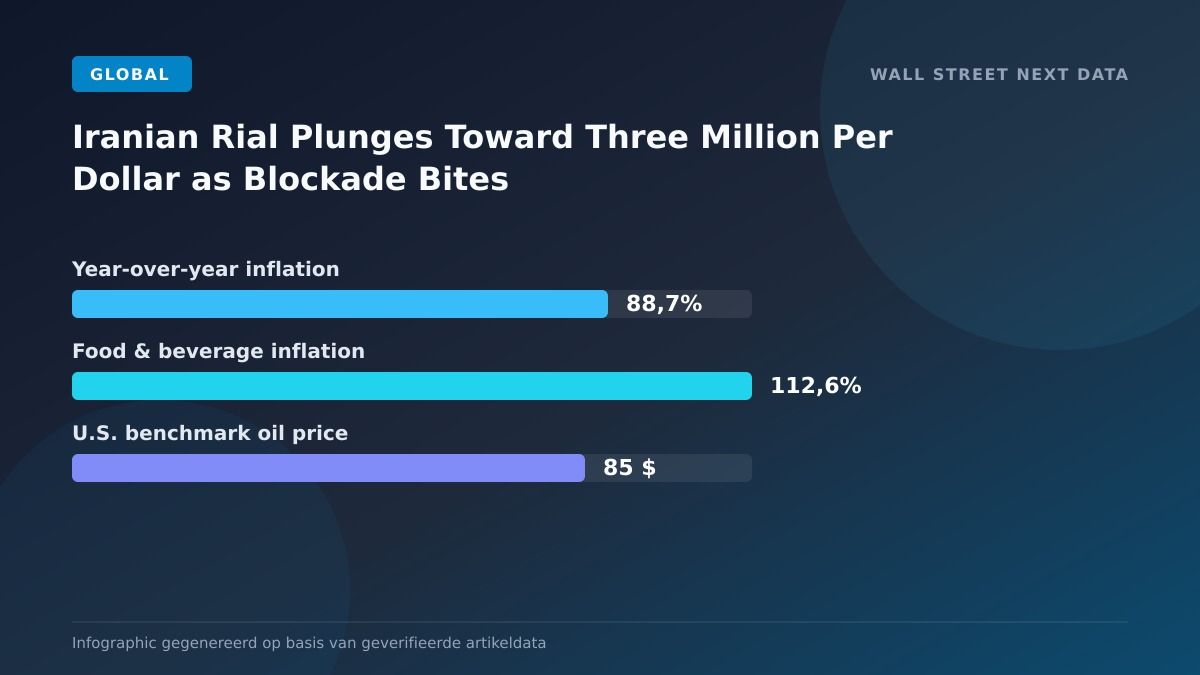
Tehran, Sunday, 29 November 2026. The Iranian rial plunged to a record low on Saturday, November 28, nearing three million per U.S. dollar on the open market. The currency traded between 2.990 million and 2.997 million rials per dollar, down sharply from 2.938 million on Friday. Runaway inflation, a nine-month-old war, and escalating U.S. pressure are driving the collapse. Consumer prices surged 88.7% year-over-year in October, with food and beverage costs jumping 112.6%. Washington has tightened its economic squeeze through a reinstated naval blockade on Iranian ports, border interdiction under Task Force Iron Gate, and new sanctions targeting unregulated shadow banking networks. U.S. Treasury Secretary Scott Bessent said the measures aim to isolate Iran from the global economy. Iranian Central Bank Governor Abdolnaser Hemmati said reserves cover basic imports for months. However, Iranians are flocking to dollars and gold as safe havens. Meanwhile, crude export disruptions have pushed U.S. benchmark oil near $85 a barrel.
A Two-Tier Currency Market
The rial’s collapse has opened a wide gap between Iran’s official and open-market rates. The central bank held the official rate near 1.96 million rials per dollar as of Thursday, while the open market traded around 2.990 million on Saturday—a premium of 52.551% [3]. The currency has lost more than 90% of its value since the U.S. exited the 2015 nuclear accord in 2018, falling from about 690,000 rials per dollar in November 2024 to Saturday’s record [3]. The dollar crossed 2 million in August and 2.85 million on November 24 [1][3].
Sanctions Squeeze Households
Washington has layered a naval blockade on Iranian ports—reimposed in July—with Task Force Iron Gate to interdict goods across land borders and the Caspian Sea [1][2][3]. On November 24, Treasury’s Operation Economic Outcast sanctioned over two dozen exchange houses and front companies [3]. The squeeze hits an economy already reeling: October consumer prices rose 88.7% year-over-year, food costs jumped 112.6% (a gap of 23.9 points), and annual inflation hit 76.8% [1][2]. Many Iranians are buying dollars and gold as safe havens [1][2], while the euro topped 3.26 million rials and the pound 3.9 million.
Retaliation and Market Fallout
Iranian officials vowed to break the blockade. Security Chief Mohsen Rezaei called it “futile,” while Foreign Ministry spokesman Esmaeil Baghaei labeled it an “unlawful use of force” under UN Charter Article 51 [3]. Treasury Secretary Scott Bessent said the sanctions aim to cut Iran off from the global economy, noting no Iranian oil tanker has loaded since August [3]. The disruptions pushed international benchmark Brent crude above $91 a barrel [3]. On Sunday, the dollar breached 3 million rials for the first time, hitting 3,003,000, as a U.S. drone struck a boat near Sirik and Tehran braced for winter power shortages.