four nations unite as fifa brings expanded 2031 women's world cup to north america and the caribbean
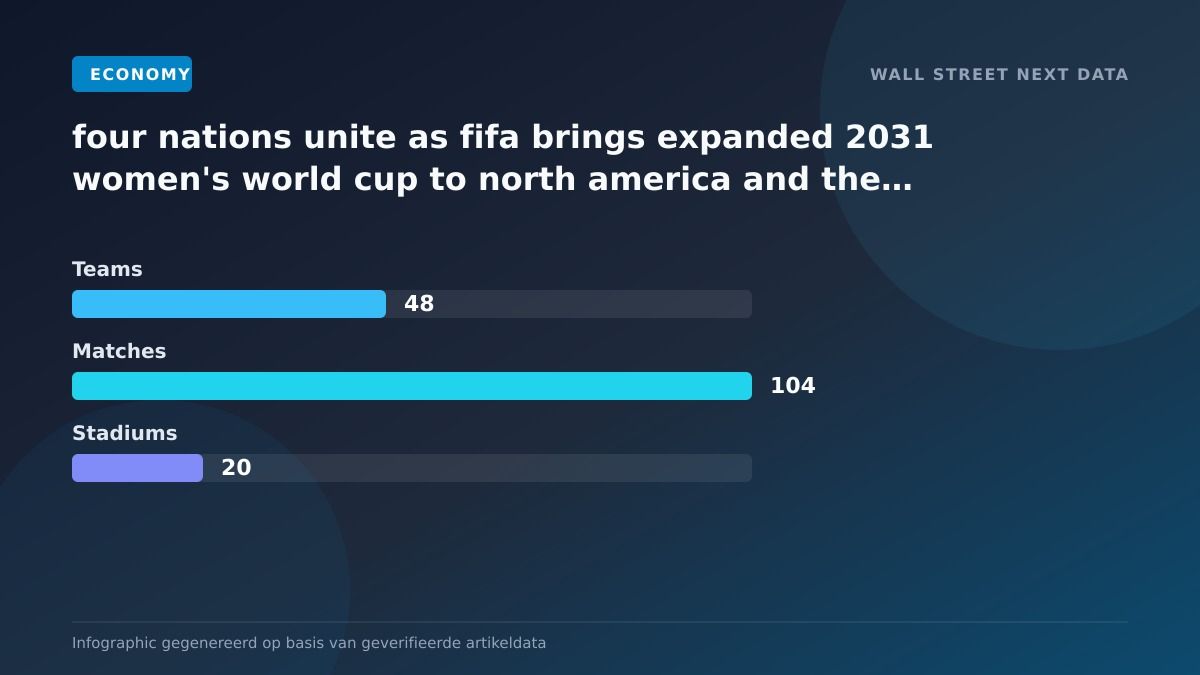
Zurich, Sunday, 29 November 2026. FIFA officially awarded the hosting rights for the 2031 Women’s World Cup to a joint four-nation bid featuring the United States, Mexico, Costa Rica, and Jamaica. The tournament will expand significantly from 32 to 48 national teams, matching the men’s format with 104 total matches across 20 host cities. The proposal includes 14 stadiums in the United States, four in Mexico, one in San José, Costa Rica, and one in Kingston, Jamaica, marking the first time the Caribbean will host matches. Organizers project 4.5 million spectators and an estimated $4 billion in revenue, driven by $1 billion in broadcasting deals and $1.4 billion in commercial partnerships. Concacaf leaders and national federations hailed the decision as a transformative catalyst for regional sports infrastructure, long-term commercial investment, and player development pathways across women’s international soccer.
hosting rights confirmed
FIFA announced on November 23 that the 2031 Women’s World Cup will be co-hosted by the United States, Mexico, Costa Rica, and Jamaica [1][2]. The decision followed a FIFA Council vote, finalizing a four-nation regional bid. The tournament expands to 48 teams and 104 matches, matching the men’s World Cup format. Organizers project 4.5 million spectators and $4 billion in revenue, including $1 billion from broadcasting and $1.4 billion from commercial partnerships [1]. The bid received a technical evaluation score of 4.4 out of 5, meeting FIFA’s minimum requirements [2].
economic impact and infrastructure
The event is expected to inject 4 billion into regional economies through ticketing, hospitality, and commercial activity. Host cities will invest in stadium upgrades and transport links, leveraging the tournament’s commercial success to attract long-term sponsors and broadcasters [1][2]. U.S. Soccer CEO JT Batson emphasized the opportunity to expand women’s soccer participation and player development pathways [1]. Revenue projections align with the 2026 men’s World Cup’s ticketing revenue of $5b, suggesting dynamic pricing may be adopted to maximize returns while balancing affordability.
broadcast and commercial expansion
Broadcasting rights are already secured in key markets, including the U.S. and Canada via Netflix and China via CCTV [2]. FIFA’s revenue model prioritizes commercial partnerships to fund infrastructure and grassroots programs. The 2023 Women’s World Cup generated $570m in revenue, so 601.754% growth is projected for 2031. Organizers aim to create a sustainable model for future tournaments, with ticketing strategies to be finalized by 2030.
regional unity and legacy
Concacaf President Victor Montagliani called the bid a historic moment for women’s football, uniting 41 member associations under a shared vision [1]. The inclusion of Jamaica marks the first Caribbean-hosted Women’s World Cup matches. U.S. Soccer President Cindy Parlow Cone highlighted the bid’s potential to inspire millions of players and accelerate global growth [1]. Infrastructure investments will target youth academies and elite pathways to ensure long-term benefits beyond 2031.