Deadly Attack on Pakistani Military Train Highlights Regional Instability
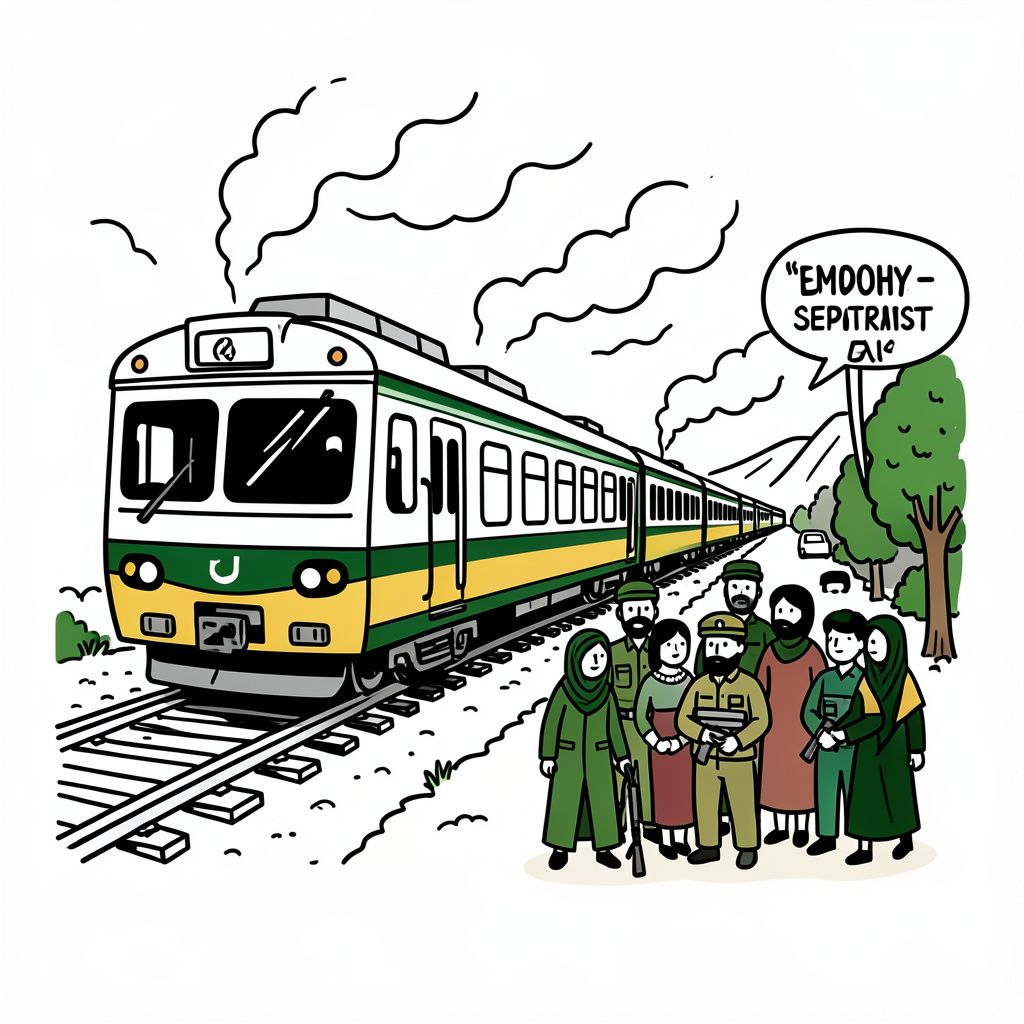
Quetta, Sunday, 24 May 2026.
A separatist suicide bombing killed 24 people on a Pakistani train carrying military families for Eid, highlighting severe security risks in the resource-rich Balochistan region.
The Anatomy of the Attack
On Sunday, May 24, 2026, a devastating explosion tore through the Jaffer Express train near the Chaman Phatak station in Quetta, Balochistan [1][2][5]. The blast, which the separatist Baloch Liberation Army (BLA) described as a suicide or “Fidayee” bombing, resulted in at least 24 fatalities and injured approximately 70 others [2][3][5]. This brings the total number of casualties from the incident to 94 individuals [2][3]. The train was serving as a shuttle to transport Pakistani security personnel and their families who were returning home for the Eid holiday [1][2][3].
A History of Escalating Tensions
The BLA, an outlawed militant organization demanding independence from Pakistan, explicitly stated that the attack targeted the military personnel on board [3][5]. This incident is rooted in long-standing geopolitical and economic grievances; the BLA frequently accuses the federal government of extracting and exploiting Balochistan’s vast mineral resources without providing equitable economic benefits to the local population [1]. Geographically and strategically, Balochistan is highly significant [GPT]. It encompasses approximately 44% of Pakistan’s total landmass, features a vital coastline along the Arabian Sea, and shares critical borders with both Iran and Afghanistan [1]. Despite its vast size and resource wealth, the province is home to only about 5% of Pakistan’s total population of over 240 million people, translating to a demographic footprint of roughly 12 million residents [1].
Economic and Geopolitical Ramifications
The economic and geopolitical ramifications of this persistent insurgency are profound [GPT]. Pakistani Prime Minister Shehbaz Sharif condemned the Sunday attack as a “heinous bomb explosion” and a “cowardly act of terrorism,” emphasizing that such violence will not weaken the nation’s resolve and expressing solidarity with the people of Balochistan [1][2][3]. Shahid Rind, a spokesperson for the Balochistan provincial government, echoed these sentiments, stating that terrorist elements “deserve no leniency” [3]. As the government attempts to secure this resource-rich region, the ongoing violence continues to pose a severe threat to both human life and the critical infrastructure necessary for Pakistan’s broader economic development [GPT]. [alert! ‘Early reports from Anadolu Agency mentioned a cargo train derailment with 27 injuries, but consensus among major outlets confirms the target was a passenger train carrying military personnel.’] [4].