Black Friday Store Visits Dip as Shoppers Spread Trips Into Saturday
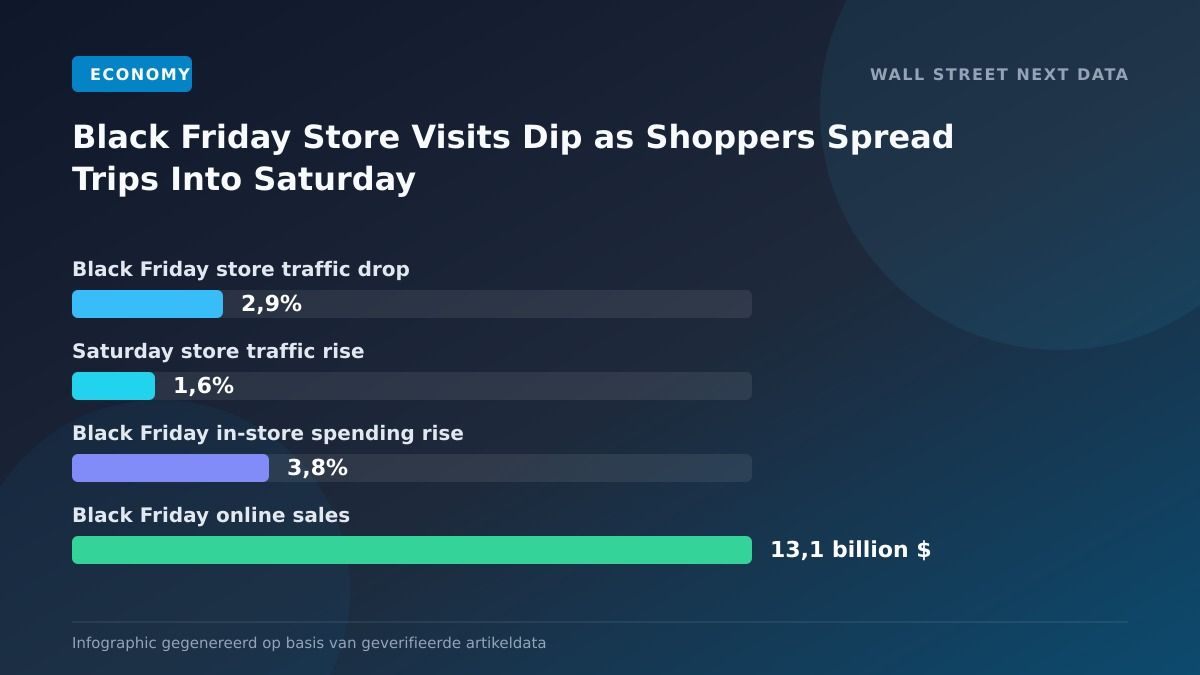
United States, Sunday, 29 November 2026. U.S. brick-and-mortar store traffic fell 2.9% year-over-year on Black Friday, according to early data from retail analytics firm RetailNext. While fewer shoppers visited physical stores on the traditional kickoff to the holiday season, the decline beat the broader November trend of a 4.0% drop. Consumers instead spread their holiday shopping across the weekend, lifting Saturday store traffic by 1.6%. Bad weather across parts of the country and tight household budgets—pressured by higher costs for gas, groceries, and rent—reshaped how and when Americans visited malls. Still, those who ventured out spent decisively. Mastercard SpendingPulse reported that in-store spending rose 3.8% on Black Friday, marking its strongest increase since 2022. Meanwhile, online sales surged 11% to a record $13.1 billion, according to Adobe Analytics, underscoring a clear shift toward deliberate, value-driven shopping. Retailers now await full weekend results, including Cyber Monday, to gauge total holiday momentum.
Traffic Trackers Split on Black Friday Decline
Sensormatic Solutions reported a 4.2% year-over-year drop in store traffic on Friday, November 27, while noting visits surged 250% compared with the previous Friday [1]. Bad weather suppressed visits, and Joe Shasteen, RetailNext’s global manager of advanced analytics, said households squeezed by petrol, groceries, and rent are changing how they plan every shopping trip [1]. The data reflects the traditional kickoff day of November 27, 2026.
Global E-Commerce Hits $82.7 Billion
Salesforce reported global online spending reached $82.7 billion on Black Friday, up 5% from last year, with U.S. sales totaling $19.1 billion [1]. The company, which analyzed data from more than 1.5 billion consumers, also found order volume rose 5% year-over-year [1]. Adobe Analytics uses a different dataset—over 1 trillion visits to U.S. retail sites—which explains discrepancies between the two estimates [1]. Electronics and software led all categories, with spending up nearly 8% from 2025 as shoppers bought gaming consoles and smartphones [1]. Excluding automobiles and gasoline, total retail sales rose 5.8%.
Inflation Weighs on Holiday Forecasts
Michelle Meyer, chief economist at the Mastercard Economics Institute, expects inflation to account for half of the forecast growth in holiday-season sales this year [1]. Higher prices linked to the Iran war’s effect on petrol and consumer goods have pressured household budgets, yet shoppers used discounts to stock up on essentials like clothing, baby products, and cleaning supplies [1]. RetailNext will release full weekend results, including Cyber Monday on Monday, November 30, on Thursday, December 3. The ten busiest days of the season typically generate 30% to 40% of all store traffic.