Cargo Hold Hazard: How a Charging Power Bank Forced a Commercial Flight Diversion
Rome, Sunday, 24 May 2026.
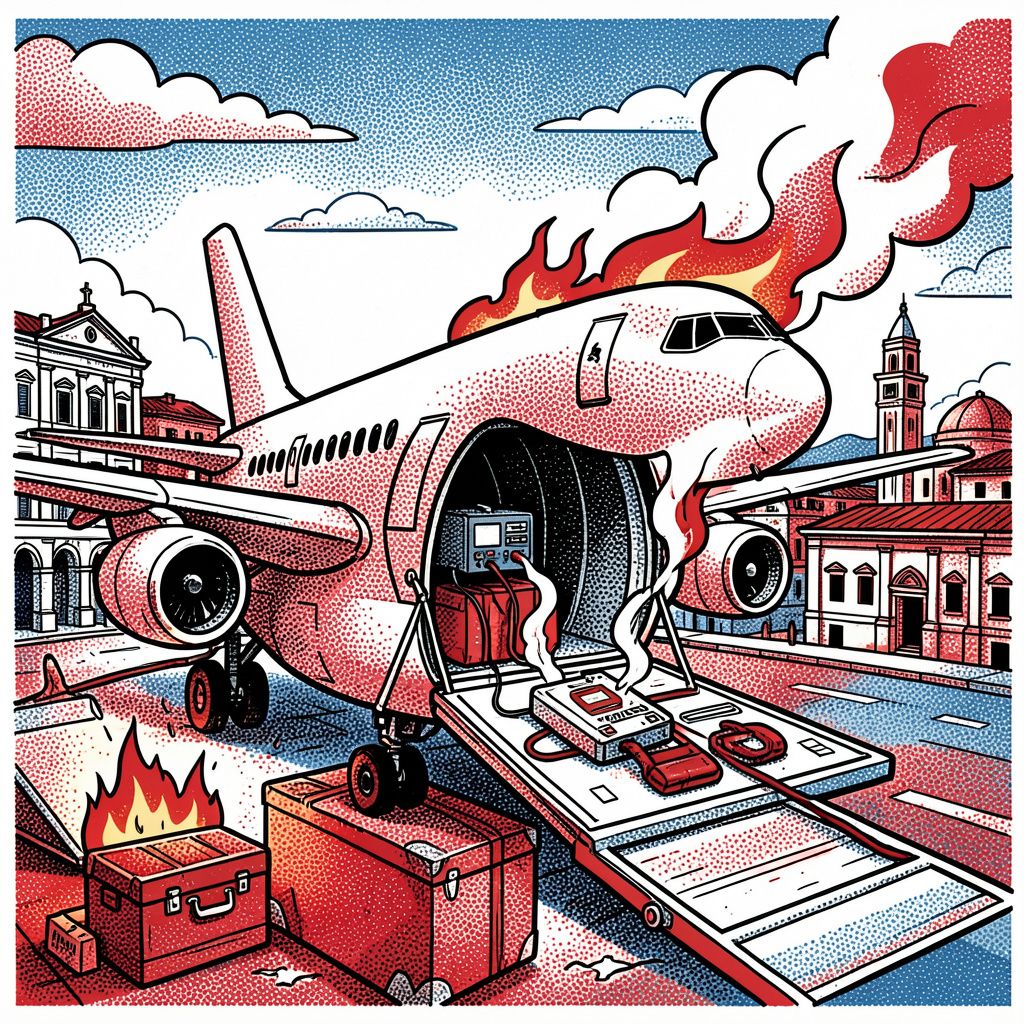
Exposing severe aviation fire risks, a London-bound flight diverted to Rome after a passenger revealed a power bank was actively charging a device inside their checked luggage.
Mid-Air Diversion and Safety Protocols
On the evening of Tuesday, May 19, 2026, EasyJet (LSE: EZJ) flight EZY2618 was en route from Hurghada, Egypt, to London’s Luton Airport when an urgent safety threat emerged from the cargo hold [1][4][GPT]. The aircraft, carrying 180 passengers, was forced to make an unscheduled diversion to Rome Fiumicino Airport, touching down at 11:30 PM local time [4]. The sudden change in trajectory was initiated after a female passenger alerted cabin crew that she had left a mobile phone actively charging via a power bank inside her checked baggage [4]. Prior to the descent, the flight’s captain announced to the cabin, “There’s something we shouldn’t have in the hold,” leaving passengers initially unaware of the exact nature of the emergency [4]. [alert! ‘Sky News reports the diversion date as May 21, 2026, but multiple other sources confirm the incident occurred on Tuesday, May 19, 2026’]
The Hidden Dangers of Lithium-Ion Batteries
The decision to divert the aircraft highlights the rigorous safety parameters governing commercial aviation [GPT]. Portable chargers and lithium-ion batteries are strictly prohibited from being transported in checked luggage on U.S. and international flights due to their inherent fire risks [1]. When these devices are connected and actively charging, the risk of thermal runaway—a chain reaction leading to intense fires—increases significantly [GPT]. If a battery fire ignites within the passenger cabin, flight crews are trained to quickly identify the smoke and extinguish the flames [3]. Conversely, a similar blaze occurring below deck in the cargo hold poses a far greater threat, as it can spread undetected and is significantly more difficult to suppress [3]. An EasyJet spokesperson confirmed that the captain’s decision to divert the flight was a precautionary measure executed in strict compliance with safety regulations [1][2][3].
Passenger Experience and Logistical Fallout
The sudden diversion caused significant distress among those on board, with many travelers fearing a serious mechanical failure or a bomb threat before the true cause was revealed [3][4]. Paul Casterton, a 57-year-old passenger traveling with his partner, described the descent as stressful, noting that “it was hard not to fear the worst” until the situation was clarified [1][4]. Following the safe landing in Rome, passengers disembarked and EasyJet provided hotel accommodations, meals, and refreshments for the stranded travelers [1][2][3]. However, the logistical disruption was substantial; the next available EasyJet service to Luton was not scheduled until 2:00 PM the following Wednesday [4]. This delay prompted some passengers to incur additional out-of-pocket expenses, with Casterton spending £350 to secure an alternative flight on Wizzair to meet pressing commitments [4].
Economic Context Amid Operational Disruptions
While the immediate costs of the diversion—ranging from fuel and landing fees to passenger accommodations—impact EasyJet’s operational budget, the airline is simultaneously navigating broader economic headwinds [GPT]. Earlier in May 2026, EasyJet’s Chief Executive, Kenton Jarvis, reassured customers that the airline was not experiencing fuel supply disruptions and promised not to impose fuel surcharges on existing bookings [2]. Despite this operational stability, the carrier has faced softening demand; bookings for the summer 2026 season have trended lower compared to the previous year, driven by geopolitical uncertainties stemming from the conflict involving the US, Israel, and Iran [2]. For the six-month period ending in September 2026, EasyJet reported selling 58% of its available capacity, a decrease of 2 percentage points from the previous year’s 60%, representing a relative drop of -3.333% in advance bookings [2]. The airline maintains that the safety of its passengers and crew remains its highest priority, adhering strictly to manufacturer guidelines despite the challenging macroeconomic environment [1][3].