Anthropic Reclaims $83 IPO Price Ahead of Key Index Inclusions
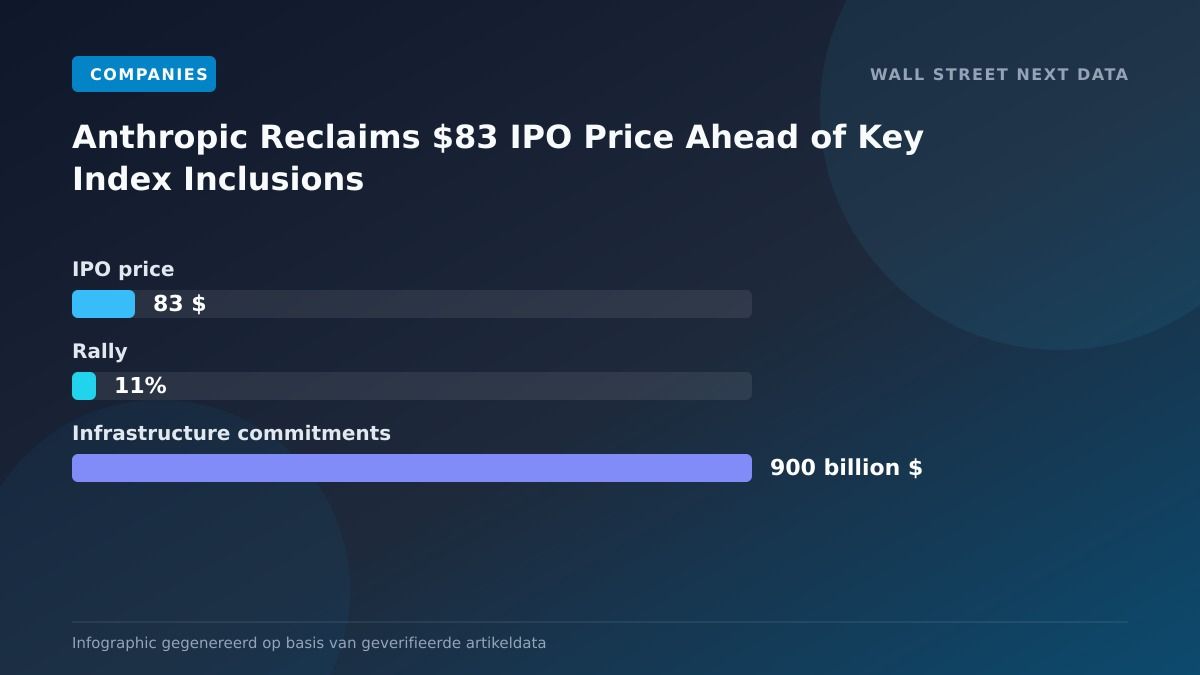
San Francisco, Sunday, 29 November 2026. Anthropic (NASDAQ: ANT) has climbed back above its $83 initial public offering (IPO) price, closing at $91.88 on Friday. The nearly 11% rally marks the artificial intelligence firm’s highest close since its November 19 debut, ending a two-day slump below its offering price. Shares had opened at $111.50 on debut day before sliding 14.8% below their first close. The rebound arrives at a pivotal moment for institutional investors. Anthropic is preparing for upcoming additions to the MSCI, Russell, and Nasdaq-100 indices, which typically drive fresh demand from passive funds that track those benchmarks. At the same time, the company approaches its first post-IPO lockup expiration step—a milestone that lifts restrictions on when insiders and early investors can sell shares, testing market liquidity. Despite the recovery, volatility remains high as investors weigh rapid enterprise adoption against roughly $900 billion in multi-year infrastructure commitments and steep valuation multiples.
Rebound Above IPO Price
After closing below its $83 offering price earlier in the week, Anthropic (NASDAQ: ANT) finished Friday at $91.88, up nearly 11% and marking its highest close since the November 19 debut. The rebound ended a two-day slide that followed a 14.8% drop from the first-day close of $97.17, briefly erasing the IPO premium as the stock approaches additions to the MSCI, Russell, and Nasdaq-100 indices, which typically trigger buying from passive funds.
Employee Wealth: Counting the Millionaires
New disclosures explain why employee millionaire estimates diverge. One count finds roughly 5,100 of 5,300 employees held equity above $1 million at the $83 IPO price; another tallies 2,800 current and former workers with vested pretax equity of at least $1 million [1]. The prospectus separates 1,774,342,693 outstanding options at a $2.91 weighted-average exercise price from 1,026,660,010 restricted stock units (RSUs) with unsatisfied vesting conditions [1]. Employees held $119 billion in option gains as of September 30, including roughly $73 billion in immediately exercisable vested options [1]. “A headline equity value answers one question; vesting and sale eligibility answer another,” the report notes [1].
Lock-up Expiration Tests Liquidity
Those gains convert to cash only as lock-up restrictions lift. Up to 10% of aggregate lock-up securities held by specified non-founder groups became eligible for transfer starting on the first trading day, while general restrictions last up to 180 days—and up to 365 days for co-founders and holders owning more than 0.5% of fully diluted shares [1]. With seven co-founders already selling nearly $2 billion in personal shares during the IPO, the staged expiration will test liquidity as insiders access their stakes. The timing coincides with upcoming index additions, though volatility persists against roughly $900 billion in multi-year infrastructure commitments.