Supreme Court Overturns President Trump’s Global Tariffs in Landmark Ruling
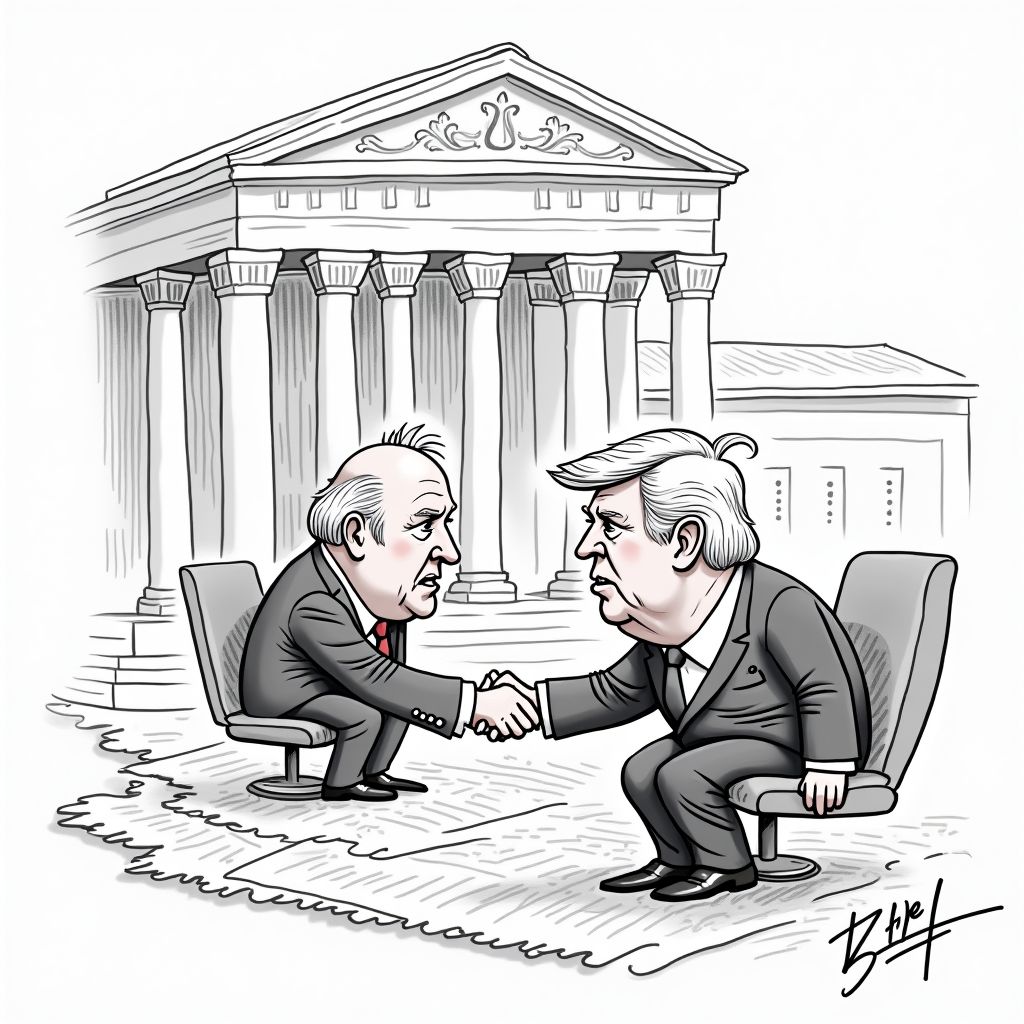
Washington D.C., Friday, 20 February 2026.
This 6-3 decision limits executive power and invalidates “Liberation Day” duties, leaving the administration potentially liable to refund over $175 billion previously collected from American importers.
A Constitutional Check on Executive Authority
In a decisive move on Friday, February 20, 2026, the Supreme Court ruled 6-3 that President Donald Trump violated federal law by unilaterally imposing sweeping global tariffs [1][5]. Writing for the majority, Chief Justice John Roberts joined the court’s three liberal justices—Sonia Sotomayor, Elena Kagan, and Ketanji Brown Jackson—along with conservative Justices Amy Coney Barrett and Neil Gorsuch to strike down the administration’s use of the International Emergency Economic Powers Act (IEEPA) [1][3]. The court rejected the executive branch’s broad interpretation of the 1977 statute, with Chief Justice Roberts noting that the President cannot assert “extraordinary power to unilaterally impose tariffs of unlimited amount, duration, and scope” without clear congressional authorization [1][2]. This ruling specifically targets the “Liberation Day” tariffs and duties levied on imports from major partners like China, Mexico, and Canada, which the administration had justified by declaring national emergencies regarding fentanyl trafficking and trade deficits in early 2025 [1][3].
The Multi-Billion Dollar Economic Shock
The financial implications of this ruling are immediate and staggering. Economists at the Penn-Wharton Budget Model estimated on Friday that the administration has collected over $175 billion in tariffs under the IEEPA authority that may now need to be refunded [5][7]. This creates a massive liability for the Treasury, as the government has been collecting approximately $500 million daily under these specific duties [7]. Despite the potential administrative chaos, Wall Street reacted positively to the prospect of reduced trade barriers; the S&P 500 rose 0.45% and the Nasdaq climbed 0.42% following the announcement [3]. The decision theoretically slashes the typical tariff rate, which had settled around 15% following the implementation of the measures last year [3].
Impact on American Households
While the administration argued that these levies were vital negotiating tools [4], the economic burden has fallen heavily on domestic consumers. A Federal Reserve Bank of New York paper released earlier this month indicated that U.S. firms and consumers bore roughly 90% of the economic cost of the 2025 tariffs [6]. The financial strain on families has been escalating; the Tax Foundation found that these tariffs cost the average U.S. household $1,000 in 2025, with projections suggesting this figure would rise to $1,300 in 2026 [6]. This represents a projected year-over-year cost increase of 30%. With the Supreme Court striking down the IEEPA-based duties, the Yale Budget Lab estimates that this household burden could fall by approximately half for the remainder of the year [6].
The Refund Quagmire
The legal victory for business groups and the twelve states that challenged the tariffs leaves open the complex question of repayment [5]. The Supreme Court did not specify a mechanism for returning the billions already collected, a situation Justice Brett Kavanaugh, dissenting alongside Justices Samuel Alito and Clarence Thomas, warned is likely to become a “mess” [1]. While U.S. Treasury Secretary Scott Bessent stated in January that the Treasury could cover tariff refunds, asserting the department is planning for cash balances of $900 billion by the end of June, the administrative process remains unclear [7]. Furthermore, the ruling does not invalidate all trade barriers; tariffs imposed under Section 232, which target specific industries like steel and aluminum, remain unaffected [4]. President Trump, speaking from Georgia just prior to the ruling, remained defiant, stating, “We’ll figure something out,” while analysts suggest the White House may attempt to pivot to other statutes to recreate the struck-down levies [3][6].
Sources
- www.cnn.com
- www.nytimes.com
- www.bbc.com
- globalnews.ca
- www.reuters.com
- www.cnbc.com
- www.bnnbloomberg.ca