San Francisco Flight Halt Exposes the Severe Impact of New Landing Restrictions
San Francisco, Monday, 8 June 2026.
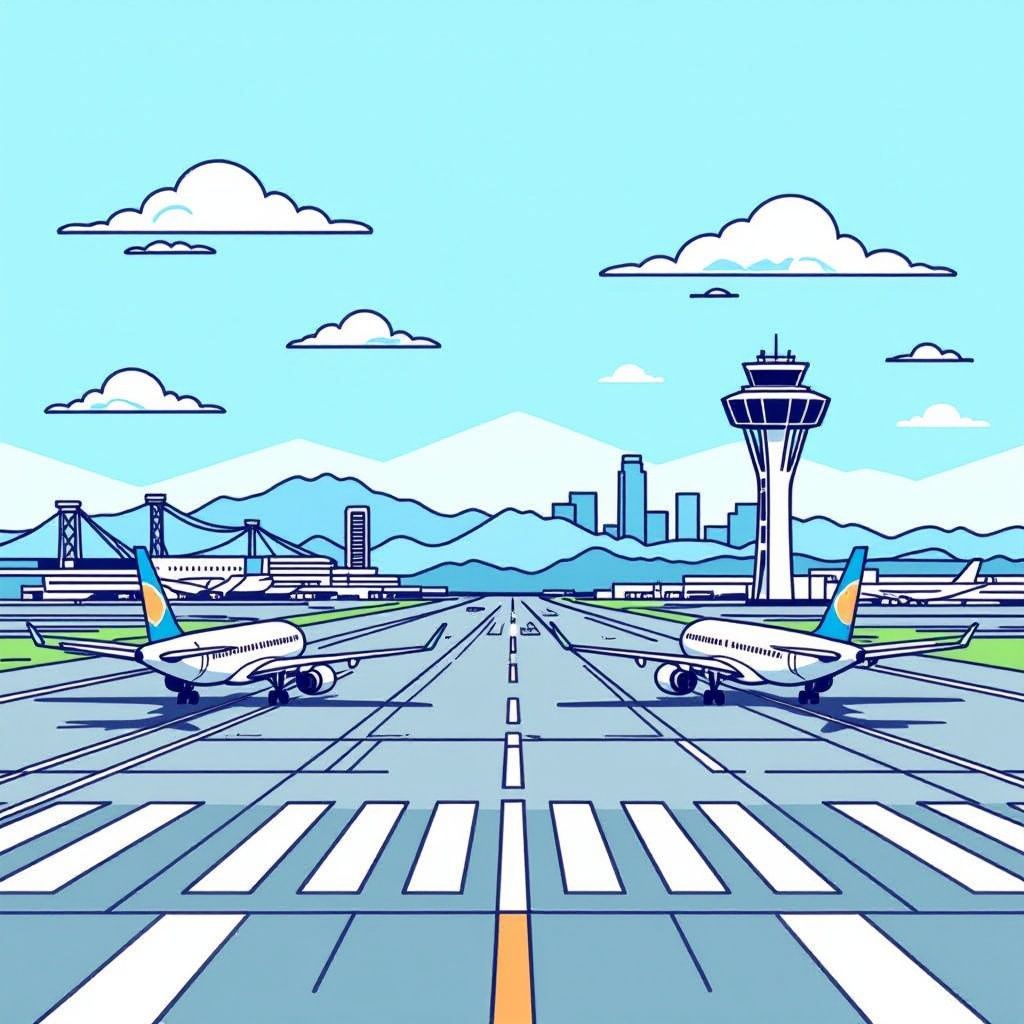
A brief weather-related ground stop at San Francisco International exacerbated severe delays driven by a permanent FAA ban on parallel landings for runways only 228.6 meters apart.
A Temporary Pause Highlights a Permanent Problem
Late on Sunday, June 7, 2026, the U.S. Federal Aviation Administration (FAA) initiated a ground stop for flights destined for San Francisco International Airport (SFO) originating from specific Western U.S. air traffic control centers [1][2]. While the official pause was brief—lasting from 9:53 p.m. until it was lifted slightly before its scheduled 11:15 p.m. PDT conclusion—the disruption rippled rapidly through the schedules of major carriers [1][2]. The halt delayed over 450 flights, severely impacting operations for several airlines [2]. Southwest Airlines saw 50 of its flights delayed, representing 83 percent of its SFO volume, while Delta Air Lines experienced delays on 43 flights, or 46 percent of its operations at the hub [2].
Beyond the Weather: A Structural Bottleneck
The underlying friction at SFO stems from a convergence of necessary infrastructure upgrades and stringent new safety mandates. On March 30, 2026, the airport commenced a six-month repaving project on Runway 1, effectively taking its north-south runways out of commission [2][3]. Compounding this construction is a permanent FAA safety directive issued on March 31, 2026, which banned the airport’s longstanding practice of side-by-side approaches on parallel Runways 28L and 28R [2]. These parallel runways are situated a mere 228.6 meters—or 750 feet—apart, falling drastically short of the FAA’s standard separation requirement of 1,310.6 meters [2][3].
Calculating the Cost to Airline Operations
The shift away from parallel landings has drastically reduced the volume of aircraft SFO can handle per hour. Reports on the exact capacity reduction vary [alert! ‘Sources provide conflicting baseline and reduced capacity figures’]. Data indicates the new staggered approach mandate halves the airport’s fair-weather arrival capacity from 60 to 30 flights per hour, translating to a -50 percent decrease [2]. Alternative FAA figures suggest a reduction from 54 to 36 arrivals per hour, a -33.333 percent drop, with the repaving project accounting for nine of those 18 lost hourly slots [3]. Regardless of the exact metric, the contraction in capacity has forced airlines to rethink their West Coast strategies.
Navigating the New Normal in Air Travel
While the Runway 1 repaving project is slated for completion on October 2, 2026, providing some eventual relief, the ban on parallel landings is permanent [2]. This means that even after the construction equipment is cleared, SFO will operate under a permanently reduced capacity ceiling [2]. For the broader aviation market, SFO serves as a compelling case study of how localized infrastructure limitations and modernized safety protocols can permanently alter the economics of a major transit hub [GPT]. Airlines operating out of San Francisco will need to transition from viewing these delays as temporary weather-related anomalies to managing them as the new baseline reality of West Coast aviation [GPT].